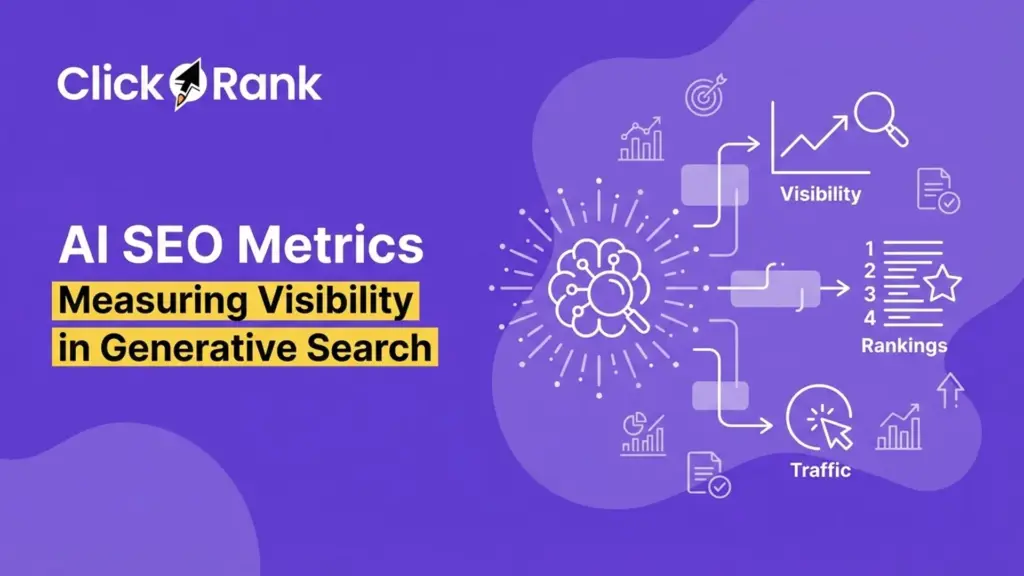
AI Search Performance Tracking is the process of measuring how visible your brand is inside AI-generated answers, not just in search engine rankings. Traditional SEO shows you rankings and clicks. AI search shows summaries, citations, and recommendations often without a visible ranking.
This matters because tools like ChatGPT, Google AI Overviews, and Perplexity are changing how people discover brands. Users now get answers directly from AI. If your brand is not cited, mentioned, or recommended, you are invisible even if you rank #1 in Google.
In this guide, you will learn how AI Search Performance Tracking works, what metrics matter, and how to measure AI-driven visibility correctly.
What Is AI Search Performance Tracking?
AI Search Performance Tracking is the process of measuring how visible your brand appears inside AI-generated answers across platforms like ChatGPT, Google AI Overviews, and Perplexity. Instead of tracking blue-link rankings, it tracks citations, mentions, summaries, and AI-driven traffic.
This matters because AI systems generate answers directly, often without showing ranked lists. Users may see a summary where your brand is referenced but never click your website. Traditional SEO dashboards will miss this visibility. That is why AI Search Performance Tracking is becoming a core part of modern measurement frameworks, alongside classic SEO tracking.
If you want to stay competitive in AI-driven discovery, you must measure where and how your content influences AI answers.
How does AI search differ from traditional search tracking?
AI search differs because it generates answers instead of ranking pages in order. Traditional search tracking measures positions, impressions, and clicks. AI search tracking measures citations, entity mentions, and answer inclusion.
In traditional SEO, you can clearly see if you rank #1 or #5. In AI systems, there may be no visible ranking at all. The model selects multiple sources and blends them into one response. Your content may shape the answer without being clearly labeled.
For AI Search Performance Tracking, this means shifting from keyword rank monitoring to prompt monitoring. Instead of asking, “What is my ranking?” you ask, “Is my brand included in AI-generated responses?” That change is critical for accurate visibility measurement.
What counts as “performance” in AI-generated search results?
Performance in AI-generated results means being cited, mentioned, summarized, or recommended inside AI answers. It is not limited to clicks. Visibility inside the answer itself is now a performance signal.
Strong AI Search Performance Tracking focuses on:
- Citation frequency
- Brand mention rate
- Share of voice within AI answers
- AI-driven referral traffic
- Sentiment of brand references
For example, if AI tools consistently recommend your brand when users ask for “best SEO tools,” that is measurable performance even if users do not immediately click.
Performance now includes influence. If your content shapes the AI response, you are visible. If it does not, you are invisible even with high rankings.
Why rankings alone no longer measure visibility?
Rankings alone no longer measure visibility because AI search removes the traditional list format. Users may get a full answer without ever seeing ranked results.
In AI-driven environments, your brand can rank #1 organically but still be excluded from AI summaries. That means zero visibility in AI-generated discovery. On the other hand, a site ranking #5 might be heavily cited by AI systems.
AI Search Performance Tracking solves this gap by measuring presence inside answers, not just position on a results page. Visibility now means inclusion in AI outputs.
If you rely only on keyword rankings, you will underestimate your true exposure or worse, miss declining AI visibility entirely.
Why Traditional SEO Metrics Fail in AI Search
Traditional SEO metrics fail in AI search because AI platforms generate answers instead of showing ranked web pages. Metrics like position, CTR, and impressions were built for blue-link search results, not for AI summaries.
In AI-driven environments, users often get complete answers without clicking anything. That means rankings may exist in the background, but they are not visible to users. As a result, classic dashboards can show stable rankings while real AI visibility drops.
AI Search Performance Tracking fixes this gap by measuring citations, mentions, and answer inclusion instead of just keyword positions. If you continue using only traditional SEO metrics, you risk making decisions based on incomplete data.
Why don’t AI answers have rankings?
AI answers do not have rankings because large language models generate blended responses from multiple sources. They do not display a visible list of results in order.
Traditional search engines rank pages using algorithms that assign positions. AI systems, however, synthesize information from different pages and combine them into one structured answer. There is no clear #1, #2, or #3 position in the output.
For AI Search Performance Tracking, this means you cannot rely on rank tracking tools alone. Instead, you must track how often your brand is included, cited, or referenced in AI responses. Visibility now means participation in the generated answer, not position on a list.
How do zero-click results distort performance data?
Zero-click results distort performance data because users get answers without visiting websites. AI summaries often provide full explanations directly inside the interface.
When this happens, impressions may increase but clicks may drop. Traditional SEO dashboards might interpret this as declining performance, even if your content is being used inside AI responses.
AI Search Performance Tracking helps you understand this shift. Instead of focusing only on clicks, you track citation frequency and brand visibility inside AI outputs. If your brand appears in answers but traffic decreases slightly, that may still indicate strong AI presence.
Zero-click environments require new metrics. Otherwise, you risk misreading performance trends.
Are impressions and clicks still reliable indicators?
Impressions and clicks are still useful, but they are no longer complete indicators of visibility. They show user interaction with traditional search results, not influence inside AI-generated answers.
In AI search environments, users may never see a standard results page. That means impressions may not fully reflect exposure. Click data may also shrink because AI answers reduce the need to visit websites.
AI Search Performance Tracking expands measurement beyond clicks. It includes citation rate, share of voice in AI responses, and brand mention analysis. These signals give a clearer view of how visible you are in AI discovery.
Relying only on impressions and clicks creates blind spots in AI-driven search ecosystems.
What visibility signals are lost in AI summaries?
AI summaries hide several traditional visibility signals, including ranking position, snippet optimization impact, and SERP feature ownership. Users no longer see the competitive layout clearly.
When AI generates a summary, it compresses information into one answer. This removes visible ranking competition and makes it harder to identify who influenced the response. Without AI Search Performance Tracking, you cannot see whether your brand contributed to the summary.
Lost signals include:
- Exact ranking positions
- SERP feature ownership (like featured snippets)
- Competitive click comparison
To compensate, businesses must track AI citations and entity mentions. These are the new visibility indicators in AI-driven search.
How AI Search Engines Generate and Rank Answers
AI search engines generate answers by retrieving relevant content and then synthesizing it into a structured response using large language models (LLMs). They do not rank pages in a simple top-10 order. Instead, they combine retrieval systems, entity recognition, and trust signals to decide which sources shape the final answer.
This matters for AI Search Performance Tracking because visibility depends on inclusion in generated answers, not just ranking in a list. If your content is trusted, well-structured, and entity-rich, it has a higher chance of being cited or summarized.
Understanding how answers are built helps you optimize for AI inclusion. When you know how selection works, you can improve your authority, entity coverage, and citation potential.
How do LLMs select sources for answers?
LLMs select sources by retrieving content that is contextually relevant, authoritative, and aligned with the user’s query intent. They use retrieval systems to pull documents, then evaluate which information best answers the prompt.
The selection process focuses on:
- Topical relevance
- Semantic similarity
- Entity alignment
- Authority indicators
Unlike traditional ranking systems, LLMs do not simply choose the #1 result. They may combine insights from multiple sources. That means your content does not need to rank first to influence the answer.
For AI Search Performance Tracking, this shifts the focus from rank position to answer inclusion. Monitoring citation frequency across different prompts becomes more important than tracking a single keyword ranking.
What role do entities and knowledge graphs play?
Entities and knowledge graphs help AI systems understand relationships between brands, topics, and concepts. They provide structured context that improves source selection accuracy.
When your brand is strongly connected to relevant entities such as tools, services, or industry terms AI systems recognize your topical authority more clearly. Knowledge graphs store structured data about organizations, products, and relationships.
For AI Search Performance Tracking, entity optimization increases citation probability. If your content clearly defines who you are, what you offer, and how you relate to key topics, AI systems can confidently include you in answers.
Clear entity signals reduce ambiguity and improve retrieval. Without them, your content may be overlooked even if it ranks well in traditional search.
How do authority and trust signals influence AI citations?
Authority and trust signals strongly influence AI citations because AI systems prioritize reliable and credible sources. Content from trusted domains is more likely to shape generated responses.
Key authority signals include:
- High-quality backlinks
- Brand mentions across the web
- Consistent topical coverage
- Expert-driven content
AI models are trained on patterns of credibility. If your brand frequently appears in authoritative contexts, it increases the likelihood of being cited.
For AI Search Performance Tracking, this means measuring authority beyond rankings. Citation rate often correlates with domain trust and brand reputation. If you want consistent AI visibility, building authority is just as important as optimizing content.
Do backlinks still matter in AI search?
Backlinks still matter in AI search because they remain a strong authority signal. Even though AI systems generate answers differently, trust and credibility signals still influence retrieval.
High-quality backlinks indicate that your content is referenced and valued by other websites. This strengthens your perceived authority in both traditional search and AI systems.
However, backlinks alone are not enough. AI Search Performance Tracking shows that entity clarity, brand mentions, and structured data also impact citation likelihood.
In short, backlinks still support visibility, but they now work alongside entity optimization and brand authority. The strongest AI visibility comes from combining all three.
Core AI Search Performance Metrics You Must Track
Core AI Search Performance Tracking metrics include citation rate, share of voice, brand mentions, sentiment, and AI referral traffic. These metrics replace traditional ranking-focused KPIs in AI-driven environments.
If you want to measure real visibility inside AI answers, you must track influence, not just clicks. AI search platforms generate summaries and recommendations. Your brand may appear in answers even when traffic does not increase immediately.
That is why AI Search Performance Tracking focuses on presence inside responses. These metrics help you understand whether AI systems recognize your authority and include your content. Without tracking them, you may think performance is stable while your AI visibility is shrinking.
Let’s break down the most important metrics you should monitor.
What is AI citation rate and why does it matter?
AI citation rate is the percentage of monitored prompts where your brand or content is cited inside AI-generated answers. It shows how often AI systems use your content as a source.
This metric matters because citations signal trust and authority. If AI platforms frequently reference your brand, it means your content is influencing answers. A low citation rate means your competitors are shaping AI responses instead.
To calculate citation rate:
- Select a list of high-value prompts.
- Track how often your domain appears.
- Divide total citations by total prompts tested.
AI Search Performance Tracking uses citation rate as a core visibility KPI. It directly reflects influence inside AI systems.
How do you measure share of voice in AI answers?
Share of voice in AI answers measures how often your brand appears compared to competitors across a set of prompts. It shows your relative visibility inside AI-generated responses.
To measure it:
- Identify key prompt clusters.
- Track all brand mentions in responses.
- Calculate your percentage of total mentions.
For example, if your brand appears in 30 out of 100 total brand mentions across prompts, your AI share of voice is 30%.
AI Search Performance Tracking relies on this metric to compare competitive presence. Even if traffic stays steady, a declining share of voice may signal that competitors are gaining influence inside AI answers.
What are AI brand mentions and sentiment signals?
AI brand mentions refer to any instance where your brand is named in AI-generated answers, whether cited directly or referenced in recommendations. Sentiment signals describe whether those mentions are positive, neutral, or negative.
These signals matter because AI systems often summarize opinions. If your brand is mentioned positively in comparisons or recommendations, it strengthens authority. Negative framing can damage perception.
AI Search Performance Tracking includes monitoring:
- Frequency of brand mentions
- Context of mention
- Sentiment tone
For example, being listed as “a reliable option” carries more weight than being mentioned without context. Tracking both volume and tone helps you understand brand positioning in AI-driven search.
How can AI referral traffic be identified and measured?
AI referral traffic can be identified by analyzing traffic sources, user behavior patterns, and referral parameters that indicate AI platforms. While not always perfectly labeled, patterns can reveal AI-driven visits.
To measure AI referral traffic:
- Review referral source data in analytics.
- Monitor spikes after high AI citation frequency.
- Analyze behavior signals such as longer session time from informational prompts.
AI Search Performance Tracking connects citation data with traffic trends. If citation rate increases and referral sessions rise shortly after, there is likely AI influence.
Because AI traffic is still evolving, combining multiple signals gives the most accurate measurement.
What tools can detect AI-generated referral traffic?
Analytics platforms like Google Analytics 4, server log analyzers, and AI visibility monitoring tools can help detect AI-generated referral traffic. Some AI platforms pass referral strings, while others may appear as direct or organic visits.
Advanced monitoring tools can track prompt-based citations and compare them with traffic spikes. These platforms help connect AI inclusion with actual sessions.
For deeper insight, combining analytics with structured citation tracking provides stronger evidence of AI-driven visits. Relying on a single signal may not give accurate results, so layered tracking is recommended for reliable AI Search Performance Tracking.
How do you separate AI traffic from organic search?
Separating AI traffic from organic search requires analyzing referral sources, user paths, and behavioral signals. AI-driven sessions often show different entry patterns compared to traditional search visits.
Start by segmenting traffic by source and medium. Look for referral domains linked to AI platforms. Next, compare engagement metrics. AI users may spend more time on specific pages aligned with informational prompts.
Server logs can also reveal crawler and referral patterns tied to AI systems. Combining referral analysis, session behavior, and citation monitoring creates a clearer separation.
AI Search Performance Tracking works best when traffic segmentation is paired with citation data. This reduces guesswork and improves measurement accuracy.
A New Framework for AI Search Visibility Measurement
A new AI Search Performance Tracking framework is built on four core pillars: Citations, Mentions, Authority, and Traffic. These pillars measure how visible and influential your brand is inside AI-generated answers.
Traditional SEO frameworks focus on rankings and clicks. AI-driven search requires a broader system. You must track whether AI systems cite your content, mention your brand, trust your authority, and drive measurable traffic.
This framework connects visibility to real business impact. It moves beyond simple keyword positions and focuses on influence inside AI responses. If your brand is strong across all four pillars, you are not just present you are shaping AI-driven discovery.
What are the four pillars of AI visibility?
The four pillars of AI visibility are Citations, Mentions, Authority, and Traffic. Together, they define complete AI Search Performance Tracking.
Citations measure how often AI platforms reference your website as a source.
Mentions track how frequently your brand name appears in AI answers.
Authority evaluates trust signals like backlinks, expertise, and topical depth.
Traffic measures actual visits influenced by AI-generated responses.
For example, a brand may have high mentions but low citations. That signals awareness but weak source trust. A strong AI visibility strategy balances all four pillars.
Tracking only one pillar gives partial insight. Measuring all four provides a full AI visibility profile.
How do these pillars map to the customer journey?
These pillars align directly with the customer journey from awareness to conversion. Citations and mentions usually drive early-stage discovery. Authority supports consideration. Traffic connects to action and conversion.
At the awareness stage, AI answers introduce brands through mentions and citations. During consideration, authority signals such as expert positioning and trusted recommendations influence decision-making. Finally, traffic reflects user action after exposure.
AI Search Performance Tracking connects each pillar to funnel stages. If citations are high but traffic is low, your call-to-action may need improvement. If mentions are strong but authority is weak, credibility signals may need strengthening.
Mapping these pillars to the journey ensures AI visibility translates into measurable business outcomes.
What benchmarks define strong AI visibility?
Strong AI visibility is defined by consistent citations across priority prompts, competitive share of voice above 25%, positive brand sentiment, and measurable AI-driven traffic growth.
While exact benchmarks vary by industry, common indicators include:
- Citation presence in at least 30% of monitored prompts
- Growing share of voice compared to competitors
- Majority positive sentiment in AI mentions
- Correlation between citation growth and referral traffic
AI Search Performance Tracking should focus on trends, not one-time wins. Consistent inclusion across multiple prompts signals real authority.
If your brand is regularly cited, positively mentioned, and generating referral visits, your AI visibility is strong and sustainable.
How Do AI Results Vary by Location, Language, and Device?
AI results vary significantly by location, language, and device because AI systems adapt answers based on regional context, user signals, and content availability. AI Search Performance Tracking must account for these variations to measure true visibility.
A brand may appear in AI answers in one country but not in another. Language differences also affect which sources are selected. Even device type can influence formatting and answer depth.
If you only test AI visibility from one region or language, your data will be incomplete. Accurate AI Search Performance Tracking requires multi-region and multi-language monitoring to understand real global exposure.
Do AI answers change by country or region?
Yes, AI answers change by country or region because AI systems prioritize locally relevant sources and region-specific authority signals. Location impacts which websites are trusted and cited.
For example, a UK-based SEO agency may be cited for prompts in the UK but replaced by US-based competitors for the same query in the United States. AI systems consider regional authority, language nuances, and local popularity.
AI Search Performance Tracking should include geo-based prompt testing. Businesses operating internationally must monitor citation rate and share of voice per country.
If your brand disappears in certain regions, it may indicate weak local authority or missing localized content.
How does language influence AI source selection?
Language directly influences AI source selection because AI systems prioritize content that matches the user’s query language and cultural context. Translation alone is not enough.
If a user asks a question in Spanish, AI systems will prefer Spanish-language authoritative sources. Even if your English content ranks well, it may not be selected.
AI Search Performance Tracking must test prompts in all key languages your audience uses. Measuring citation rate per language reveals content gaps.
Strong multilingual visibility requires localized content, regional backlinks, and clear entity recognition across languages. Without language-specific optimization, AI inclusion will remain limited.
What role does local SEO play in AI search visibility?
Local SEO plays a critical role in AI visibility because AI systems often recommend regionally relevant businesses. Structured local data improves selection probability.
If someone asks, “Best SEO agency near me,” AI tools will prioritize businesses with strong local signals such as:
- Verified business listings
- Consistent NAP information
- Local backlinks
- Regional reviews
AI Search Performance Tracking should include location-based prompts like “near me” or city-specific queries. Tracking citations for these prompts shows whether your local authority is strong enough.
Without local SEO foundations, businesses may struggle to appear in AI-generated local recommendations.
How can businesses track regional AI performance?
Businesses can track regional AI performance by running geo-specific prompt tests and comparing citation rates, mentions, and share of voice by country. This creates a regional AI visibility map.
Steps to track regional performance:
- Identify priority regions.
- Test identical prompts using region-based settings or VPN tools.
- Record citation presence and competitor mentions.
- Compare trends over time.
AI Search Performance Tracking should segment data by region and language. This reveals where authority is strong and where improvements are needed.
Regional monitoring prevents blind spots and ensures global AI visibility remains consistent.
Cross-Platform AI Visibility Tracking
Cross-platform AI visibility tracking means monitoring how your brand appears across multiple AI systems, not just one. AI Search Performance Tracking must include different platforms because each AI tool retrieves, cites, and presents information differently.
A brand may be highly visible in ChatGPT but barely appear in Google AI Overviews. If you only track one platform, your data will be misleading. AI systems use different training data, retrieval methods, and citation formats.
To measure true AI visibility, you must compare citation rate, share of voice, and brand mentions across platforms. Cross-platform tracking ensures your strategy is not dependent on one ecosystem.
How does visibility differ across AI platforms?
Visibility differs across AI platforms because each system uses different retrieval models, partnerships, and answer structures. AI Search Performance Tracking must test prompts across tools to identify platform-specific patterns.
Some platforms prioritize structured sources. Others emphasize conversational summaries. Citation style and transparency also vary. This means your inclusion rate can fluctuate significantly.
Testing identical prompts across platforms helps you identify where your brand is strong and where it is weak. Platform-level comparison is essential for balanced AI visibility growth.
ChatGPT vs Google AI Overviews
ChatGPT and Google AI Overviews differ in how they retrieve and display information. ChatGPT often generates conversational answers and may not always show clear citations unless browsing or source references are enabled. Google AI Overviews typically pull from indexed web content and may display linked sources.
This means AI Search Performance Tracking must monitor both citation visibility and contextual mentions. A brand might influence ChatGPT responses without visible links, while Google AI Overviews may show direct source references.
Because Google is tightly connected to its search index, structured data and SEO fundamentals often influence inclusion more strongly there. ChatGPT may rely more on broad authority patterns and content depth. Tracking both reveals platform-specific optimization opportunities.
Gemini vs Perplexity
Gemini and Perplexity differ mainly in citation transparency and retrieval focus. Perplexity is known for clearly listing sources, which makes citation tracking easier. Gemini, depending on integration, may blend results into summaries with varying citation formats.
For AI Search Performance Tracking, Perplexity often provides clearer measurable citation data. Gemini may require deeper prompt testing to confirm influence.
If your brand appears frequently in Perplexity but rarely in Gemini, that may signal differences in retrieval weighting. Monitoring both platforms helps you understand how authority, entities, and content structure impact inclusion across ecosystems.
Voice assistants vs text-based AI
Voice assistants and text-based AI deliver answers differently. Voice AI typically provides one concise answer without listing multiple sources. Text-based AI may provide expanded summaries with visible references.
This creates measurement challenges. In voice environments, being the selected answer is critical because only one brand may be mentioned. In text AI, multiple brands may be cited.
AI Search Performance Tracking should test both voice-style prompts and written queries. Voice optimization often requires stronger authority and concise, structured answers. Without voice monitoring, brands may miss high-intent conversational visibility.
Why is cross-platform tracking essential for brands?
Cross-platform tracking is essential because AI ecosystems are fragmented. Users interact with different tools depending on context, device, and preference.
If your brand only tracks one AI system, you risk overestimating visibility. AI Search Performance Tracking must measure presence across major AI platforms to ensure broad exposure.
Competitors may dominate on one platform while you dominate on another. Without cross-platform data, you cannot identify these gaps.
Consistent monitoring allows brands to adjust content, entity signals, and authority-building efforts strategically. A diversified AI presence reduces dependency on any single AI provider.
How can you build a unified AI visibility dashboard?
You can build a unified AI visibility dashboard by consolidating citation rate, share of voice, brand mentions, and AI referral traffic into one reporting system. AI Search Performance Tracking requires structured, repeatable measurement.
Steps to build a dashboard:
- Create a standardized prompt list.
- Test across multiple AI platforms weekly or monthly.
- Record citation frequency and competitor mentions.
- Segment by region, language, and platform.
- Connect findings with traffic analytics.
A simple spreadsheet can work at first. Over time, automated tracking tools can improve accuracy.
The goal is one centralized view of AI visibility across ecosystems. That clarity supports smarter strategic decisions.
Prompt-Based Monitoring & AI Query Clustering
Prompt-based monitoring is the foundation of modern AI Search Performance Tracking because AI systems respond to prompts, not just keywords. Instead of tracking keyword rankings, you track how your brand appears when real users ask AI tools specific questions.
In AI search, users type full questions like “What is the best SEO audit tool?” or “How do I improve AI visibility?” These prompts trigger generated answers. If your brand appears inside those responses, you are visible.
AI Query Clustering groups similar prompts together to measure influence at scale. This method helps businesses track patterns instead of single queries. Without prompt monitoring, AI visibility becomes impossible to measure accurately.
What is prompt monitoring in AI search tracking?
Prompt monitoring is the process of testing and tracking how your brand appears in AI-generated responses for selected prompts. It replaces traditional rank tracking in AI Search Performance Tracking.
Instead of tracking one keyword like “SEO tool,” you monitor prompts such as:
- “Best SEO tools for small businesses”
- “Top AI SEO audit software”
- “How to audit a website for SEO”
Each prompt is tested across AI platforms to check if your brand is cited, mentioned, or recommended.
Prompt monitoring helps you measure real AI visibility. If your brand appears consistently across important prompts, your influence is strong. If it disappears, you know optimization is needed.
How do you identify high-impact prompt clusters?
High-impact prompt clusters are groups of related AI queries that drive awareness, consideration, or purchase decisions. They are identified by analyzing search intent and business relevance.
To identify them:
- List your core products or services.
- Map informational, comparison, and transactional questions.
- Group similar prompts into clusters.
- Prioritize clusters tied to revenue.
For example, prompts like “best SEO audit tool,” “SEO audit software comparison,” and “affordable SEO audit tools” belong to one cluster.
AI Search Performance Tracking becomes scalable when prompts are clustered. Instead of tracking 200 individual prompts, you track performance across 10–20 strategic clusters.
How does search intent translate into AI prompts?
Search intent translates into AI prompts through natural language questions. AI users express intent more conversationally than traditional search queries.
Informational intent becomes prompts like:
- “How does AI search tracking work?”
Commercial intent becomes:
- “Which AI SEO tool is best for agencies?”
Transactional intent becomes:
- “Where can I run a free SEO audit?”
AI Search Performance Tracking must categorize prompts by intent. This shows where your brand appears in the customer journey.
If your brand appears in informational prompts but not in commercial ones, you may need stronger product-focused content. Intent-based clustering ensures AI visibility aligns with funnel stages.
Can prompt engineering improve brand visibility?
Yes, prompt engineering can improve brand visibility by revealing how AI systems interpret questions and select sources. It helps you test and refine how your content is surfaced.
By adjusting prompt phrasing, you can identify:
- Which variations trigger your brand mention
- Which competitors appear instead
- How AI frames recommendations
AI Search Performance Tracking benefits from controlled prompt testing. For example, adding “expert-reviewed” or “trusted” to a prompt may shift which brands are cited.
While you cannot control user prompts directly, understanding prompt patterns helps you optimize content structure, authority signals, and entity clarity. That increases the likelihood of AI inclusion.
AI Authority Signals Beyond Backlinks
AI authority signals go beyond backlinks and include brand mentions, topical depth, expert positioning, and community trust. In AI Search Performance Tracking, authority is not measured only by link volume but by overall credibility signals across the web.
AI models analyze patterns of trust. If your brand is consistently referenced in reliable sources, discussed positively, and connected to clear entities, it gains stronger inclusion probability in AI answers.
Backlinks still matter, but they are only one part of the authority equation. AI systems evaluate reputation signals from multiple directions. To increase AI visibility, brands must build broad credibility, not just link profiles.
What authority signals do AI models trust?
AI models trust signals that indicate expertise, reliability, and consistent topical coverage. These signals help AI systems determine which sources are safe to include in generated answers.
Key authority signals include:
- High-quality backlinks from trusted sites
- Consistent brand mentions in reputable publications
- Expert-authored content
- Strong entity associations
- Structured data clarity
AI Search Performance Tracking shows that brands with layered authority signals appear more frequently in citations.
Authority today is multi-dimensional. If your site has links but lacks topical consistency or brand recognition, AI systems may prioritize competitors with stronger holistic credibility.
How do brand mentions influence AI credibility?
Brand mentions influence AI credibility because they signal recognition and relevance across the web. Even unlinked mentions help AI systems identify a brand as established and discussed.
If your brand is frequently referenced in industry blogs, news sites, and expert discussions, AI models interpret that as authority. Repeated contextual mentions strengthen entity recognition.
AI Search Performance Tracking often shows a correlation between rising brand mentions and increased citation rate.
For example, if your brand is commonly described as “a trusted SEO platform,” AI systems are more likely to use that framing in responses. Mentions build narrative authority, which directly supports AI inclusion.
Does topical authority increase AI citations?
Yes, topical authority significantly increases AI citations because AI systems prefer sources that cover a subject deeply and consistently. Surface-level content rarely earns repeated inclusion.
Topical authority means publishing comprehensive, interconnected content around a subject. When your brand consistently covers AI search, SEO measurement, and visibility tracking, it becomes strongly associated with those topics.
AI Search Performance Tracking often shows higher citation rates for brands with content clusters instead of isolated blog posts.
To strengthen topical authority:
- Build pillar and cluster content structures
- Interlink related articles
- Update content regularly
- Cover advanced and beginner topics
The more complete your topical coverage, the more confidently AI systems cite your content.
How does community presence affect AI visibility?
Community presence affects AI visibility because discussions in forums, social platforms, and Q&A sites reinforce brand credibility. AI systems analyze broad web patterns, not just websites.
If your brand appears in expert conversations, industry communities, and educational content, it strengthens perceived authority. Community discussions often shape how AI models understand brand reputation.
AI Search Performance Tracking should include monitoring community mentions and sentiment. Positive discussion trends often align with increased AI inclusion.
Participating in community knowledge sharing builds long-term AI credibility. Authority today is built not only through links but through visible engagement across digital ecosystems.
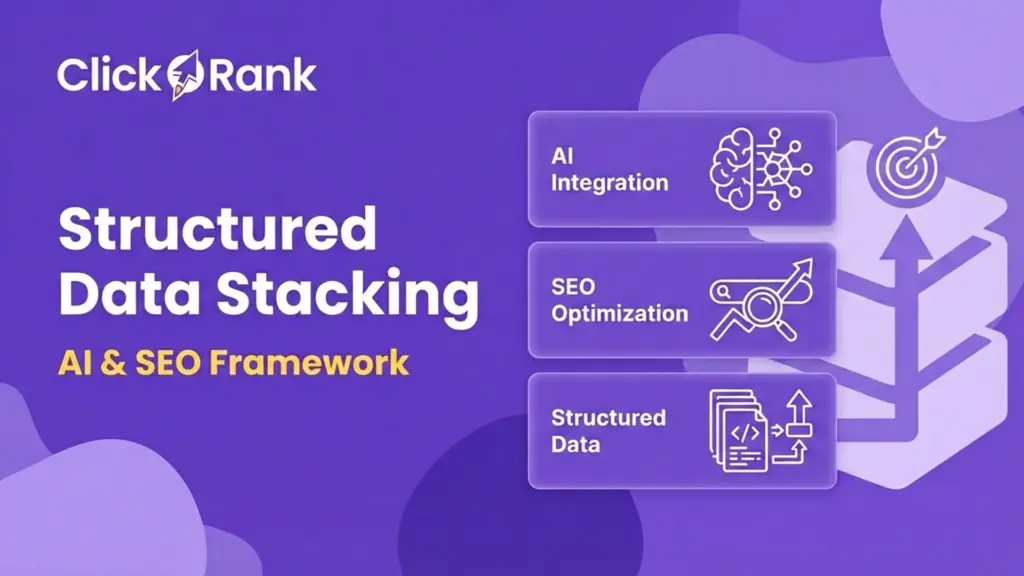
The Role of Structured Data & Entities in AI Search
Structured data and entities improve AI Search Performance Tracking by helping AI systems clearly understand who you are, what you offer, and how you relate to key topics. AI search engines rely on entity clarity to retrieve and cite accurate sources.
When your website uses schema markup and defines entities properly, it reduces ambiguity. AI models can confidently connect your brand to topics, products, and services. Without structured signals, your content may rank but still fail to be selected in AI-generated answers.
Entity optimization is no longer optional. It directly affects citation rate and AI visibility. If AI systems cannot clearly map your brand in their knowledge structures, your inclusion probability drops.
How does schema markup support AI retrieval?
Schema markup supports AI retrieval by providing structured, machine-readable context about your content. It tells AI systems exactly what your page represents.
For example, schema can define:
- Organization details
- Product information
- FAQs
- Articles and authors
- Reviews and ratings
AI Search Performance Tracking shows that pages with structured data are more likely to be selected in AI-generated summaries because they reduce interpretation errors.
Schema does not guarantee citations, but it improves clarity. When AI systems understand your entities correctly, retrieval accuracy increases. Clear structure improves inclusion probability across AI platforms.
What entity optimization improves AI citations?
Entity optimization improves AI citations by strengthening how your brand connects to relevant topics and concepts. AI systems rely on entity relationships to determine authority.
To improve entity optimization:
- Clearly define your brand as an organization.
- Use consistent naming across platforms.
- Connect content to specific topics using internal linking.
- Build associations with recognized industry terms.
AI Search Performance Tracking often reveals higher citation frequency for brands with strong entity clarity.
For example, if your site consistently connects your brand to “AI search visibility” and “SEO measurement frameworks,” AI systems build stronger associations. This increases the chance of being cited for related prompts.
How do knowledge graphs enhance brand recognition?
Knowledge graphs enhance brand recognition by mapping relationships between entities such as brands, topics, people, and products. They help AI systems understand context at scale.
When your brand appears in structured databases, authoritative sites, and consistent entity relationships, knowledge graphs strengthen your digital identity.
AI Search Performance Tracking benefits from strong knowledge graph presence because AI systems rely on these connections to verify credibility.
For example, if your brand is consistently linked to SEO tools, audits, and AI search topics across multiple trusted sources, knowledge graphs reinforce that association. This improves recognition and increases citation likelihood.
Clear entity mapping strengthens long-term AI visibility.
Which schema types matter most for AI search?
The schema types that matter most for AI search include Organization, Article, FAQ, Product, and Review schema. These provide structured clarity around authority, content, and offerings.
Organization schema defines your brand identity.
Article schema supports content credibility.
FAQ schema aligns with conversational AI prompts.
Product schema improves commercial visibility.
Review schema strengthens trust signals.
AI Search Performance Tracking shows stronger inclusion rates when structured data aligns with user intent. FAQ schema, for example, often improves answer extraction for informational prompts.
Choosing the right schema types improves retrieval accuracy and increases the likelihood of AI-generated citations.
AI Search Funnel Metrics: From Awareness to Conversion
AI Search Performance Tracking must measure visibility across the full funnel, from awareness to conversion. AI answers influence users at different decision stages, not just at the click stage.
At the top of the funnel, AI citations introduce your brand. In the middle, AI comparisons shape trust and evaluation. At the bottom, AI recommendations can directly impact purchase decisions. If you only measure traffic, you miss earlier influence stages.
AI visibility must be mapped to funnel behavior. When you understand how AI affects awareness, consideration, and conversion, you can optimize each stage strategically instead of focusing only on clicks.
How do AI citations drive top-of-funnel awareness?
AI citations drive top-of-funnel awareness by introducing your brand inside informational answers. When users ask broad questions, AI systems often cite multiple sources.
For example, if someone asks, “What is AI Search Performance Tracking?” and your brand is cited in the explanation, that creates early exposure. The user may not click immediately, but awareness begins.
In AI Search Performance Tracking, citation rate for informational prompts is a key awareness metric. The more often your brand appears in educational answers, the stronger your visibility at the discovery stage.
Top-of-funnel AI presence builds recognition. Over time, repeated citations increase familiarity and trust.
How do AI comparisons influence consideration?
AI comparisons influence consideration by positioning brands side-by-side during evaluation prompts. Users often ask AI tools to compare products, tools, or services before deciding.
For example:
- “Best AI SEO tools comparison”
- “ClickRank vs other SEO audit tools”
If your brand appears positively in these comparison answers, it strengthens middle-funnel influence. AI Search Performance Tracking should monitor mention frequency and sentiment during comparison prompts.
Being listed as “recommended” or “strong for agencies” directly affects user perception. If competitors appear instead, you are losing consideration-stage visibility.
Comparison prompts are high-value. Tracking them reveals your competitive positioning in AI-driven decision-making.
Can AI recommendations drive conversions?
Yes, AI recommendations can directly drive conversions by suggesting specific brands during transactional prompts. AI tools increasingly act as advisors.
For example:
- “Which SEO audit tool should I use?”
- “Best free site audit tool right now?”
If your brand is recommended clearly and confidently, it can trigger immediate action. AI Search Performance Tracking should measure citation rate and sentiment for high-intent prompts.
While AI may reduce clicks in some cases, strong recommendation visibility can increase highly qualified traffic. Users arriving after AI endorsement often have higher intent.
Monitoring recommendation prompts helps estimate bottom-of-funnel AI impact.
How should businesses map AI touchpoints to the funnel?
Businesses should map AI touchpoints by categorizing prompts into awareness, consideration, and conversion stages. Each category should have its own tracking cluster.
Steps to map AI touchpoints:
- Identify informational prompts (awareness).
- List comparison prompts (consideration).
- Define transactional prompts (conversion).
- Track citation and mention rates per stage.
- Compare AI visibility trends against funnel performance metrics.
AI Search Performance Tracking becomes more actionable when aligned with funnel stages. If awareness citations grow but conversions stay flat, you may need stronger calls-to-action.
Funnel mapping ensures AI visibility translates into measurable business growth.
ROI & Attribution in AI Search Performance
ROI in AI Search Performance Tracking measures the business value generated from AI visibility, not just traditional organic clicks. Attribution is more complex because AI often influences decisions without sending direct traffic.
In AI-driven search, users may see your brand cited, then later search for you directly or convert through another channel. Traditional last-click attribution models miss this influence. That is why AI Search Performance Tracking must combine citation data, traffic patterns, and assisted conversions.
Measuring ROI from AI visibility requires new proxy metrics and multi-touch thinking. If you rely only on direct AI referral traffic, you will underestimate the true impact of AI-driven discovery.
Why is AI search attribution challenging?
AI search attribution is challenging because AI systems often provide full answers without requiring a click. Users may discover your brand through an AI citation but convert later via direct or branded search.
This breaks traditional attribution models. Analytics platforms may credit:
- Direct traffic
- Branded search
- Paid ads
But the original influence may have been an AI-generated recommendation.
AI Search Performance Tracking must therefore measure influence, not just referral sessions. Since AI answers blend sources and reduce click dependency, the path to conversion becomes less visible.
Without adjusted attribution models, businesses risk undervaluing AI visibility and underinvesting in AI optimization.
What proxy metrics can estimate AI-driven conversions?
Proxy metrics help estimate AI-driven conversions when direct attribution is unclear. They connect AI visibility trends with business outcomes.
Useful proxy metrics include:
- Growth in branded search volume after citation increases
- Direct traffic spikes following AI recommendation exposure
- Assisted conversions linked to informational page visits
- Conversion rate from AI-influenced landing pages
For example, if AI citation rate increases for transactional prompts and branded search rises shortly after, AI likely influenced demand.
AI Search Performance Tracking uses these correlations to estimate AI-driven impact. While not perfect, combining multiple signals gives a stronger approximation of conversion influence.
How do you calculate ROI from AI visibility?
You calculate ROI from AI visibility by comparing estimated AI-driven revenue against the cost of AI optimization efforts. The formula remains similar to traditional SEO ROI but uses AI-adjusted inputs.
Steps:
- Estimate AI-influenced revenue using proxy metrics.
- Calculate total investment in AI content, authority building, and monitoring.
- Apply ROI formula:
(Revenue – Cost) ÷ Cost × 100
For example, if AI-driven visibility contributes an estimated $20,000 in revenue and costs $5,000 to maintain, ROI equals 300%.
AI Search Performance Tracking focuses on trends over time. Consistent growth in citations, share of voice, and assisted conversions signals positive ROI from AI visibility.
How should AI traffic be valued vs organic traffic?
AI traffic should often be valued higher than traditional organic traffic because it may carry stronger intent and prior trust. Users arriving after AI recommendations are often more informed.
In many cases, AI-influenced users:
- Spend more time on site
- Show higher engagement
- Convert at stronger rates
AI Search Performance Tracking should segment AI referral traffic separately and compare conversion rates against standard organic sessions.
If AI-driven visitors convert at a higher percentage, their value per session is greater. This supports increased investment in AI visibility strategies.
Valuing AI traffic correctly ensures smarter budgeting and resource allocation in AI-driven search environments.
Tools for AI Search Performance Tracking
Tools for AI Search Performance Tracking help you monitor citations, brand mentions, share of voice, and AI-driven traffic across platforms. Traditional SEO tools are not enough because AI visibility is not based on rankings alone.
You need tools that test prompts, detect citations, and measure influence inside AI-generated answers. Without proper tracking software, your AI visibility strategy becomes guesswork.
The right tools allow you to monitor performance across ChatGPT, Google AI Overviews, Gemini, and other platforms. They also help connect AI visibility with real traffic and conversions.
Choosing the correct AI Search Performance Tracking tools ensures you can measure influence, compare competitors, and make data-driven optimization decisions.
What features should you look for in AI tracking tools?
AI tracking tools should include prompt monitoring, citation detection, share-of-voice tracking, competitor comparison, and regional testing capabilities. These features allow full AI Search Performance Tracking.
Key features to look for:
- Custom prompt cluster tracking
- Citation frequency monitoring
- Brand mention and sentiment analysis
- Cross-platform AI testing
- Regional and language segmentation
- Traffic correlation reporting
A strong tool should allow weekly or monthly monitoring of high-impact prompts. It should also track competitor visibility to benchmark performance.
If a tool only tracks keyword rankings, it is not built for AI search environments. AI visibility requires prompt-based measurement, not position tracking.
How do AI tracking tools differ from traditional rank trackers?
AI tracking tools differ because they monitor answer inclusion instead of keyword positions. Traditional rank trackers measure where your page appears in search engine results. AI tools measure whether your brand appears in generated responses.
Traditional tools focus on:
- Rankings
- CTR
- Impressions
AI Search Performance Tracking tools focus on:
- Citation rate
- Share of voice in answers
- Brand mention frequency
- AI referral traffic
Rank trackers cannot tell you if your brand is being recommended inside an AI summary. AI tracking platforms test prompts directly and analyze output responses.
The measurement model shifts from “Where do I rank?” to “Am I included in AI answers?”
AI citation tracking tools
AI citation tracking tools monitor how often your domain appears as a source inside AI-generated responses. They test selected prompts and record inclusion frequency.
These tools often:
- Run automated prompt testing
- Capture response screenshots or logs
- Track citation trends over time
- Compare citation rate against competitors
For AI Search Performance Tracking, citation tracking is essential. Without it, you cannot measure influence inside AI answers.
Strong citation tracking tools also segment data by region and platform, helping you identify where visibility gaps exist.
Brand mention monitoring tools
Brand mention monitoring tools track when and how your brand name appears across AI-generated answers and broader digital ecosystems. They analyze frequency, context, and sentiment.
These tools help you understand:
- Positive vs negative framing
- Competitive positioning
- Emerging perception trends
In AI Search Performance Tracking, mention tracking supports authority analysis. A growing mention rate often correlates with stronger citation performance.
Mention monitoring also helps identify reputation risks. If AI systems frame your brand negatively, you can adjust content and authority-building strategies proactively.
Hybrid SEO + AI analytics platforms
Hybrid SEO + AI analytics platforms combine traditional SEO metrics with AI visibility tracking. They allow unified reporting for rankings, traffic, citations, and AI-driven influence.
These platforms typically include:
- Keyword tracking
- Prompt-based AI testing
- Citation and mention reporting
- Traffic and conversion analytics
For businesses transitioning into AI-first search environments, hybrid platforms provide smoother integration.
AI Search Performance Tracking becomes more powerful when combined with traditional SEO data. This unified approach helps connect AI visibility with measurable revenue impact.
Common Challenges in Tracking AI Search Performance
AI Search Performance Tracking faces challenges because AI platforms do not provide transparent, standardized analytics. Unlike traditional search engines, most AI systems do not offer clear dashboards showing citation frequency or visibility data.
This creates measurement gaps. Brands must rely on manual prompt testing, third-party tools, and indirect signals. Data may vary across sessions, regions, or time periods.
AI systems are also constantly evolving. Model updates can change source selection patterns without warning. That means yesterday’s visibility may not reflect today’s exposure.
Understanding these challenges helps businesses build smarter tracking systems. Instead of expecting perfect data, you design layered measurement strategies that reduce blind spots.
Why is AI search data limited or inconsistent?
AI search data is limited because most AI platforms do not provide official performance reporting. There is no built-in “AI Search Console” showing citation rate or brand inclusion.
Inconsistent results also occur because AI models can generate slightly different answers each time a prompt is tested. Variations in phrasing, location, and timing can influence output.
For AI Search Performance Tracking, this means:
- Results may fluctuate
- Citation visibility may change daily
- Different users may see different responses
To reduce inconsistency, businesses should standardize prompts and test them at regular intervals. Trend analysis over time is more reliable than one-time measurements.
How do black-box algorithms affect measurement accuracy?
Black-box algorithms affect accuracy because AI systems do not reveal exactly how they select sources. Retrieval methods, weighting systems, and training data are not fully transparent.
This makes it difficult to determine why your brand was included or excluded. You may improve content, but citation rate may still fluctuate without clear explanation.
In AI Search Performance Tracking, this uncertainty means you must rely on pattern recognition rather than precise algorithm insight.
Instead of trying to reverse-engineer the system completely, focus on strengthening authority, entity clarity, and topical depth. These broad improvements generally increase inclusion probability across platforms.
What are the risks of relying on incomplete AI metrics?
Relying on incomplete AI metrics can lead to poor strategic decisions. If you only track citation frequency without considering sentiment or share of voice, you may misinterpret visibility strength.
For example:
- High mentions but negative sentiment
- Strong awareness but weak conversion influence
- Good performance on one platform but invisibility on others
AI Search Performance Tracking must combine multiple signals to avoid false conclusions.
Incomplete metrics may also cause overconfidence. A single high citation rate does not guarantee sustained visibility. Multi-layer tracking reduces risk.
How can businesses mitigate data blind spots?
Businesses can mitigate data blind spots by using layered tracking methods and combining AI visibility metrics with traditional analytics.
Best practices include:
- Monitoring multiple AI platforms.
- Tracking citation rate, mentions, and sentiment together.
- Segmenting by region and language.
- Comparing AI visibility trends with traffic and conversion patterns.
- Running consistent, standardized prompt tests.
AI Search Performance Tracking works best when data is aggregated across systems instead of relying on a single metric.
Layered measurement reduces uncertainty and provides clearer strategic direction in AI-driven search environments.
The Future of AI Search Measurement
The future of AI Search Performance Tracking will move toward platform-native analytics, deeper visibility metrics, and AI-specific KPIs. As AI-driven discovery grows, measurement systems will evolve beyond rankings and clicks.
Today, AI visibility tracking is partly manual and indirect. In the future, AI platforms may provide clearer reporting on citations, recommendation frequency, and answer influence. Measurement will become more structured and standardized.
Businesses that prepare early will gain competitive advantage. AI search is not a temporary trend. It is becoming a core discovery channel. Brands that build AI-focused tracking systems now will adapt faster as analytics tools improve.
Will AI platforms provide native analytics dashboards?
AI platforms will likely introduce native analytics dashboards as businesses demand clearer visibility data. However, these dashboards may focus on usage and engagement rather than full citation transparency.
Platforms may provide:
- Brand inclusion metrics
- Recommendation frequency
- AI-driven referral tracking
- Prompt-level performance data
AI Search Performance Tracking will become easier if official dashboards are released. But even then, third-party tools will still be needed for cross-platform comparison.
Until native analytics mature, businesses must continue using structured prompt monitoring and traffic correlation to estimate AI visibility impact.
How will generative engine optimization evolve?
Generative engine optimization will evolve from simple content optimization to full AI authority engineering. It will combine entity optimization, structured data, brand authority, and conversational formatting.
Future optimization will focus on:
- Clear entity mapping
- Structured answer formatting
- Expert-backed content
- Cross-platform authority signals
AI Search Performance Tracking will shift from tracking visibility alone to optimizing influence. Brands will design content specifically for AI retrieval and summarization.
Optimization strategies will become more data-driven as measurement improves. Authority, clarity, and trust will define AI inclusion success.
What new KPIs will define success in AI search?
New KPIs in AI search will focus on influence metrics rather than position metrics. AI Search Performance Tracking will prioritize visibility inside answers.
Emerging KPIs include:
- AI citation rate
- Share of voice in AI responses
- Brand recommendation frequency
- AI-assisted conversions
- Sentiment strength in AI mentions
Traditional rankings will still matter, but they will no longer be the primary success indicator.
The brands that track and improve these AI-specific KPIs will outperform competitors in AI-driven discovery environments.
How should businesses prepare for AI-first discovery?
Businesses should prepare for AI-first discovery by building authority, optimizing entities, and implementing structured prompt monitoring systems. Preparation must be strategic, not reactive.
Key preparation steps:
- Strengthen topical authority with pillar and cluster content.
- Implement structured data and entity optimization.
- Monitor high-impact prompt clusters.
- Track AI citation and mention trends regularly.
- Align AI visibility with funnel strategy.
AI Search Performance Tracking should become part of your standard measurement framework, not a side experiment.
Brands that treat AI visibility as a core growth channel will adapt faster as AI-driven discovery becomes dominant.
Building a Future-Proof AI Search Measurement Strategy
A future-proof AI Search Performance Tracking strategy requires combining citation monitoring, authority building, funnel mapping, and cross-platform testing into one system. Businesses must treat AI visibility as a core performance channel, not an experiment.
AI discovery is expanding across search engines, assistants, and AI platforms. If you do not measure your presence inside AI answers, you are operating with incomplete data. Rankings alone no longer show the full picture.
A strong strategy connects AI citations, mentions, traffic, and conversions into one measurable framework. When AI visibility becomes part of your standard reporting, you gain a long-term competitive edge in AI-driven search ecosystems.
What steps should businesses take today?
Businesses should start by implementing structured AI Search Performance Tracking across high-impact prompt clusters. Action today creates advantage tomorrow.
Key steps:
- Identify priority prompts tied to revenue.
- Track citation rate and share of voice weekly.
- Strengthen entity clarity and structured data.
- Build topical authority through cluster content.
- Monitor AI-driven referral traffic separately.
You can also align this with your broader SEO Performance & Measurement Framework to ensure AI visibility integrates with existing reporting systems.
Taking early action allows you to build authority before competitors dominate AI inclusion.
How can SEO teams adapt to AI-driven discovery?
SEO teams must shift from ranking-focused thinking to influence-focused measurement. AI Search Performance Tracking requires new workflows.
Teams should:
- Monitor prompts instead of only keywords.
- Track citations and brand mentions.
- Optimize for entity clarity and structured data.
- Align AI visibility metrics with funnel KPIs.
Content teams should format answers clearly and concisely for AI retrieval. Technical teams should strengthen schema and entity structure.
AI-driven discovery rewards clarity, authority, and consistency. SEO teams that adapt measurement systems will stay relevant in AI-first environments.
Why AI search tracking is the next evolution of SEO?
AI search tracking is the next evolution of SEO because visibility is shifting from ranked links to generated answers. Search engines are becoming answer engines.
AI Search Performance Tracking expands SEO beyond traffic into influence measurement. It measures whether your brand shapes AI responses, not just whether users click.
SEO has always evolved from keywords to links to entities. AI visibility is the next stage.
Businesses that integrate AI tracking into their core measurement systems will lead in AI-driven discovery. Those who ignore it risk invisible decline.
What is AI search performance tracking?
AI search performance tracking measures how often a brand appears, is cited, or influences answers in AI-driven search systems like generative engines and AI overviews. It evaluates visibility beyond rankings by analyzing citations, mentions, share of voice, and AI-driven traffic to understand overall discovery performance.
How can I track my brand in AI-generated answers?
You can track brand presence in AI answers by monitoring citations, mentions, and sentiment across AI platforms using prompt-based testing, brand monitoring tools, and referral analytics. Comparing responses across multiple prompts helps identify visibility trends and gaps in AI-generated content.
Does AI search reduce website traffic?
AI search can reduce clicks because users often get complete answers directly in AI summaries, leading to more zero-click searches. However, strong brand citations in AI responses can still drive qualified traffic and improve trust, making visibility in AI answers a critical performance metric.
What metrics matter most in AI search performance?
Key AI search metrics include citation frequency, share of voice, brand mentions, sentiment, and AI referral traffic. These metrics indicate how often AI systems rely on your content and how visible your brand is within generated answers, offering a more accurate measure than rankings alone.
How is AI search different from traditional SEO?
Traditional SEO focuses on rankings and clicks, while AI search prioritizes answer generation, entity understanding, and source credibility. Instead of ranking pages, AI systems synthesize information from multiple sources, making authority, structured data, and topical depth more important than keyword positioning alone.
Can small businesses compete in AI search results?
Yes. AI search favors authoritative, well-structured, and highly relevant content rather than brand size alone. Small businesses can improve visibility by building topical authority, using structured data, earning mentions, and publishing clear, expert-driven content that AI systems can easily interpret and cite.