An editorial calendar is far more than just a schedule; it’s the strategic blueprint that ensures your content marketing efforts are tightly aligned with your SEO goals. It’s the central nervous system for any content-driven organization, dictating what gets created, when it gets published, and how it contributes to the overall authority and ranking of your website.
By establishing a clear, predictable flow of high-value posts, the calendar directly supports robust Content SEO, making it possible to target specific keywords, build internal link structures, and maintain the consistency search engines love. Without this organizational structure, content creation often becomes reactive and fragmented, severely hindering long-term SEO success. A well-managed calendar shifts the focus from merely producing articles to strategically publishing assets that drive measurable results.
What Is an Editorial Calendar?
An editorial calendar is essentially a visual workflow and scheduling tool used by content teams to manage all stages of content production, from ideation and drafting to final publication and promotion. Think of it as a comprehensive dashboard that provides a bird’s-eye view of every piece of content scheduled for a specific time frame, typically covering anywhere from one month to an entire year.
Its primary purpose is to move content from a concept in a brainstorm session to a high-performing asset on your site in a structured, repeatable manner. For a team focused on scaling their organic reach, integrating Content SEO considerations into this calendar is non-negotiable. It helps assign responsibilities, track progress, and, most crucially, ensures that every single published piece works in concert with your overall content strategy. It is the tactical layer that executes the strategic vision.
Why Do Content Teams Use Editorial Calendars?
Content teams rely on editorial calendars to move away from chaotic, last-minute production and toward a predictable, high-quality output. The primary reason is efficiency—it eliminates bottlenecks by clearly defining who does what and when. This structure is vital for large teams or those producing a high volume of content. Beyond logistics, the calendar is a potent tool for maintaining brand voice and quality standards.
By planning content far in advance, teams have ample time for thorough research, expert-level writing, and essential SEO optimization steps like competitive analysis and backlink strategy integration. When teams consistently use a detailed editorial calendar, they naturally improve their Content SEO performance because they shift from random acts of content creation to deliberate, strategic publishing designed for organic growth.
How Does an Editorial Calendar Help With Planning?
The planning aspect is where the editorial calendar shines for Content SEO. It forces the team to look ahead and ensure there are no glaring gaps in their topic coverage relative to their target keywords. Instead of writing about whatever comes to mind that week, planning months in advance allows for the development of topic clusters and pillar content, which are foundational for modern SEO.
This high-level view helps identify keyword opportunities that might be seasonally relevant or aligned with upcoming product launches. For example, if you know a major industry event is in six months, your calendar allows you to schedule a series of related articles building up to it, perfectly timed to capture search interest. This proactive planning is impossible without a structured calendar, and it is a fundamental driver of sustainable organic traffic growth.
How Does It Improve Team Collaboration?
In a world where content passes through writers, editors, designers, and SEO specialists, collaboration can quickly become a mess without a central hub. An editorial calendar acts as this single source of truth, ensuring everyone operates from the same playbook. It clearly outlines task ownership, deadlines, and the current status of each content piece (e.g., “Drafting,” “In Review,” “Ready for SEO check”).
For instance, the SEO specialist can check the calendar to see which articles are nearing completion and flag them for a final Content SEO checker analysis, confirming proper keyword usage, meta-data optimization, and internal linking before they go live. This transparency minimizes miscommunication, reduces duplicated efforts, and ensures that all dependencies are met on time, leading to a much smoother and faster path to publication.
What Are the Key Components of an Editorial Calendar?
A robust editorial calendar must contain several non-negotiable data points to be effective for serious Content SEO. These components ensure that every piece of content serves a strategic purpose.
- Content Title and Focus Keyword: The finalized title and the primary keyword the article is targeting.
- Target Persona/Audience: Which specific segment of the audience this content is intended for.
- Content Format: Blog post, eBook, video script, infographic, etc.
- Author/Owner: Who is responsible for the content’s creation.
- Due Dates and Publish Dates: Critical milestones for drafting, editing, and final publication.
- Status: A clear indicator of where the content is in the workflow (e.g., Idea, Outline, Drafting, SEO Review, Scheduled).
- CTA/Goal: The specific action the content is meant to drive (e.g., Newsletter Signup, Product Demo Request, Internal Link Click).
- Pillar/Cluster Association: Identifying which larger pillar topic the content supports, critical for topic cluster organization.
- SEO Score/Checklist: A final sign-off that the post has met all internal SEO requirements, often including a check using a Content SEO tools suite.
What Types of Content Should Be Included?
An effective calendar encompasses more than just blog posts. It should be a holistic view of all high-value content assets that contribute to your organic search visibility and authority. This includes long-form pillar articles, supporting cluster posts, case studies, white papers, video scripts (since YouTube is a massive search engine), and even updates to existing, high-performing legacy content.
Moreover, it should schedule promotional content for distribution channels—social media posts, email newsletters, and outreach plans—that will drive traffic and authority signals back to the main content. The content should be scheduled based on the needs of the Content SEO strategy, prioritizing assets that will drive the highest impact keywords and conversion potential first.
How Do Deadlines and Publishing Dates Work?
Deadlines and publishing dates are the backbone of the editorial calendar’s functionality. Deadlines are internal milestones (e.g., outline due, first draft due, editor review complete) designed to keep the project moving and prevent last-minute rushes.
Publishing dates are the fixed, external dates when the content is scheduled to go live and start generating organic value. The time gap between the final deadline and the publishing date is crucial; this is reserved for the final, critical steps: SEO optimization, including meta-data writing, internal linking, and the final Content SEO score checker review. Sticking rigorously to these dates ensures a consistent publishing cadence, which search engines favor and your audience comes to expect, reinforcing your authority in your niche.
How Does an Editorial Calendar Differ From a Content Strategy?
The distinction between an editorial calendar and a content strategy is essential for anyone serious about Content SEO. The content strategy is the high-level, foundational document that answers why you are creating content. It defines your target audience, your unique value proposition, your primary business objectives, the core topics you will cover (your pillars), and the overall SEO strategy (keyword targets, competitive gap analysis).
The editorial calendar, on the other hand, is the tactical implementation tool that answers what and when. It’s where the strategic goals are broken down into individual, actionable content pieces, scheduled, assigned, and tracked through the workflow. You cannot execute a good strategy without a good calendar, and a calendar without a strategy is just a random list of topics. They are interdependent, but the strategy must always precede the calendar.
How to Create an Editorial Calendar for Content SEO?
Creating an editorial calendar that truly serves your Content SEO goals requires a systematic, data-driven approach, moving past a simple list of titles and dates. The process must start with a deep dive into existing data and future aspirations. It’s about building a living document that guides your team towards measurable organic growth.
The best calendars are built backward from major goals (e.g., rank for 20 high-value keywords in the next 12 months) and forward from identified audience needs. This dual focus ensures that your content is both strategically valuable to the business and genuinely helpful to the user, a core tenet of modern SEO. Successfully implementing this calendar is one of the biggest drivers of sustainable traffic growth.
What Tools Are Best for Managing an Editorial Calendar?
The choice of tool can drastically impact the effectiveness of your editorial calendar for Content SEO. No single tool is perfect for everyone, but the best option offers visibility, customization, and integration capabilities. Specialized content marketing platforms often include built-in workflow features and reporting that align closely with content production. Project management software like Trello, Asana, or ClickUp provides immense flexibility to customize workflows, adding custom fields for things like ‘Target Keyword,’ ‘SEO Difficulty Score,’ or ‘Pillar Topic,’ which are vital for granular tracking. For smaller teams or those just starting, collaborative spreadsheets remain a highly accessible and flexible option, provided they are structured meticulously. Regardless of the tool, it must facilitate easy sharing and updating, and ideally, integrate with your SEO and analytics platforms. The goal is to choose a solution that minimizes administrative overhead and maximizes the time spent on content creation and optimization, which is key to improving your Content SEO checker results.
Should I Use Excel, Google Sheets, or a Specialized Tool?
The decision between a simple spreadsheet (Excel/Google Sheets) and a specialized tool depends on the complexity of your operation and the size of your team. Google Sheets is often the recommended starting point due to its cost-effectiveness, collaboration features, and ease of use. It allows for custom formulas, color-coding, and filters that can effectively manage a calendar for small-to-medium teams focused on Content SEO. You can track keyword rank, content stage, and author assignment all in one place.
However, as your team grows, or if your content demands intricate workflows (e.g., multiple rounds of legal or expert review), a specialized tool or project management software becomes indispensable. These tools offer automated notifications, integration with Slack or email, and superior visual organization (like Kanban boards), which handle complex dependencies more smoothly. The key is to graduate to a more robust tool when the overhead of managing the spreadsheet starts to slow down the content velocity.
How Do Project Management Tools Integrate With Content SEO?
Project management (PM) tools excel at integrating the logistical side of content creation with the analytical demands of Content SEO. They allow you to define a standardized content workflow, ensuring that the SEO review step is never skipped. Within a PM tool, a specific task can be created for “Final Content SEO tools Check” or “Internal Link Building,” and it can be assigned a clear owner and deadline.
Crucially, many PM tools allow for custom fields where you can directly embed data from your SEO tools, such as the target keyword, its search volume, and the current content’s organic position. This makes the calendar a performance-driven document. For instance, an editor can easily see that Article X, currently in the “Drafting” stage, is targeting a high-difficulty, high-volume keyword, prompting them to assign a top-tier writer and ensure an extra round of internal linking to support the piece’s SEO ambition.
How to Choose Topics for Your Editorial Calendar?
Topic selection must be a rigorous, evidence-based process driven by Content SEO data, not guesswork. This phase ensures every minute spent on creation is an investment in organic growth.
- Keyword Gap Analysis: Identify topics where your competitors rank but you don’t. This offers immediate, high-potential opportunities.
- User Intent Mapping: Choose topics that directly address the search intent (informational, navigational, commercial) of your target audience at every stage of their journey.
- Pillar & Cluster Development: Plan content in related groups, where a few authoritative “Pillar” articles are supported by many detailed “Cluster” articles, all internally linked. This structure is a powerful signal to search engines about your topical authority.
- Content Audit: Schedule updates and expansions for existing content that is already performing well but has potential to rank higher (often called “Content Refresh”). This is often a lower-effort, high-return strategy.
Topics must directly align with business objectives—if a topic drives traffic but never conversions, it should be lower priority than one that drives slightly less traffic but significantly more leads.
How Do Keyword Research and Content SEO Influence Topic Selection?
Keyword research is the single most important input for topic selection in a calendar designed for Content SEO. It moves the process from creative brainstorming to strategic planning. Research should identify not just high-volume keywords, but keywords with manageable difficulty and strong commercial intent. The calendar ensures these keywords are not targeted randomly but are organized into coherent topic clusters.
For example, if your pillar topic is “Email Marketing Strategies,” your calendar will schedule cluster posts targeting long-tail keywords like “best time to send B2B email,” “email subject line personalization tools,” and “abandoned cart email sequence examples.” The calendar dictates the timing and sequence of these cluster posts to maximize their internal linking effectiveness. This systematic approach, informed by deep Content SEO tools data, is what builds the authoritative content library that Google rewards.
How Can Audience Personas Guide Topic Decisions?
Audience personas act as a critical filter for the raw data gathered during keyword research. While keyword research tells you what people are searching for, personas tell you who is searching and why (their pain points, current knowledge, and stage in the buying journey). Your calendar must ensure a balanced distribution of content across all personas and stages.
- Awareness Stage Persona: Needs broad, informational content scheduled early in the quarter (e.g., “What is X?”).
- Consideration Stage Persona: Needs comparative, solution-focused content (e.g., “X vs. Y Tool”).
- Decision Stage Persona: Needs case studies, testimonials, and detailed pricing content.
By linking each scheduled article in the calendar to a specific persona and stage, you guarantee that your content pipeline is addressing the full funnel, maximizing the opportunity to capture and convert relevant organic traffic, directly supporting your holistic Content SEO strategy.
How Often Should You Update Your Editorial Calendar?
The editorial calendar should be treated as a living, breathing document, requiring regular review and updating to maintain its effectiveness for Content SEO. While the high-level plan (e.g., the next six months of pillar topics) might be set quarterly, the tactical, day-to-day schedule needs more frequent attention.
- Weekly Review: Essential for checking on content status, resolving immediate roadblocks, and ensuring deadlines are being met.
- Monthly Review: Used to review upcoming content, adjust to any short-term business or industry changes, and evaluate the performance of recently published posts (i.e., quick check on organic traffic and ranking).
- Quarterly Audit: The most comprehensive review. This involves analyzing overall SEO performance, identifying new keyword opportunities, adjusting topic clusters based on what’s ranking, and planning out the next quarter’s themes and high-value content.
Failing to update the calendar makes it a static, irrelevant relic that eventually hinders, rather than helps, content execution.
How Does Updating Affect SEO Performance?
Regular updating of the editorial calendar is directly linked to maintaining and improving SEO performance. It allows the team to pivot quickly to capitalize on new, trending keywords or to respond to a competitor’s successful content launch.
More critically, it allows for the scheduling of content “refreshes”—going back and updating a piece of content that is, for example, ranked position 5 to try and push it to position 1 or 2. This is a highly effective, low-effort Content SEO strategy. By frequently updating the calendar, you formalize the process of refreshing meta-descriptions, improving keyword density, and checking the performance with a Content SEO score checker on older, high-potential assets, which can lead to rapid ranking gains without creating net-new content.
What Signals Indicate It’s Time for a Review?
Several key signals, often stemming from your SEO analytics, indicate that a full review and adjustment of your editorial calendar is necessary.
- Sudden Drop in Organic Traffic/Rankings: A change in Google’s algorithm or a major competitor launch may necessitate a rapid pivot in content focus.
- High-Potential Keywords Not Targeted: New keyword research reveals a high-volume, low-difficulty keyword that has not been included in the existing plan.
- Stagnant Content Performance: If a high-priority piece published three months ago is still stuck on the second page of SERPs, the calendar needs to schedule an immediate refresh and internal linking push for that piece.
- Significant Business or Product Shift: A new product launch requires a major reallocation of content resources to support the new commercial goals.
- Resource Imbalances: If one writer is constantly overloaded while another is underutilized, the calendar needs to be adjusted to balance the workload and maintain consistent output quality and quantity for strong Content SEO.
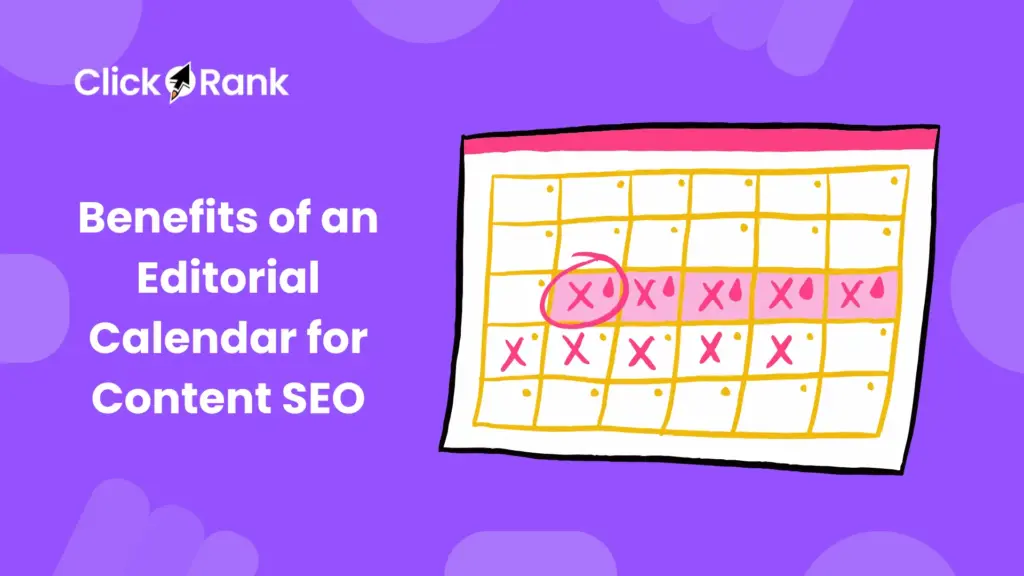
What Are the Benefits of an Editorial Calendar for Content SEO?
The benefits of a well-executed editorial calendar extend far beyond simple organization; they fundamentally change the trajectory of your organic growth. By imposing discipline and foresight onto the content creation process, the calendar transforms sporadic publishing into a cohesive, SEO-optimized content stream. It’s the difference between throwing darts and using a laser-guided system. The structured approach it demands is precisely what search algorithms reward—consistency, topical depth, and quality.
How Does It Improve Content Consistency?
Consistency is one of the most underrated pillars of successful Content SEO. Search engines favor websites that publish high-quality, relevant content at a regular, predictable cadence because it signals an active, authoritative source. An editorial calendar enforces this consistency by pre-scheduling publication dates and managing the workflow backward from them. It prevents the common scenario where content creation stalls due to bottlenecks or lack of ideas. By ensuring a steady stream of content, you keep your site fresh in the eyes of search crawlers, increase the average time users spend on your site, and build audience expectation and loyalty. This consistency across titles, formats, and especially the quality of Content SEO execution is crucial for long-term ranking stability and growth.
How Does It Help With SEO Rankings?
An editorial calendar directly influences SEO rankings by enabling a powerful, structured approach to topical authority. It ensures that every piece of content targets a specific, researched keyword and contributes to a larger, overarching pillar topic.
This systematic content clustering allows you to demonstrate comprehensive knowledge on a subject matter, which search engines highly value. Furthermore, by planning content months ahead, you ensure that you don’t accidentally target the same keyword with multiple articles (keyword cannibalization), a common mistake that confuses search engine algorithms. The calendar ensures a clean, organized, and strategically linked content architecture—the key to unlocking higher SERP positions. Regularly using Content SEO tools during the content creation cycle, managed by the calendar, further ensures that every post is optimized to its fullest potential before publication.
Can It Affect Keyword Density and Internal Linking?
Absolutely. The editorial calendar is instrumental in optimizing both keyword density and internal linking, two tactical but powerful elements of Content SEO.
- Keyword Density (and Usage): By specifying the primary and secondary keywords in the calendar entry, the team is constantly reminded of the content’s SEO target. More importantly, the calendar allows for the intentional scheduling of supporting articles that use related semantic keywords, ensuring that the main pillar article isn’t artificially stuffed with the target keyword but is naturally supported by contextually relevant surrounding content.
- Internal Linking: This is where the calendar offers maximum strategic leverage. Since you know what you are publishing next month, you can instruct the writer of today’s post to proactively include an internal link to the piece scheduled for the future. You can also track the linking structure, ensuring new content links up to the relevant pillar pages and other cluster pieces. This planned, intentional internal linking structure is impossible without the foresight provided by a detailed editorial calendar. It boosts page authority and helps search engines crawl and understand the hierarchy of your content.
How Does Scheduling Content Impact SERP Visibility?
Strategic content scheduling, managed through the calendar, has a significant positive impact on SERP visibility. First, consistent scheduling (e.g., every Tuesday and Thursday) trains Google’s crawlers to visit your site regularly, ensuring new content is indexed and enters the ranking competition quickly.
Second, the calendar allows you to align content publication with anticipated peaks in search demand, such as seasonal trends, major holidays, or industry events. This precision timing means your content is live and fully optimized exactly when your target audience is searching for it, maximizing the chances of appearing high on the Search Engine Results Pages (SERPs). Planning the entire content ecosystem using the calendar is a strategic move that fundamentally improves the overall organic footprint of your website. The ability to track the performance of various types of content, scheduled via the calendar, also helps refine future strategies for maximizing SERP visibility.
How Does It Optimize Resource Allocation?
Resource allocation is highly optimized when driven by a robust calendar, preventing the burnout and waste associated with reactive publishing. The calendar provides a clear forecast of the workload, allowing managers to assign tasks (writing, editing, graphic design, SEO review) well in advance, utilizing each team member’s time and expertise most efficiently. For example, if a major video is scheduled for two months out, the calendar ensures the scriptwriter, videographer, and video editor all have their tasks clearly defined and scheduled sequentially.
For Content SEO, this means the optimization steps are budgeted with the correct time. A high-priority article targeting a difficult keyword will be allocated more time for the final Content SEO score checker review and link-building outreach than a low-priority, informational blog post. This optimized resource use ensures that effort is always directed toward the content that will yield the highest return in terms of traffic and conversions.
How to Measure the Effectiveness of an Editorial Calendar?
An editorial calendar is not a static document; its true value is measured by the performance of the content it produces. To ensure your planning is translating into tangible results for your Content SEO, you must implement a rigorous review process using key performance indicators (KPIs).
The measurement phase closes the loop, informing future content decisions and justifying the resources invested in the calendar itself. Measurement must focus on business impact, not just vanity metrics.
What Metrics Should Be Tracked?
Tracking the right metrics is essential to gauge the success of your calendar’s strategy. Beyond the obvious raw publication volume, you need to track metrics that directly relate to your Content SEO goals:
- Organic Traffic Growth: This is the most fundamental metric. Are the content pieces scheduled in the calendar generating an overall increase in traffic from organic search?
- Keyword Ranking Performance: Track the average ranking position for the primary keywords targeted by the content scheduled in the calendar.
- Page Authority/Domain Authority (or equivalent): The growth of these scores is an indirect result of a well-executed calendar that promotes strong internal linking and high-quality linkable assets.
- Content Velocity: The time it takes for a piece of content to move from idea to publication. A good calendar improves this speed and consistency.
- Topical Cluster Saturation: How much content has been published against your defined pillar topics? A high saturation often correlates with higher topical authority.
- Conversion Rate per Content Piece: Which calendar-scheduled content is actually driving leads, sign-ups, or sales?
How Do Traffic and Engagement Metrics Relate to SEO?
Traffic and engagement are the direct result of successful Content SEO execution driven by your calendar. Organic Traffic proves your content is ranking well enough to be found by users. Without consistent, high-quality organic traffic, your content creation efforts are failing their primary goal. Engagement Metrics (time on page, bounce rate, pages per session) signal to search engines that users found your content valuable, relevant, and authoritative.
A low bounce rate on a scheduled article targeting a commercial keyword is a strong indicator that the calendar’s topic and format selection were correct. If your calendar schedules content that users immediately bounce from, the calendar’s strategy is flawed, indicating a need for review on user intent and content quality, often identified during a Content SEO tools check. High engagement metrics are a key factor in improving and maintaining high search rankings.
How Can Conversion Rates Show Calendar Effectiveness?
Conversion rates are the ultimate measure of your editorial calendar’s effectiveness, proving that your Content SEO efforts are translating into business value. If an article targeting a middle-of-the-funnel keyword, as scheduled by your calendar, has a high conversion rate (e.g., users downloading a guide or signing up for a demo), it means the calendar successfully:
- Identified the correct high-intent keyword.
- Timed the publication correctly.
- Ensured the content quality and CTA were perfectly aligned with the target audience’s needs.
Tracking conversion rates allows you to identify which types of content, planned for what part of the sales funnel, are the most lucrative. This data is then fed back into the calendar for the next planning cycle, allowing you to prioritize and scale the production of high-converting content formats and topics, thereby maximizing the return on your content investment.
How Often Should Analytics Be Reviewed?
Analytics must be reviewed at an increasing frequency as you move closer to the present.
- Daily/Weekly: Quick check on recently published content for any immediate issues (e.g., a broken link, a high bounce rate on day one).
- Monthly: Detailed review of organic traffic, keyword positions, and top-level conversion metrics for the past 30 days. This review helps identify early trends and informs short-term tactical adjustments.
- Quarterly: Comprehensive analysis. This is where you conduct deep dives into topical cluster performance, link-building success, and the long-term ROI of the content planned in the previous quarter. This quarterly audit uses the data to inform the major strategic decisions for the next quarter’s calendar planning, ensuring the continuous application of successful Content SEO strategies.
How Do You Adjust the Calendar Based on Results?
Adjusting the calendar based on performance data is the step that separates passive scheduling from strategic growth. The results from your analytics should directly influence future content production:
- Amplify Success: If a cluster of articles is driving exceptional organic traffic, immediately schedule more content (deeper dives, spin-offs, related topics) to strengthen that pillar. Use a Content SEO checker on the successful content to replicate its best practices.
- Triage Underperformers: If an article is getting traffic but has a low conversion rate, schedule a content refresh to improve the CTA or user experience. If it’s not ranking at all, schedule time for internal link building or external promotion to boost its authority.
- Reprioritize: If a low-priority article suddenly spikes in traffic, elevate its related cluster content on the calendar. Conversely, if a planned high-priority topic is showing severely declining search volume, push it back or replace it entirely.
This cyclical process of Plan -> Publish -> Measure -> Adjust ensures the editorial calendar remains a powerful, data-driven engine for Content SEO growth.
What Are Common Challenges With Editorial Calendars?
While an editorial calendar is essential for strategic Content SEO, its implementation is not without hurdles. Teams often struggle with keeping the calendar current, managing scope creep, and ensuring consistent adoption across all content creators. Recognizing these common pitfalls is the first step toward building a resilient and effective content workflow that actually drives organic results.
How Do You Avoid Overloading Your Calendar?
Overloading the calendar—scheduling more content than the team can realistically produce at a high level of quality—is a critical mistake that kills momentum and sacrifices Content SEO. To avoid this:
- Implement a Capacity Check: Before finalizing a schedule, review the actual historical content velocity of the team. Set a realistic baseline for articles per week/month and stick to it.
- Prioritize Ruthlessly: Every piece of content should be scored based on its potential organic traffic/conversion impact and its level of effort. Only schedule the high-impact, manageable-effort items. Lower-priority items should be parked in a “Backlog” queue, not on the active calendar.
- Factor in SEO Overhead: Do not just budget time for writing and editing. Explicitly schedule time for keyword research, competitive analysis, the final Content SEO tools check, internal linking, and content promotion. These are the steps that ensure quality, and they must be accounted for to prevent calendar overload.
How Do You Keep Team Members Accountable?
Accountability is paramount for a calendar to function as a workflow tool. If deadlines are consistently missed, the entire schedule collapses. Key strategies include:
- Clear Ownership: Every task in the calendar (e.g., “Outline,” “First Draft,” “SEO Review”) must be assigned to one single individual—the Content Owner—whose name is prominently displayed.
- Automated Reminders: Use the calendar tool’s built-in features to send automated alerts when tasks are nearing or past their due date.
- Consistent Review Meetings: Hold a short (15-minute) weekly “stand-up” review focused solely on content status and roadblocks. Do not allow a lack of progress to be swept under the rug. The calendar should be the centerpiece of this meeting.
- Performance Review Integration: Link content completion and quality (measured by the Content SEO score checker results and subsequent organic performance) to team members’ overall performance evaluations.
What Are the Pitfalls of Poor Planning?
Poor planning in the editorial calendar leads directly to wasted resources and abysmal Content SEO performance. The most critical pitfalls include:
- Keyword Cannibalization: Scheduling two or more articles that unintentionally target the same core keyword, leading to competition between your own pages and confusing search engines about which page to rank.
- Topic Gaps: Failing to cover a critical aspect of a pillar topic, leaving a hole in your topical authority that competitors can exploit.
- Inconsistent Quality: Rushing content due to poor scheduling, leading to articles that lack depth, insufficient SEO optimization, and an overall poor user experience, which negatively affects rankings.
- Misaligned Content: Producing high-quality content that targets keywords with low commercial intent, resulting in high traffic but zero conversions—a failure to translate Content SEO into business results.
- Reactive Publishing: Constantly reacting to trends or competitor activity rather than executing a pre-planned, strategic content roadmap.
What is the ideal length for an editorial calendar?
There is no single 'ideal' length. Most content teams plan at a minimum of 3 months in advance to allow for proper keyword research, pillar development, and strategic interlinking. High-growth or seasonal businesses often plan 6 to 12 months ahead, setting the overall thematic framework for their Content SEO. The key is to have a long-term strategic view (12 months of themes) and a detailed tactical view (3 months of specific content titles and deadlines).
How far in advance should I plan content?
For high-value, long-form content (Pillar Articles), you should plan 60-90 days in advance. This time is needed for deep research, detailed outlines, multiple review stages, and comprehensive final Content SEO tools checks. For regular blog posts and cluster content, 30-60 days is typically sufficient to maintain a consistent publishing schedule and ensure proper internal linking.
Can an editorial calendar improve social media SEO?
Yes, indirectly. While social media platforms use their own algorithms, an editorial calendar improves social media performance by ensuring a consistent flow of high-quality, strategically relevant content to share. This regular sharing generates traffic signals back to your website, increasing brand visibility and potentially earning high-quality backlinks, both of which are strong positive factors for overall Content SEO.
Should I have separate calendars for blogs and social media?
It is highly recommended to have one master editorial calendar that contains high-level information for all content types, but with separate, integrated views. The master calendar ensures thematic alignment and prevents content overlap. You should, however, maintain a separate, highly detailed Social Media Calendar that focuses purely on platform-specific formatting, scheduling times, and engagement metrics for the promotion of the content planned in the master calendar.
How do I handle unexpected content changes?
Build buffer time (an average of one week) into every content project within the calendar. When unexpected changes (e.g., major company announcement, industry crisis) occur, immediately identify the lowest-priority scheduled content for the current month and move it to the backlog to free up resources. Use a dedicated 'URGENT/BREAKING' status tag in your calendar to clearly mark the content being prioritized to maintain clarity and focus on the new Content SEO target.
Can freelancers effectively follow an editorial calendar?
Absolutely. An editorial calendar is arguably more crucial for managing freelancers. It provides them with clear deadlines, specific target keywords, the required content structure (outline), and the ultimate Content SEO goal for the piece. The calendar acts as the primary project brief, ensuring the freelancer's output is perfectly aligned with your internal content strategy and quality requirements, even allowing them to quickly check the required score using a Content SEO score checker if provided access.
How does an editorial calendar support content repurposing?
The calendar should schedule repurposing as a defined task. After a pillar article performs well organically, the calendar should explicitly schedule the creation of derivative assets—e.g., 'Schedule Article X for a video script repurposing' or 'Plan a slide deck from Article Y.' This ensures you maximize the ROI of every piece of content by extending its reach and value across different formats, which further reinforces your topical authority.
Is it necessary to include content formats in the calendar?
Yes, it is essential. The content format (blog post, video, infographic, eBook) impacts the resources needed, the timeline, and the final Content SEO strategy. For example, a video often requires a much longer lead time and different team members than a standard blog post. Including the format ensures accurate resource allocation and helps maintain a balanced content mix for diverse organic traffic sources.
How can I track ROI from content planned in the calendar?
To track ROI, you must link each scheduled content piece in your calendar to specific conversion events (e.g., lead forms, product purchases) using UTM parameters and goal tracking in your analytics. ROI is calculated by measuring the revenue/value generated by the organic traffic to a specific piece of content, minus the cost of producing that content (writer, editor, SEO time). The calendar allows you to aggregate this data by topic cluster or content type for high-level ROI analysis.
Can AI tools assist in managing an editorial calendar?
Yes, AI tools are becoming highly integrated. Suggesting long-tail variations based on your existing pillar topics for your Content SEO strategy. Creating preliminary outlines for content based on competitor SERP analysis. Some advanced tools can estimate the potential organic traffic of a topic based on difficulty and search volume, helping with priority setting in the calendar. SEO Checks: Automatically providing a preliminary Content SEO checker score for a draft.