Google algorithm history still controls modern SEO because every ranking system used today is built on lessons from past Google search algorithm changes. If you ignore the history of Google algorithm updates, you miss how trust, quality, and relevance are measured in 2026.
Google never resets its systems. Each major update adds a new layer to how search works. From early link signals to AI-driven understanding, the Google algorithm updates history explains why some sites grow while others disappear. Many SEO mistakes happen because people react to single updates instead of understanding the full major Google updates timeline.
This guide focuses on SEO algorithm updates as a system, not random events. You will learn how Google core updates evolved, how older updates like Panda, Penguin, and Hummingbird still influence rankings, and why modern AI systems depend on historical signals. AI SEO by showing how past updates shaped today’s AI-first search. By the end, you’ll know how to use history to build stable, update-proof SEO strategies.
Why Google Algorithm History Still Controls Modern SEO
Google algorithm history still controls modern SEO because today’s rankings are built on past Google search algorithm changes, not isolated updates. Every new system Google launches reuses signals, trust models, and quality lessons from earlier updates. That is why sites hit years ago often struggle again during modern Google core updates.
In 2026, SEO is no longer about chasing a single update. It is about understanding how SEO algorithm updates evolved from links to content quality, then to trust, and now to AI-driven systems. The major Google updates timeline explains why authority, experience, and relevance matter more than tactics.
If you treat updates as one-off events, you react too late. When you understand Google algorithm updates history, you can predict impact, build stable rankings, and align with AI-first search systems. This historical view connects directly to our AI SEO, showing how modern AI rankings still depend on long-term algorithm foundations.
What are Google algorithm updates in simple terms?
Google algorithm updates are changes Google makes to how it ranks and selects content in search results. These updates adjust how Google understands pages, measures trust, and decides which results deserve visibility for a query.
In simple terms, each update fine-tunes how Google evaluates quality, relevance, and reliability. Some updates target spam, some improve language understanding, and others rebalance rankings across the web. Together, these Google search algorithms shape who wins and who loses in search.
For SEO, this means rankings do not drop randomly. They change because Google updates how it weighs signals like content quality, links, user experience, and expertise. Understanding SEO algorithm updates helps you fix the right problem instead of guessing. When you know what an update was designed to improve, you can align your content and site structure with Google’s real goals instead of chasing myths.
How Google’s algorithm decides what content deserves visibility
Google decides content visibility by combining relevance, trust, and usefulness signals at scale. It first checks whether content matches search intent, then evaluates quality signals like depth, originality, and experience. Pages that clearly answer real user needs move forward in the selection process.
Over time, Google added systems to reduce manipulation and reward genuine value. Updates like Panda and Helpful Content taught Google to downrank thin or copied content. Penguin trained systems to ignore artificial links. These lessons now feed into AI-based ranking models.
In 2026, visibility depends on how well content fits Google’s learned patterns of “helpful.” Clear structure, topical coverage, and trust signals matter more than keywords. Sites that align with how Google learned from past updates are more likely to be retrieved, summarized, and cited in modern AI-driven search results.
Difference between “ranking factors” and “ranking systems”
Ranking factors are individual signals Google looks at, such as page speed, links, content depth, or mobile usability. Ranking systems are the larger engines that combine many signals to decide rankings. This difference is critical for understanding Google algorithm updates history.
Early SEO focused on single factors like backlinks. Over time, Google moved to systems like Panda, Penguin, RankBrain, and Helpful Content. These systems evaluate patterns, not isolated signals. They learn which combinations indicate quality or manipulation.
In modern SEO, optimizing one factor rarely works alone. Google core updates adjust how entire systems weigh signals together. If your strategy focuses only on checklists, you miss how systems judge overall trust and usefulness. Understanding systems helps you optimize holistically instead of chasing individual ranking factors that no longer work in isolation.
Why understanding algorithm history matters in 2026 SEO
Understanding algorithm history matters in 2026 SEO because Google now builds on past learning instead of replacing it. Modern systems reuse trust signals, quality models, and spam patterns learned from earlier Google algorithm updates.
When a core update rolls out, Google is not testing new ideas. It is refining how existing systems judge content at scale. SEOs who know the major Google updates timeline can recognize patterns and respond correctly instead of panicking.
History also explains why shortcuts fail. Tactics that worked before were removed for a reason. In 2026, AI systems amplify those lessons faster. If your site violates principles learned from Panda, Penguin, or Helpful Content, AI-driven systems detect it quickly. Historical knowledge helps you future-proof SEO by aligning with long-term ranking logic, not short-term tricks.
How past updates shape today’s AI-driven search
AI-driven search systems are trained on years of data from past Google updates. Signals introduced by Panda, Penguin, Hummingbird, and BERT taught Google how to judge quality, intent, and trust at scale. These signals now feed AI retrieval and ranking layers.
When AI systems choose sources for summaries or answers, they rely on historical patterns of credibility. Sites that survived multiple updates usually show strong trust, consistency, and topical authority. That history increases their chances of being selected by AI systems.
This means AI search is not random. It is a continuation of Google algorithm updates history, applied faster and smarter. If your site aligns with what Google learned over the last decade, AI systems treat it as safer, more reliable, and more visible.
Why SEO failures happen when history is ignored
SEO failures happen when teams react to updates without understanding why they exist. Ignoring history leads to repeating mistakes Google already learned to punish. Thin content, link manipulation, and scaled low-value pages keep failing for this reason.
Many sites chase tactics that worked years ago, forgetting why Google removed them. When a core update hits, these sites collapse because their foundations were never aligned with long-term systems. Recovery becomes difficult because trust loss compounds over time.
In 2026, ignoring Google algorithm updates history is risky. AI systems accelerate judgment and reduce recovery windows. Teams that study past updates build strategies around trust, authority, and usefulness. Teams that don’t are stuck chasing rankings that never stabilize.
How Google’s Search Algorithm Actually Works (Beyond the Basics)
Google’s search algorithm works as a multi-stage system that evaluates pages long before rankings are shown. Ranking is the final step, not the starting point. Most SEO problems happen because sites fail earlier stages like crawling, indexing, or retrieval.
In 2026, Google search algorithm changes focus more on selection quality than position changes. If your content is not discovered, understood, or selected, ranking tweaks will not help. This is why many sites see drops after Google core updates without clear technical errors.
Understanding how SEO algorithm updates interact with crawling, indexing, retrieval, and ranking gives you control. You stop guessing and start fixing the exact layer where visibility breaks. This system-level view explains how Google algorithm updates history shaped today’s AI-first search and why modern SEO must work beyond surface-level ranking factors.
What happens before ranking even starts?
Before ranking starts, Google crawls, indexes, and retrieves content to decide if it is even eligible to rank. Ranking only happens after a page passes these earlier selection stages.
Most Google search algorithm changes now focus on filtering at these early layers. Pages can be indexed but never retrieved. Others are crawled but not trusted enough to be shown. This is why rankings disappear without penalties.
In modern SEO algorithm updates, visibility loss often means retrieval failure, not ranking loss. If Google does not see your page as useful, reliable, or relevant, it will not enter the ranking stage. Understanding pre-ranking stages helps you diagnose real issues faster. Instead of chasing backlinks or keywords, you fix crawl access, content clarity, and trust signals that decide whether ranking even begins.
Crawling how Google discovers content
Crawling is how Google discovers new and updated pages by following links, sitemaps, and known URLs. If Google cannot crawl a page, it does not exist in search. This stage is influenced by crawl budget, site structure, and technical accessibility.
Over time, Google algorithm updates history shows a shift toward selective crawling. Google now crawls less but smarter. Low-value pages, duplicate URLs, and thin content get less crawl attention. This is why large sites often struggle after updates.
In 2026, efficient crawling depends on clean architecture, strong internal links, and removing crawl waste. Pages buried deep or blocked by poor navigation may never be evaluated. Fixing crawlability ensures your best content is consistently discovered and considered by Google’s ranking systems.
Indexing how Google understands content
Indexing is how Google processes crawled pages and stores their meaning. Google does not save pages as humans see them. It extracts text, entities, topics, and relationships to understand what the page is about.
Past Google search algorithm changes like Panda and Hummingbird trained Google to judge content depth and intent during indexing. Thin or confusing pages may be crawled but weakly indexed. That makes them invisible later.
In modern SEO algorithm updates, indexing quality matters more than volume. Clear headings, semantic structure, and focused topics help Google understand intent. If indexing is weak, rankings fail silently. Improving clarity, topical relevance, and structure increases how strongly your content is represented in Google’s index.
Retrieval how Google selects sources
Retrieval is the stage where Google selects which indexed pages are eligible to answer a query. This step happens before ranking and is critical in AI-driven search. Many indexed pages are never retrieved.
Google algorithm updates history shows retrieval becoming stricter over time. Systems now favor pages with strong topical authority, trust signals, and historical performance. If Google doubts usefulness, it excludes the page early.
In 2026, retrieval drives visibility in AI Overviews and answer systems. Pages that clearly match intent and demonstrate expertise are pulled forward. Others are ignored, regardless of optimization. Improving retrieval means focusing on content usefulness, consistency, and trust across a topic, not just single-page SEO.
Ranking how Google orders results
Ranking is where Google orders retrieved pages based on relevance, quality, and trust. This is the most visible stage, but it relies entirely on earlier steps. If a page reaches ranking, it already passed several filters.
Modern Google core updates adjust how ranking signals are weighted, not whether pages exist. Shifts often reflect changes in trust, authority, or content usefulness across competitors.
In SEO algorithm updates today, ranking changes usually mean Google found better answers elsewhere. Improving rankings means strengthening signals that influenced retrieval and indexing first. Ranking optimization alone no longer works without fixing deeper system alignment.
What systems power Google Search today?
Google Search is powered by multiple systems working together, not a single algorithm. Each system handles relevance, quality, trust, spam detection, and AI understanding.
Google algorithm updates history shows a move from manual rules to learning systems. Core systems now adapt continuously instead of updating occasionally. Spam systems work separately to remove manipulation before ranking begins.
In 2026, SEO success depends on aligning with how these systems cooperate. Optimizing for one signal is ineffective if another system filters you out. Understanding system roles helps you build balanced strategies that survive Google search algorithm changes without constant rework.
Core ranking systems vs spam systems
Core ranking systems decide which pages best answer a query. Spam systems exist to remove low-quality or manipulative content before ranking happens. These systems operate independently but affect the same results.
Updates like Penguin and SpamBrain trained Google to detect link abuse and scaled spam automatically. Once flagged, pages struggle to recover, even if rankings briefly return.
In modern SEO algorithm updates, spam systems act first. If content triggers spam signals, it never competes in rankings. This is why cleaning link profiles, removing manipulative content, and focusing on genuine value is essential for long-term visibility.
Trust systems vs relevance systems
Relevance systems decide if content matches a query. Trust systems decide if that content deserves to be shown. Both are required. A relevant page without trust will be filtered out.
Google algorithm updates history shows trust becoming more important over time. Systems learned to evaluate sources, consistency, and historical behavior. This explains why new sites struggle during core updates.
In 2026, trust signals like brand presence, content accuracy, and experience matter heavily. SEO strategies that focus only on relevance fail when trust systems override them. Building trust across your site increases stability during algorithm changes.
Quality systems vs AI systems
Quality systems judge usefulness, depth, and user satisfaction. AI systems interpret language, intent, and context at scale. Together, they power modern search experiences.
Updates like Helpful Content trained quality systems to suppress low-value pages. AI systems like BERT and neural matching improved understanding, not ranking rules.
In today’s Google search algorithm changes, AI systems enhance selection, not replace quality judgment. If content lacks value, AI will not save it. Combining strong quality signals with clear, human-first writing ensures alignment with both systems and protects visibility as AI search evolves.
The Evolution of Google’s Algorithm (Era-Based History Model)
Google’s algorithm evolved in clear eras, each solving the problems created by the previous one. This era-based history explains why modern Google search algorithm changes still rely on old signals, just applied more intelligently.
Instead of replacing systems, Google layers new logic on top of existing foundations. The link-focused beginnings exposed manipulation. The quality-focused phase corrected that. Each era trained Google on what to reward and what to suppress.
Understanding this evolution is critical for 2026 SEO. Many SEO algorithm updates today are refinements of lessons learned years ago. Sites that align with these long-term shifts survive Google core updates more consistently. This historical model helps you see why authority, content quality, and user experience now matter more than isolated tactics or short-term optimizations.
The Link Era (1998–2009)
The Link Era was when Google ranked pages mainly by backlinks and link authority. During this period, links acted as votes, and more links often meant higher rankings.
Google’s early success came from PageRank, which evaluated how pages linked to each other. This made search results better than keyword-only engines. However, it also taught SEOs that links could be manipulated.
Most early Google algorithm updates focused on refining link value, not content quality. As link building became aggressive, spam increased. This era explains why backlinks still matter today, but only within trust systems. Google learned that links alone cannot define quality, shaping every SEO algorithm update that followed.
How PageRank shaped early Google
PageRank shaped early Google by treating links as trust signals between websites. Pages linked by authoritative sites gained more importance, helping Google surface better results than competitors.
This system rewarded naturally referenced content, such as academic pages and trusted resources. It made Google fast, scalable, and effective in the early web. However, it also simplified ranking decisions too much.
Over time, Google learned that PageRank worked best as a foundation, not a final answer. Modern Google core updates still use link-based trust, but PageRank is now filtered through quality, relevance, and spam systems built later.
Why backlinks dominated rankings
Backlinks dominated rankings because they were easy to measure and hard to fake at scale in the early web. Content quality signals were limited, but links provided clear relationships between sites.
SEOs quickly realized that acquiring links could outperform better content. This led to directories, link exchanges, and paid links becoming common. Rankings often depended more on link volume than usefulness.
This dominance forced Google to rethink ranking logic. Today’s Google search algorithm changes still value links, but only when they come from trusted, relevant sources. The backlink era explains why unnatural link building now carries high risk.
Manipulation problems Google faced
Manipulation became widespread as link-based ranking matured. Link farms, private networks, and anchor text abuse distorted results. Users started seeing low-quality pages ranking highly.
Google responded with early spam updates and later Penguin-style systems. These efforts marked the end of pure link dominance. Google learned that without quality controls, links could not indicate trust.
This period trained Google’s spam detection logic. In 2026, AI spam systems still rely on patterns discovered during this era. Sites that repeat old manipulation tactics are filtered faster and more permanently.
The Quality Era (2010–2015)
The Quality Era began when Google shifted focus from links to content quality and user satisfaction. Updates during this time aimed to reward helpful content and suppress thin or low-value pages.
Google algorithm updates history shows this as a turning point. Panda, UX signals, and mobile considerations reshaped rankings. Content depth and usefulness started to outweigh pure authority.
This era explains why modern SEO algorithm updates punish shallow content. Google learned how to measure value at scale. Quality became a requirement, not a bonus, laying the groundwork for AI-driven evaluation systems used today.
Why Google shifted from links to content quality
Google shifted to content quality because link signals alone failed to protect users. Too many low-value sites ranked well due to aggressive link tactics.Panda introduced site-wide quality scoring, teaching Google to detect thin, duplicated, or unhelpful content. This reduced the impact of manipulative SEO at scale.
This shift permanently changed SEO. Content quality became a baseline expectation. Modern Google core updates still rely on Panda-style logic, even though Panda is no longer a named update.
Rise of user experience as a ranking signal
User experience emerged as a ranking signal when Google realized satisfaction matters as much as relevance. Slow, confusing, or mobile-unfriendly pages hurt users, even if content was relevant.
Signals like mobile usability, layout stability, and engagement became ranking considerations. This helped Google surface pages people could actually use.
In 2026, UX is deeply embedded in ranking systems. Core Web Vitals and experience signals evolved from this era. Ignoring UX today repeats mistakes Google already corrected years ago.
The Intelligence Era (2016–2020)
The Intelligence Era began when Google started using machine learning to understand searches instead of relying only on rules. During this phase, Google search algorithm changes focused on interpretation, not just matching keywords.
Systems like RankBrain helped Google process new or unclear queries by learning patterns from user behavior. This allowed Google to handle long, conversational searches more accurately. It also reduced the advantage of exact-match keyword tactics.
For SEO, this era marked the shift from keyword targeting to intent targeting. Pages that answered real questions performed better than pages optimized only for phrases. This era explains why modern SEO algorithm updates reward clarity, structure, and meaning. Google learned how humans search, setting the foundation for AI-driven systems used today.
Machine learning enters search
Machine learning entered search to help Google understand queries it had never seen before. RankBrain analyzed patterns in searches and results to predict what users wanted.
Instead of fixed rules, Google could now adjust rankings dynamically. Pages that satisfied users gained visibility, even without perfect keyword alignment.
This change reduced manual manipulation and improved relevance. In 2026, almost every ranking system uses machine learning trained during this era. It taught Google how to learn from data, not guesses.
Search intent understanding begins
Search intent understanding began when Google stopped treating queries as strings of words. Systems started interpreting purpose: informational, navigational, or transactional.
Hummingbird and RankBrain helped Google match meaning, not wording. This rewarded pages that solved problems clearly.
This shift explains why content written for humans outperforms keyword-stuffed pages. Intent modeling from this era still powers AI-based retrieval today.
The Trust Era (2021–2023)
The Trust Era focused on who creates content, not just what the content says. Google algorithm updates during this period emphasized credibility, accuracy, and real-world authority.
Google learned that helpful-looking content could still be misleading. Trust signals became essential for ranking stability, especially after Google core updates.
For SEO, this era proved that long-term trust beats short-term tactics. Sites with consistent expertise survived updates better. This era explains why brand strength and author credibility matter more in 2026 SEO.
Authority, authenticity, and content credibility
Google strengthened systems to detect authoritative sources and suppress unreliable ones. Signals like citations, consistency, and transparency became important.Authentic content from experienced creators gained advantage. Fake authority lost ground quickly.These lessons now feed AI trust filters. If credibility is weak, content struggles to surface, regardless of optimization.
Rise of E-A-T and E-E-A-T
E-A-T evolved into E-E-A-T by adding experience as a quality signal. Google wanted proof that creators understand topics firsthand.This helped filter generic, recycled content. Experience separated real expertise from surface-level writing.In 2026, E-E-A-T is embedded across systems. Ignoring it leads to long-term visibility loss.
The AI Era (2024–2026)
The AI Era is defined by retrieval-first search and answer generation. Google now selects sources before ranking and often answers without clicks.Google algorithm updates history shows this is an evolution, not a break. AI systems reuse trust, quality, and intent signals learned earlier.
For SEO, visibility now includes being cited, summarized, or referenced. This era rewards structured, trustworthy, and entity-rich content more than ever.
AI retrieval systems
AI retrieval systems decide which sources are eligible to be used in answers. Many indexed pages are excluded early.Strong topical authority and trust increase retrieval chances. Weak signals mean invisibility.This makes retrieval optimization critical in modern SEO.
AI summaries and answer engines
AI summaries combine information from trusted sources into direct answers. Ranking position is less important than selection.Clear, factual content is more likely to be used. Fluff is ignored.This changes how SEO success is measured.
Search without clicking
Search without clicking happens when users get answers instantly. Visibility replaces traffic as the main goal.Brands still benefit through citations and recall. Authority becomes the win.This trend defines SEO strategy beyond 2026.
Complete Historical Timeline of Major Google Algorithm Updates
The complete historical timeline of major Google algorithm updates shows how Google search evolved from simple link ranking to complex quality and intent systems. Each update solved a real problem Google faced at scale, and none of them were random.
This timeline helps explain why modern Google core updates feel broad and unpredictable. They are not new rules, but recalibrations of systems built over decades. Every SEO algorithm update added new signals while keeping old ones.
If you want stability in 2026 SEO, you must understand this timeline. It reveals why shortcuts stop working, why trust compounds over time, and why AI systems still rely on lessons learned years ago. This historical view turns updates from threats into predictable patterns you can plan around.
Early Foundation Updates
Early foundation updates established how Google evaluated trust and authority on the web. These updates focused on links, relationships, and mathematical models instead of on-page tricks.
At this stage, Google’s goal was simple: find important pages faster than competitors. PageRank became the backbone of search and defined early SEO practices. Content mattered, but links mattered more.
This phase explains why links are still part of ranking today. Google never removed them. Instead, later updates added controls, filters, and quality checks. Understanding this foundation helps explain why authority is still hard to fake, even in modern AI-driven search systems.
PageRank (1998)
PageRank introduced a link authority model where links acted as votes of trust between pages. Pages linked by important sites gained more weight, helping Google surface valuable content.
The graph-based trust model allowed Google to analyze the web as a network, not isolated pages. Authority flowed through links, making relevance scalable across billions of pages.
While simple, PageRank changed search forever. Modern Google algorithm updates still use link-based trust, but now filtered through quality, relevance, and spam systems. PageRank remains a foundational signal, not a standalone ranking rule.
Quality Control Updates
Quality control updates marked Google’s shift from popularity to usefulness. These updates targeted thin content, manipulation, and poor user experience that links alone could not fix.
This phase reshaped SEO permanently. Content quality, originality, and site-wide trust became ranking requirements. Many sites lost visibility because Google started judging value, not volume.
Modern SEO algorithm updates still rely heavily on systems introduced during this era. Panda, Penguin, and Hummingbird taught Google how to scale quality evaluation, forming the backbone of today’s AI-assisted ranking systems.
Panda Update (2011)
The Panda update introduced thin content filtering and site-wide quality scoring. Google learned to evaluate overall usefulness, not just individual pages.Sites with duplicated, shallow, or low-value content saw broad ranking losses. Quality became a trust signal that affected entire domains.
Panda’s logic still exists today. Modern Google core updates reuse Panda-style quality evaluation, making content depth and usefulness essential for long-term visibility.
Penguin Update (2012)
The Penguin update targeted link manipulation and anchor text abuse. It trained Google to detect unnatural link patterns and spam networks.Sites relying on paid links or aggressive anchor strategies lost rankings quickly. Recovery required removing manipulation, not adding more links.
Penguin taught Google how to judge link trust. Today’s AI spam systems still rely on these patterns, making link quality more important than quantity.
Hummingbird Update (2013)
Hummingbird introduced a semantic search model focused on meaning over keywords. Google began understanding queries as concepts, not strings.This allowed better query intent processing and improved conversational search results. Pages answering questions clearly performed better.
Hummingbird set the stage for AI-driven language understanding. Its principles still power modern intent and retrieval systems.
Pigeon Update (2014)
The Pigeon update integrated local SEO into core ranking systems. Local trust signals and proximity became key factors for local results.Google improved how it connected businesses, locations, and relevance. Accurate listings and local authority gained importance.
Pigeon explains why local SEO today depends on trust, consistency, and real-world signals, not just keywords.
Mobilegeddon (2015)
Mobilegeddon introduced mobile-first ranking logic, making mobile usability a ranking factor. Pages that failed on mobile lost visibility.This update forced sites to adapt to user behavior changes. UX became part of ranking, not just design.
Mobilegeddon laid the foundation for modern page experience signals. In 2026, mobile UX remains a core expectation, not an option.
Intelligence & Machine Learning Systems
Intelligence and machine learning systems changed how Google understands queries and content at scale. Instead of relying only on fixed rules, Google started using learning systems to interpret meaning, context, and intent.
This shift explains why SEO algorithm updates after 2015 felt less predictable. Rankings began changing based on how users searched and how content satisfied intent, not just technical signals. Google search algorithm changes became smarter, not stricter.
In 2026 SEO, these systems are critical because they power retrieval, relevance scoring, and AI summaries. If your content is unclear or shallow, machine learning systems struggle to classify it correctly. Understanding these systems helps you write content that Google can interpret accurately and reward consistently across core updates.
RankBrain (2015)
RankBrain was Google’s first large-scale machine learning interpretation system. It helped Google understand unfamiliar or ambiguous queries by learning patterns from past searches.
Instead of exact keyword matching, RankBrain connected queries with similar meaning. This improved relevance for long-tail and conversational searches. Pages that answered intent performed better, even without perfect keyword alignment.
RankBrain changed SEO forever. It reduced the power of keyword stuffing and increased the value of clarity and usefulness. In modern Google algorithm updates, RankBrain-style logic is everywhere. It trained Google to evaluate how well content satisfies real user intent, not just how well it matches terms.
Neural Matching
Neural matching focuses on concept matching rather than words. It helps Google connect queries with content that discusses the same idea using different language.
This system improved topic relevance scoring across the index. Pages no longer needed exact phrases to rank. Instead, they needed strong topical coverage and semantic clarity.
Neural matching explains why modern SEO rewards comprehensive content. If your page covers a topic clearly and completely, Google can match it to many related queries. This system feeds AI retrieval today, making semantic depth a key visibility factor in 2026.
BERT (2019)
BERT improved Google’s ability to understand language and context within sentences. It helped Google interpret nuance, relationships between words, and natural phrasing.
Before BERT, small words and sentence structure were often misunderstood. BERT fixed that by using natural language processing to understand meaning more like a human.
For SEO, BERT reinforced one rule: write naturally. Clear, human-friendly content performs better than robotic optimization. BERT’s language understanding now supports AI summaries and answer systems, making clarity and context essential for modern search visibility.
Experience & Trust Updates
Experience and trust updates shifted Google’s focus from “what ranks” to “what deserves trust.” These updates strengthened how Google evaluates user satisfaction, credibility, and long-term reliability.
Google search algorithm changes during this phase showed that relevance alone is not enough. Content must be usable, accurate, and created by credible sources. Sites with poor experience or weak trust signals became unstable during Google core updates.
In 2026 SEO, experience and trust are deeply embedded across ranking systems. They influence indexing, retrieval, and AI selection. Understanding these SEO algorithm updates helps explain why some sites survive updates repeatedly while others drop and never recover.
Page Experience Update
The Page Experience update introduced Core Web Vitals and formalized UX ranking signals. Google started measuring loading speed, interactivity, and visual stability.
This update pushed SEO beyond content and links. Even high-quality pages could lose visibility if they delivered poor experiences. Mobile usability and performance became baseline expectations.
Today, Page Experience signals are not optional. They are integrated into core ranking systems. Sites that ignore UX struggle to compete, especially in AI-driven search where poor experiences reduce trust and selection likelihood.
E-A-T Evolution
E-A-T evolved as Google strengthened its evaluation of expertise, authority, and trustworthiness. It was not a single update, but a framework guiding quality systems.Google learned that accurate information depends on who creates it. Signals like author credibility, citations, and topical consistency gained importance.
E-A-T explains why content from trusted sources performs better during core updates. It also explains why anonymous, low-credibility sites struggle to maintain rankings over time.
E-E-A-T Expansion
E-E-A-T expanded the framework by adding experience as a quality signal. Google wanted evidence that content creators have real, first-hand knowledge.This helped suppress generic, mass-produced content. Real-world experience became a differentiator for quality.
In 2026, E-E-A-T influences AI trust filters and retrieval systems. Content without demonstrated experience is less likely to be surfaced, summarized, or cited, regardless of optimization.
Content Quality & AI Filtering Systems
Content quality and AI filtering systems exist to protect search results from low-value, mass-produced, or manipulative content. These systems decide whether content should be trusted and shown at all, before rankings even matter.
Google search algorithm changes in recent years made this layer much stricter. Instead of reacting to spam after it ranks, Google now filters weak content early. This is why many pages stay indexed but never receive traffic.
In 2026 SEO, these systems are critical. AI-driven search relies on clean training data and reliable sources. If your content fails quality filters, it is excluded from retrieval, summaries, and citations. Understanding these SEO algorithm updates helps you focus on creating content that survives long-term, not content that temporarily ranks.
Helpful Content System
The Helpful Content System is designed to detect human-first content and suppress pages created mainly for search engines. It evaluates whether content genuinely helps users or exists only to capture traffic.
This system uses AI spam filtering to identify patterns like shallow answers, excessive automation, and content written without expertise. Once triggered, it can reduce visibility across an entire site, not just one page.
Low-value content suppression is the core outcome. Pages that add no new insight are quietly ignored, even if they are optimized. In 2026, recovery requires improving real usefulness, depth, and experience signals. The Helpful Content System rewards sites that consistently publish original, problem-solving content written for people, not algorithms.
SpamBrain
SpamBrain is Google’s AI-based spam detection system designed to identify and suppress manipulation at scale. It analyzes patterns across links, content, and site behavior to detect spam automatically, without waiting for manual actions.
This system is especially effective at link spam suppression. SpamBrain learns how unnatural links are created, shared, and reused across networks. Once detected, those links are ignored or neutralized, removing their ranking benefit entirely. In many cases, sites lose visibility without receiving a clear penalty notice.
SpamBrain also enables auto-penalty systems. Instead of reacting slowly, Google can now devalue spam signals in real time. This makes recovery harder for sites using shortcuts. In 2026, the safest SEO strategy is avoiding manipulation completely. SpamBrain rewards clean link profiles, consistent content quality, and long-term trust, while quietly filtering anything designed to game the system.
Modern Core & Spam Updates
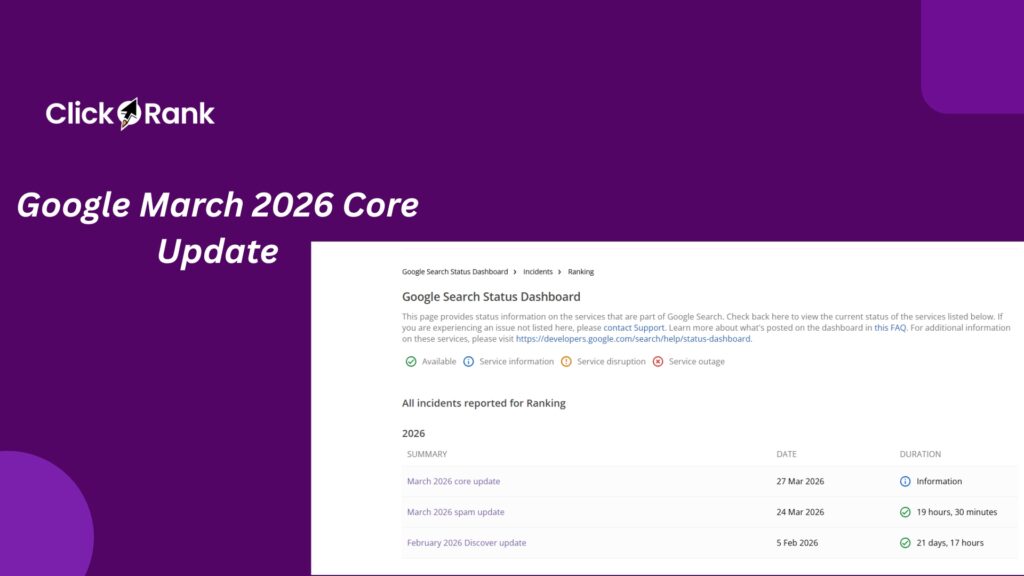
Modern core and spam updates are ongoing systems that constantly rebalance search results. They are not one-time events. Google uses them to reassess quality, trust, and relevance across the entire index.
These Google search algorithm changes explain why rankings shift even when nothing “breaks” on a site. Core updates reevaluate which sites deserve visibility, while spam updates remove manipulation before it spreads. Together, they keep search results clean and reliable.
In 2026 SEO, reacting to every update is a mistake. These systems run continuously. Sites built on strong content, trust, and experience usually stabilize after updates. Sites built on shortcuts lose visibility repeatedly. Understanding how modern SEO algorithm updates work helps you focus on long-term alignment instead of constant fixes.
Core Updates
Core updates are broad ranking recalibration systems that adjust how Google weighs existing signals. They do not target specific tactics or pages. Instead, they reassess quality across the web.
During a core update, Google performs quality re-weighting. Content depth, usefulness, experience, and authority are recalculated relative to competitors. This often causes visibility shifts without penalties.
Trust redistribution is the key effect. Sites with stronger long-term signals gain visibility, while weaker ones lose it. Recovery does not come from quick tweaks. It comes from improving overall content quality, topical authority, and trust alignment over time.
Spam Updates
Spam updates focus on manipulation detection and removing abusive practices from search results. They target link spam, hacked content, auto-generated pages, and scaled content abuse systems.
Modern spam updates use AI spam networks to detect patterns across many sites at once. This allows Google to suppress spam faster and more accurately than manual methods.
In 2026, spam updates act early in the ranking pipeline. Content or links flagged as manipulative are filtered before ranking begins. The best defense is clean SEO: natural links, original content, and real value. Once spam systems trigger, recovery is slow and uncertain.
Google Algorithm Systems (Not Updates)
Google no longer relies on isolated updates. Instead, it runs continuous algorithm systems that learn, adapt, and refine results every day. This shift explains why Google search algorithm changes now feel constant instead of tied to named updates.
In 2026, SEO algorithm updates are better understood as system adjustments, not switches being flipped. Ranking, spam detection, trust evaluation, and AI understanding all run together. When one system improves, rankings shift automatically.
This system-based model explains why chasing update dates no longer works. Visibility depends on how well your site aligns with Google’s long-term systems. Understanding these systems helps you diagnose issues correctly and build SEO strategies that stay stable through Google core updates instead of reacting to every fluctuation.
Ranking Systems vs Updates
Ranking systems are permanent engines that evaluate content, while updates are adjustments to how those systems weigh signals. Google no longer “updates” rankings in the old sense. It refines systems continuously.
This change explains why rankings fluctuate without announcements. Google tweaks relevance, quality, or trust models in real time. Waiting for update names delays action.
For modern SEO, this means optimization must align with systems, not updates. If content quality improves, systems reward it naturally. If trust weakens, visibility drops automatically. Understanding this difference helps you focus on long-term improvements instead of short-term reactions.
Why Google no longer “just updates” algorithms
Google stopped relying on isolated updates because search scale became too large. Static rules could not handle spam, language, and intent changes fast enough.Learning systems allow Google to improve results constantly. This reduces the need for disruptive updates and improves consistency.In 2026, most ranking changes happen quietly. SEO success comes from system alignment, not update timing.
Continuous learning systems model
Continuous learning systems adjust rankings based on new data. They learn from content patterns, user behavior, and spam signals over time.This model means rankings are never final. Improvement and decline are gradual, not sudden.Sites built on real value benefit long-term, while manipulative tactics decay automatically.
Retrieval Systems
Retrieval systems decide which pages are even eligible to rank or appear in AI answers. Many indexed pages never pass this stage.Google algorithm changes increasingly focus on retrieval quality. If your content is not selected here, ranking improvements will not matter.In 2026, retrieval determines visibility in AI Overviews and answer engines. Optimizing for retrieval is now as important as optimizing for ranking.
Source selection logic
Source selection logic filters pages based on relevance, authority, and usefulness. Only the strongest candidates move forward.Clear intent matching and topical depth improve selection chances.Weak or generic pages are excluded early.
Authority filtering
Authority filtering evaluates whether a source is credible within a topic. Past performance and consistency matter.This protects search results from unreliable sources.Authority compounds over time, making shortcuts ineffective.
Trust scoring
Trust scoring measures reliability, accuracy, and historical behavior. Sites with weak trust signals are suppressed quietly.This explains why some sites never recover after drops.Trust must be earned, not optimized overnight.
AI Systems
AI systems power understanding, summarization, and citation in modern search. They sit on top of ranking and retrieval layers.These systems reuse trust, quality, and relevance signals learned over years of updates.
In 2026 SEO, AI visibility depends on how well content supports these systems.
AI summarisation engines
AI summarisation engines generate answers using selected sources. Ranking position matters less than clarity and trust.Structured, factual content is favored.Fluff is ignored.
AI answer extraction systems
These systems extract precise answers from content. Clear sections and direct explanations perform best.Vague writing reduces extraction chances.Answer-first content improves visibility.
AI citation logic
AI citation logic decides which sources are credited. Trusted, authoritative pages are more likely to be cited.Citations replace clicks as a success metric.Being a source now matters more than being #1.
AI Search Transformation
AI search transformation means Google now answers questions instead of just listing links. Rankings still matter, but visibility is increasingly driven by AI systems that select, summarize, and cite content.
Google search algorithm changes in this phase focus on retrieval and understanding, not ten blue links. Pages can gain visibility without ranking first, and lose traffic even while “ranking.”
In 2026 SEO, success means adapting to AI-first discovery. If your content is not selected by AI systems, it will not appear in AI Overviews, AI Mode, or answer engines. This shift connects directly to our AI SEO pillar, where visibility, trust, and entity authority replace traditional ranking obsession. Understanding this transformation helps you optimize for how search actually works today.
Google Gemini’s role in modern search
Google Gemini acts as an AI layer that interprets queries, selects sources, and generates answers on top of traditional ranking systems. It does not replace Google Search. It enhances it.
Gemini analyzes intent, context, and follow-up meaning. It then pulls information from trusted sources instead of relying only on ranked lists. This is why some sites appear in answers without ranking highly.
For SEO, Gemini changes the goal. Content must be clear, factual, and trustworthy enough to be selected by AI. Optimizing only for keywords or positions is no longer enough. Gemini rewards content that explains topics well and fits into Google’s long-term trust systems.
AI layer above traditional ranking
The AI layer sits above classic ranking systems. It uses ranked and retrieved pages as inputs, then decides what information to use.This means ranking is a qualification step, not the final outcome. AI may skip top-ranked pages if they lack clarity or trust.
Retrieval-first SEO model
The retrieval-first model means content must be selected before it can be ranked or summarized. If retrieval fails, visibility is zero.Strong topical authority, structure, and trust increase retrieval chances.SEO now starts with retrieval, not rankings.
AI Overviews & AI Mode
AI Overviews and AI Mode present direct answers inside search results. Users get solutions without visiting websites.These systems pull from multiple trusted sources and summarize information instantly. Traffic is optional. Visibility is not.
For modern SEO algorithm updates, this means brands must optimize for being referenced, not just clicked. Content that explains clearly and accurately is more likely to be used in AI responses.
Why clicks are no longer required for visibility
AI answers reduce the need for users to click. Information is delivered directly in search.Your brand can still gain exposure through citations and mentions.Visibility now includes being part of the answer, not just the destination.
Brand visibility without ranking
Brands can appear in AI answers even without top rankings. Authority and clarity drive selection.This creates new SEO opportunities beyond position tracking.
Search without SERPs
Search without SERPs means users get answers directly from AI systems without seeing traditional result pages. Google search algorithm changes now prioritize answers, summaries, and guidance over lists of links.
This shift is driven by AI Overviews, Gemini, and conversational search. Google still uses ranking systems, but users often never reach them. Many searches end at the answer layer.
For 2026 SEO, this changes success metrics. Traffic alone is no longer the goal. Visibility, citation, and brand recall matter more. If your content is not optimized for answer extraction and AI retrieval, it may never appear, even if it technically ranks. Understanding search without SERPs helps you adapt SEO strategies to how users actually interact with search today.
Zero-click search ecosystem
The zero-click search ecosystem exists when users complete their task without clicking a website. AI answers, featured snippets, and knowledge panels power this behavior.Google designed this to improve speed and satisfaction. For many queries, visiting a page is unnecessary.
For brands, zero-click does not mean zero value. Being cited builds trust and awareness. In 2026, SEO strategies must aim for presence inside answers, not just traffic generation.
Answer engine optimisation (AEO)
Answer engine optimisation focuses on making content easy for AI systems to extract, trust, and present as answers. It goes beyond traditional SEO.AEO emphasizes clear structure, direct explanations, entity clarity, and factual accuracy. Content should solve specific questions cleanly.
In an AI-driven ecosystem, AEO improves visibility even without clicks. Optimizing for answers ensures your content is selected, summarized, and referenced by modern search engines.
How Algorithm Updates Actually Impact Rankings
Algorithms updates impact rankings by changing how Google evaluates trust, quality, and relevance across the entire index. Rankings move because Google recalculates value, not because sites are randomly penalized.
Google search algorithm changes usually affect visibility in layers. Some pages disappear without warnings, while others gain suddenly. This happens when systems rebalance signals learned over time.
In 2026 SEO, understanding impact matters more than tracking dates. Most SEO algorithm updates adjust weighting inside existing systems. If your site aligns with long-term quality and trust signals, fluctuations settle. If not, losses compound. This section explains what actually changes first and why reacting correctly depends on knowing which layer of the algorithm was affected.
What changes first after an update?
The first changes after an update happen behind the scenes, not in rankings. Google adjusts indexing, trust evaluation, and authority signals before visible position shifts occur.
This explains why traffic drops often feel sudden. Pages may be de-prioritized during retrieval before rankings update publicly. Many SEO failures happen because teams react too late.
In modern Google core updates, the earliest signals involve trust and authority reassessment. Fixing surface issues rarely helps. Understanding which internal layer changed allows you to respond with the right improvements instead of guesswork.
Index reshuffling
Index reshuffling happens when Google reevaluates how pages are stored and categorized. Some pages remain indexed but lose strength or relevance.This can cause pages to stop appearing for queries they once ranked for. No penalty occurs. Google simply reduces their weight.Improving clarity, structure, and topical relevance helps pages regain indexing strength over time.
Trust redistribution
Trust redistribution occurs when Google shifts visibility toward more reliable sources. Sites with weak signals lose exposure quietly.This often affects sites relying on outdated tactics. Trust is reallocated to stronger, consistent sources.Building credibility and experience is the only recovery path.
Authority recalibration
Authority recalibration adjusts how much influence a site has within a topic. Competitors may gain while you lose.This reflects relative strength, not absolute failure.Topical depth and consistency help restore authority after updates.
Why some sites recover and others die
Some sites recover after Google algorithm updates because their foundations align with long-term ranking systems. Others disappear because updates expose weaknesses that were already there. Recovery is rarely about quick fixes. It depends on whether Google’s systems still trust the site.
Google search algorithm changes reward sites with consistent quality, authority, and credibility. If a site loses rankings but still has strong trust signals, it often rebounds after recalibration. Sites built on shortcuts usually decline further with each core update.
In 2026 SEO, recovery speed depends on depth, not tactics. Sites with real expertise, clean structures, and strong brand signals are re-evaluated positively. Sites with thin content, weak authority, or manipulation history struggle because trust systems downgrade them permanently. Understanding this difference helps you invest in changes that actually lead to recovery instead of chasing temporary ranking spikes.
Structural trust
Structural trust comes from how a site is built and maintained. Clean architecture, clear internal linking, and logical topic grouping help Google understand and trust the site.
Sites with crawl issues, duplication, or chaotic structures send weak trust signals. Even good content struggles inside a broken structure.Strong structure supports long-term recovery because it improves crawling, indexing, and retrieval consistency.
Content authority
Content authority means owning a topic, not just publishing articles. Google rewards sites that cover subjects deeply and consistently.
Thin or scattered content fails during updates. Authoritative hubs recover faster.Building topical depth increases stability across core updates.
Link trust profile
A healthy link profile grows naturally over time. Spam-heavy or artificial links trigger suppression during updates.Google trusts links from relevant, authoritative sources. Quantity alone does not help.Cleaning link risk improves long-term survival.
Brand signals
Brand signals include recognition, mentions, and consistency across the web. Strong brands recover faster.Google trusts entities users recognize. Anonymous sites struggle.
SEO Strategy Model Aligned With Google’s Algorithm Evolution
An SEO strategy aligned with Google’s algorithm evolution focuses on systems, not tactics. Google search algorithm changes now reward sites that build long-term authority instead of chasing short-term wins.
From early link-based ranking to AI-driven retrieval, every era pushed SEO toward depth, clarity, and trust. In 2026, SEO algorithm updates favor sites that demonstrate expertise across topics, not isolated pages optimized for keywords.
This model shifts SEO from page-level tricks to site-wide strength. Content strategy becomes the core driver of visibility, AI selection, and ranking stability. When your content aligns with how Google’s systems evolved, updates stop feeling dangerous and start working in your favor. This section explains how to structure content so it survives core updates and performs in AI-first search.
Content strategy
A strong content strategy focuses on solving real user problems across an entire topic, not publishing disconnected articles. Google rewards sites that show consistency, depth, and usefulness over time.
Modern SEO algorithm updates evaluate content at a site level. One weak section can affect overall trust. That’s why content planning matters more than content volume.
In 2026, effective content strategy means building topic clusters, answering intent clearly, and updating content regularly. Pages should support each other, not compete. This approach improves indexing, retrieval, and AI visibility. When content works as a system, Google’s ranking systems treat the site as a reliable source instead of a collection of pages.
Topical authority building
Topical authority is built by covering a subject fully and consistently. Google trusts sites that answer all major questions within a topic.This reduces reliance on backlinks and protects rankings during updates. Authority compounds over time.
Semantic coverage
Semantic coverage means addressing related concepts, not repeating keywords. Google evaluates meaning, not phrasing. Covering subtopics improves intent matching and relevance.This aligns content with AI-driven understanding systems.
Entity-based SEO
Entity-based SEO focuses on clear subjects, brands, people, and concepts. Google understands entities better than pages.Consistent entity signals improve trust and context.Entity clarity boosts visibility in AI answers and summaries.
Trust strategy
A trust strategy focuses on proving reliability to Google’s systems over time, not just optimizing pages. Google search algorithm changes increasingly reward sites that show consistent trust signals across content, links, and brand presence.
In 2026 SEO, trust is evaluated continuously. Core updates and AI systems reassess whether a site deserves visibility based on credibility, history, and real-world signals. If trust is weak, rankings and AI visibility fade, even if content is relevant.
A strong trust strategy supports recovery, stability, and AI selection. It helps Google feel confident using your content in rankings, summaries, and citations. Trust is not built with one change. It is built through brand signals, authority recognition, and credible authorship that reinforce each other across the entire site.
Brand building
Brand building creates recognition beyond your website. Google trusts brands that users search for, mention, and recognize.
Consistent branding across the web strengthens entity signals. Mentions, reviews, and citations reinforce legitimacy.
Digital authority signals
Digital authority signals include backlinks, mentions, references, and visibility across trusted platforms. Quality matters more than volume.These signals show Google that others trust your site. They support rankings and AI selection.Authority grows gradually and compounds over time.
Author credibility
Author credibility shows who is responsible for content. Clear author profiles, experience, and expertise matter. Google prefers content created by identifiable, knowledgeable people. Anonymous content is less trusted.Credible authors improve E-E-A-T and long-term visibility.
Technical strategy
A technical strategy ensures Google’s systems can crawl, understand, and trust your site without friction. Google search algorithm changes now punish technical weakness faster because AI systems rely on clean data.
In 2026 SEO, technical issues do not just limit rankings. They block retrieval, AI selection, and visibility. A site can have great content and still fail if Google struggles to access or interpret it.
Modern SEO algorithm updates favor sites that are easy to crawl, clearly indexed, and logically structured. Technical strategy is no longer a checklist. It is the foundation that allows content, trust, and AI systems to work together. Without it, even strong brands lose visibility during core updates.
Crawlability
Crawlability determines whether Google can discover and revisit your content efficiently. Poor crawl paths waste crawl budget and delay updates.Clean internal linking and reduced duplication help Google focus on important pages.Good crawlability supports faster indexing and retrieval.
Indexation control
Indexation control means deciding what Google should index and what it should ignore. Not every page deserves visibility.Noindexing low-value pages improves overall site quality signals.Controlled indexing helps prevent trust dilution during updates.
Architecture SEO
Architecture SEO structures content into logical topic clusters. This improves understanding and authority signals.
Flat, organized structures perform better than deep, messy ones.Strong architecture supports topical authority and AI retrieval.
AI-SEO strategy
An AI-SEO strategy focuses on being selected by AI systems, not just ranked. Google’s AI layers now decide visibility before users see results.In 2026, SEO algorithm updates heavily affect AI retrieval and summarization. Content must be clear, structured, and entity-focused to qualify.
AI-SEO aligns content, technical setup, and trust so Google can confidently use your site in answers. This strategy ensures visibility even when clicks disappear and rankings matter less.
Retrieval optimisation
Retrieval optimization improves the chances your content is selected by AI systems. Clear intent matching and depth matter.Topical authority increases retrieval frequency.If retrieval fails, rankings are irrelevant.
AI visibility
AI visibility means appearing in summaries, answers, and citations. This requires clarity and trust.Well-structured explanations perform best.Visibility now extends beyond SERPs.
Entity indexing
Entity indexing helps Google understand who and what your site represents. Consistent entities improve context.Entities connect content across topics.Strong entity signals boost AI trust.
Structured data for AI
Structured data helps AI systems extract meaning faster. It clarifies entities, relationships, and intent.Schema improves answer extraction and citation.In AI-first search, structure amplifies visibility.
Future of Google Algorithm (2026+ Outlook)
The future of the Google algorithm is centered on AI systems that select, explain, and answer instead of just ranking pages. Google search algorithm changes are moving away from lists of results toward decision-making engines.
In 2026 and beyond, Google will rely more on retrieval, trust scoring, and entity understanding than traditional ranking factors. Core updates will feel less dramatic but more continuous. Visibility will depend on how well content supports AI understanding and user satisfaction.
For SEO, this means strategy must evolve. Ranking positions alone will not define success. Being trusted, cited, and referenced by AI systems will matter more. Sites that adapt to this future early will gain stable visibility, while those stuck in old models will fade as search becomes more answer-driven.
Where Google search is heading
Google search is heading toward AI-first experiences where systems decide the best answers before users see results. Rankings still exist, but they support AI selection, not user choice.
Google search algorithm changes increasingly prioritize understanding intent, context, and reliability. Systems will favor sources that consistently demonstrate expertise and clarity.
In 2026 SEO, this shift means content must be built for interpretation, not just discovery. If AI cannot understand or trust your content, it will not be surfaced. Aligning with this direction prepares sites for long-term visibility beyond traditional SERPs.
AI-first ranking
AI-first ranking means AI systems influence which content is considered valuable before traditional ranking applies. Retrieval and trust filters act first.This reduces volatility and spam. Quality becomes a baseline must optimize for AI understanding, not just signals.
Answer engines replacing search engines
Answer engines deliver direct solutions instead of links. Google is evolving into a decision platform.Users expect instant answers. Clicking is optional.SEO success shifts toward being the source AI relies on, not the destination users visit.
SEO after rankings
SEO after rankings focuses on being seen, trusted, and remembered instead of chasing top positions. As Google search algorithm changes push answers to the surface, rankings become a background signal rather than the main goal.
In 2026 SEO, success is measured by whether your content appears in AI answers, summaries, and citations. A page can rank lower but still gain more visibility than a top-ranked page if it is selected by AI systems. This shift forces SEO to move from competition for clicks to competition for relevance and trust.
Modern SEO algorithm updates reward sources that AI can confidently reference. If your brand, content, and entities are clear, visibility continues even when traffic drops. SEO is no longer about positions. It is about being part of the answer ecosystem.
Visibility over position
Visibility means appearing where users look first, even without a ranking number. AI answers and summaries dominate attention.Being referenced matters more than ranking first.Visibility builds authority in AI search.
Presence over traffic
Presence focuses on consistent exposure, not raw visits. AI citations and mentions still influence users.Traffic may decline, but impact can grow.SEO goals must adapt to this reality.
Brand recall over clicks
Brand recall happens when users remember your name from answers. Trust grows through repetition.Clicks are optional. Recognition is not.
From Algorithm Chasing to System Thinking
Modern SEO has shifted from reacting to Google updates toward building systems that align with how search actually works. Google search algorithm changes are now continuous, making update-chasing ineffective.
In 2026 SEO, success comes from system thinking. Google evaluates sites across trust, quality, authority, and AI understanding at all times. Waiting for named updates means reacting too late. Sites that win are designed to perform well regardless of algorithm shifts.
This mindset reduces volatility and builds durable visibility. Instead of fixing drops, you prevent them. Understanding Google algorithm updates history shows that long-term alignment always outperforms short-term tactics. System thinking turns SEO into a predictable growth model instead of a cycle of panic and recovery.
Why modern SEO is no longer about updates
Modern SEO is no longer about updates because Google no longer changes search in isolated moments. Systems learn and adapt constantly.
Google core updates simply rebalance existing signals. They do not introduce new rules overnight.
In 2026, chasing updates wastes resources. Aligning with systems builds stability and compounding results.
System-based SEO mindset
A system-based SEO mindset treats SEO as an ecosystem, not a checklist. Content, technical SEO, trust, and AI visibility work together.Weakness in one area affects the whole system.Strong systems recover naturally after updates.
Trust-based optimisation
Trust-based optimisation focuses on credibility, experience, and consistency. Google rewards reliable sources over time.Trust grows slowly but protects rankings.Shortcuts erode trust permanently.
Authority engineering
Authority engineering builds expertise and recognition intentionally. It is not accidental.Topical depth, brand signals, and quality links reinforce authority.
What is a Google algorithm update?
A Google algorithm update is a change made to Google’s ranking system to improve how search results are evaluated and delivered to users. These updates aim to provide more relevant, helpful and trustworthy search results by refining how Google interprets content, quality, user experience and spam signals. Major updates often change how websites rank in search results.
How often does Google update its algorithm?
Google makes changes to its algorithm hundreds of times every year, but most are minor and unnoticed. Significant updates that affect rankings like core updates or spam updates happen periodically and can cause noticeable shifts in search results.
What is a Google core update and why does it matter?
A Google core update is a broad change to the main ranking system that affects how content quality, relevance and trust are evaluated. Unlike small tweaks, core updates can shift rankings across many industries and content types, so SEO strategies often need to be reassessed after these rollouts.
What are some of the most important Google algorithm changes in history?
Important Google algorithm changes include Panda (targeted low-quality content), Penguin (reduced link spam), Hummingbird (semantic search), Mobilegeddon (mobile-friendly ranking), and recent Helpful Content systems that reward user-first content quality. These updates reshaped how search evaluates relevance and quality over time.
How can I tell if my website was hit by a Google algorithm update?
If your organic traffic drops significantly after a known algorithm rollout especially core or spam updates it may indicate a ranking impact. SEO tools that track SERP volatility around update dates can help confirm if your ranking changes coincide with a Google update.
What should I do if my website is affected by a Google update?
Focus on high-quality, user-focused content, follow Google’s Webmaster Guidelines, improve site trust signals and user experience, and fix technical SEO issues. After major updates, reassess weaknesses like thin content, poor relevance or spammy signals improvements there often help recovery.