There is something almost anticlimactic about the end of a core update rollout.
For twelve days, rankings were shifting. Traffic was fluctuating. Every time you opened Search Console, something had moved. You told clients not to panic. You told yourself not to panic. You watched the volatility trackers hit 9.5 out of 10 and tried to focus on the long game.
And then on April 8, at 6:12 AM Pacific time, it stopped.
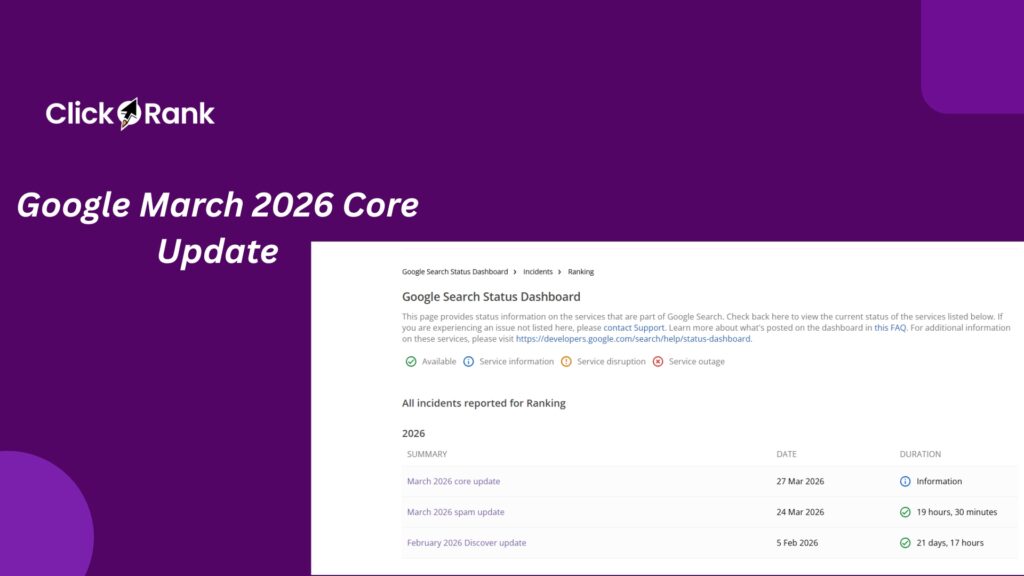
Google posted a single line to the Search Status Dashboard: “The rollout was complete as of April 8, 2026. ‘ No blog post. No specific guidance. No list of what changed. Just that one line confirming that the first broad core update of 2026 was finished.
Now the real work starts. Because while everyone was watching the rollout, the actual question, “What do I do now that it’s over?” is the one most content does not answer well. This article tries to.
|
12 days 4 hrs — Total rollout duration (March 27 – April 8) |
9.5/10
SEMrush Sensor peak volatility score during rollout |
55%+
of monitored websites saw ranking changes |
3
separate Google updates in a single 6-week window |
Three Updates in Six Weeks—That Has Never Happened Before
The March 2026 Core Update did not arrive in isolation. It was the third major algorithm event in under six weeks:
- February 5–27: The Discover Core Update Google’s first-ever update scoped exclusively to Google Discover. It ran for 22 days, rewarded locally relevant content, and penalized clickbait in Discover feeds.
- March 24–25: The March 2026 Spam Update was completed in under 20 hours. That is the fastest spam update rollout in Google’s dashboard history. It targeted manipulative link schemes, thin affiliate content, and sites violating spam policies.
- March 27 – April 8: The March 2026 Core Update The first broad core update of 2026. Affected all languages, all industries, all regions globally.
The back-to-back sequencing matters for your diagnosis. If your traffic dropped, you need to know which update caused it. A spam update hit and a core update hit require completely different responses. I will cover how to separate them below.
What Made This Update Different
Glenn Gabe, one of the most careful observers of Google algorithm impact, noted something interesting in his monitoring during the rollout: this update felt less powerful than some recent ones. The December 2025 Core Update landed hard and fast this one was less explosive overall.
That does not mean nothing changed. Across the 40+ sites I was monitoring, the pattern was consistent: sites with strong topical authority, original content, and clean technical foundations either held their positions or gained modestly. Sites with mass-produced content, weak E-E-A-T signals, or heavy reliance on unedited AI content dropped some significantly.
What Google described as ‘a regular update designed to better surface relevant, satisfying content’ was, in practice, another step in a consistent direction it has been moving for 18 months. The bar for what it means to be the ‘most helpful result’ is getting higher with every update.
The First Thing to Do — Nothing (For Now)
I know that sounds counterintuitive when you are staring at traffic charts that look different from two weeks ago. But Google’s guidance is clear, and I think it is right: do not draw firm conclusions from data until at least a full week after rollout completion.
That puts your analysis window at April 15 at the earliest. Why?
- Some ranking changes during a rollout reverse naturally as the algorithm settles; what looked like a permanent drop may partially recover on its own
- The Spam Update (March 24–25) and Core Update (March 27) overlap in the data; any rankings changes between March 24 and April 8 could potentially belong to either update, and the cause matters for the fix
- Early data are noisy; sites frequently see temporary volatility that normalises within 7–10 days of rollout completion
How to Diagnose What Happened to Your Site
Once April 15 arrives and you have a stable data window, here is the exact diagnostic process I run on every site after a core update.
Step 1 — Confirm Which Update Hit You
Open Google Search Console → Performance → Search Results. Set your date range to compare:
- Before: February 1 – March 23 (clean pre-update baseline)
- After: April 15 onwards (stable post-update data)
Now look at the onset date of any traffic or impression changes. If your decline started March 24–25, the spam update is the likely cause. If it started March 27 or later, the Core Update is the likely cause. If you see two separate drops — one around March 24 and one around March 27 — you may have been hit by both.
This distinction matters because the fix is different. Spam Update recovery requires a review of your link profile and spam policies. Core Update recovery requires improvements to content quality and E-E-A-T a longer-term process.
Step 2 — Identify Which Pages Moved
Do not look at sitewide traffic first. Core updates typically affect specific pages or content clusters, not the entire domain uniformly. In GSC Performance, click the Pages tab and sort by the change in clicks between your two date windows.
Look for patterns in the pages that declined:
- Are they all in the same topic category? Suggests a topical authority issue Google is now ranking a competitor with deeper coverage on that topic.
- Are they all thin or short pages? Suggests a content depth issue these pages are not satisfying the full query intent.
- Are they all pages without named authors? Suggests an E-E-A-T issue especially for YMYL topics where credentials matter significantly.
- Are they pages with high impressions but always low CTR? It may not be a core update issue it could be a meta description problem that predates this update.
Step 3 — Check Your Winners Too
Do not only look at what dropped. Look at which pages gained visibility after the update. The pages that improved tell you what Google is now rewarding. Those are your models. Whatever those pages have that your declining pages do not that is your roadmap.
In my monitoring across client sites, the pages that gained consistently shared one characteristic: they contained information or perspectives that were not available on any other page ranking for the same query. Original data, first-hand case study results, and specific implementation examples from real work. Information that is earned, not aggregated.
What the Update Actually Rewarded and Penalised
Based on ranking movement analysis across the sites I monitored, these patterns were consistent enough to be actionable.
What Gained Rankings
- Sites with deep topical authority comprehensive coverage of a focused subject area, not broad coverage of many unrelated topics
- Content with genuine information-gain articles adding original data, first-hand experience, or unique perspectives not found in competing results
- Pages with named, credentialed authors and visible E-E-A-T signals in the content itself — not just at the domain level
- Sites with clean Core Web Vitals across their most important pages: LCP under 2.5 seconds, INP under 200ms, CLS under 0.1
- Content that was recently updated with fresh data and a visible last-updated date
What Lost Rankings
- Mass-produced AI content without meaningful human editorial oversight traffic drops of 60–80% reported by JetDigitalPro across their tracked dataset of 600,000 pages
- Thin content on high-competition topics pages where the primary content is a repackaging of information already available in the top 5 results
- Sites with fragmented topical identity covering 10 unrelated topics shallowly rather than 2–3 topics with genuine depth
- Pages relying on domain authority to carry individual weak pages the Core Update appears to have strengthened page-level evaluation independent of domain signals
- YMYL content with anonymous authorship or generic author bios that do not demonstrate actual expertise
| Content Type | March 2026 Core Update Impact |
| Original research + data + first-hand experience | Strong gains |
| AI-assisted + heavy human editing + genuine expertise | Stable or modest gains |
| AI-drafted + light editing + generic content | Moderate losses |
| Mass-produced AI content, no editorial oversight | Significant losses (60–80% per JetDigitalPro data) |
| Thin pages on competitive topics | Dropped — replaced by more comprehensive competitors |
| YMYL content with verified author credentials | Stable or gains |
| YMYL content with anonymous or generic authorship | Losses, especially in health/finance/legal |
Now That It Is Over — Your 5-Step Action Plan
The rollout being complete is not a reason to panic-edit everything. It is a reason to start a deliberate improvement process that positions you well for the next core update, expected in June or July 2026. Here is how I approach it.
Action 1 — Wait, Then Conduct a Proper Audit (April 15+)
Let the data stabilise through April 15. Then conduct a structured content audit using the diagnostic process above. Identify which pages declined, why (content quality, E-E-A-T, topical gap, technical issue), and prioritise improvements by commercial importance fix your highest-traffic and highest-conversion pages first.
Action 2 — Apply the Information Gain Test to Every Declining Page
For each page that dropped, ask one question: is there anything on this page that a user could not find by reading the top 3 results for this query?
If the answer is no, that page has a content quality problem that meta tag optimisation or internal linking will not fix. It needs substantive editorial improvement original examples, first-hand data, specific implementation details, unique perspectives that only come from genuine experience.
This is the hardest work. But it is the only work that produces durable recovery.
Action 3 — Fix E-E-A-T at the Page Level, Not Just the Domain Level
If your declining pages are in YMYL categories or competitive professional topics, check every one of them for page-level trust signals:
- Named author with relevant credentials visible on the page not buried on an About page
- First-person experience signals in the content specific examples from actual work
- Primary source citations link to the original research, not a blog that summarised it
- Last-updated date for any content with statistics or time-sensitive information
- Author’s professional profile link LinkedIn, industry publications, verifiable credentials
Action 4 — Build Your Topical Clusters
The update reinforced a pattern that has been consistent since 2024: sites with deep topical coverage on a focused subject consistently outperform sites with shallow coverage across many subjects.
If your declining pages belong to a topic area where your site has only one or two articles, you have a topical authority gap. The fix is not to rewrite the existing pages it is to build the supporting cluster that signals comprehensive expertise on that topic.
Use ClickRank’s internal linking tool to identify the topical connections you already have, and prioritise building the content that fills the most important gaps.
Action 5 — Fix Technical Issues That Create Eligibility Gaps
Before content quality can save a page, the page needs to be technically eligible properly indexed, crawlable, with acceptable Core Web Vitals. Run a fresh audit in ClickRank after the rollout:
- Check the Page Indexing report for any new ‘Not Indexed’ entries that emerged during the rollout
- Run Core Web Vitals in GSC address any pages that moved from ‘Good’ to ‘Needs Improvement’
- Check your Top Query Per Page report identify pages with high impressions but missing keywords in title or description, and optimise
- Review any pages with significant ranking drops for schema markup gaps structured data helps AI Overviews and traditional rankings simultaneously
What This Means for Recovery Timeline
I want to be direct about something that often gets glossed over in core update analysis: recovery takes longer than most people want it to.
Technical Recovery — Faster
Core Web Vitals fixes, schema implementation, and robots.txt issues can produce improvements within 4–8 weeks. These are signals Google re-evaluates relatively quickly. If a technical issue was preventing a good page from ranking, fixing it can show results before the next core update.
Content Quality Recovery — Slower
Meaningful improvements to content quality adding original data, improving E-E-A-T signals, building topical authority clusters are typically recognized at the next major core update. The June/July 2026 update is where you want your improvements to be in place. That gives you roughly 10–12 weeks to do substantive editorial work.
The practical implication: do not wait for the June update to start. The improvements you make in April and May are the improvements that position you well when Google recalibrates again.
| Improvement Type | Expected Recognition Timeline |
| Core Web Vitals fixes | 4–8 weeks |
| Schema markup implementation | 2–4 weeks (recrawl dependent) |
| Meta title/description optimisation | 2–4 weeks (ClickRank deploys instantly) |
| E-E-A-T signals added to existing pages | Next core update (June/July 2026) |
| Topical cluster content published | Next core update (June/July 2026) |
| Content with information gain improvements | Next core update (June/July 2026) |
The Bigger Picture — What This Update Is Telling Us
I said at the start of this article that there is something anticlimactic about a rollout ending. But I actually think the completion of the March 2026 Core Update is more significant than it appears.
Three major algorithm events in six weeks is not normal. Google has been running at a pace of quality enforcement that is faster and more layered than anything we have seen since the early Panda/Penguin era. The February Discover update, the fastest spam update in history, and now a core update that affected over half of monitored sites all within six weeks.
That pace is telling us something. Google is not making incremental adjustments. It is accelerating the pace at which it distinguishes between content that genuinely helps users and content that is simply optimised to appear helpful.
The brands and sites that are growing organic visibility in 2026 are not the ones chasing each algorithm change. They are the ones that built genuine expertise, wrote from real experience, and created content ecosystems that signal deep topic mastery. The March 2026 Core Update rewarded those sites again.
It will reward them again in June. The question is whether your site is building toward that or away from it.
Is the March 2026 Core Update really finished?
Yes. Google confirmed completion on April 8, 2026, at 6:12 AM PDT via the Search Status Dashboard. The rollout lasted exactly 12 days and 4 hours. Rankings may still experience minor adjustments as systems continue to process changes, but the primary rollout phase is complete.
My traffic dropped how do I know if it was the Core Update or the Spam Update?
Check your GSC Performance data for the onset date of your decline. If it started March 24–25, it is likely the Spam Update. If it started March 27 or later, it is likely the Core Update. If you see two separate declines at both dates, you may have been impacted by both. The fixes are different: Spam Update requires reviewing your link profile and spam policies; Core Update requires content quality and E-E-A-T improvements
When is the right time to start making changes?
Wait until at least April 15 before drawing conclusions from your data. Then begin your content audit and prioritise improvements. Technical fixes like schema and Core Web Vitals can be implemented immediately. Content quality improvements should be planned for the June/July 2026 update cycle; that is the next window where substantive improvements are likely to be recognized.