
What Is Search Intent in Content SEO and Why Does It Matter?
Understanding search intent is not just a best practice in modern SEO; it is the fundamental core of creating content that actually works. If you miss the mark on what a user is truly trying to accomplish when they type a query into a search engine, your beautifully written article, no matter how detailed, will struggle to rank and engage. Search intent acts as the blueprint for content success, moving us beyond simple keyword matching to address the underlying need or goal of the person searching. Ignoring this crucial element means you are essentially playing a game of content roulette, hoping your content will accidentally satisfy the user’s need. But successful SEO is not about luck; it’s about precision. By prioritizing search intent—the “why” behind the query—we move from being mere content creators to becoming problem solvers for our audience, which is precisely what search engines are designed to reward. This deep alignment between user need and content delivery is what separates top-performing pages from the rest.
What Is Search Intent and Why Is It Essential for Content SEO?
The journey to effective content marketing begins and ends with correctly identifying search intent. It is the non-negotiable first step in creating any high-performing piece of content. Without a clear understanding of the user’s motivation, content becomes a shot in the dark, leading to high bounce rates and poor visibility. When we talk about search intent in the context of content SEO, we are looking to bridge the gap between a keyword (the “what”) and the user’s ultimate goal (the “why”). This focus ensures every piece of content serves a distinct purpose, moving the user closer to a solution, an answer, or a purchase. High-quality content is defined less by its length and more by its ability to perfectly match the user’s underlying intention.
How Do Experts Define Search Intent in Modern SEO?
Experts define search intent as the primary goal a user has in mind when typing a query into a search engine. It’s the user’s purpose. Is the person looking to find an answer (informational), navigate to a specific website (navigational), make a purchase (transactional), or research a product/service before buying (commercial investigation)? The core challenge for SEO professionals is to correctly interpret the cryptic signals within a keyword phrase to uncover this underlying motivation. It’s a shift from optimizing for words to optimizing for human psychology. Recognizing the nuances between these intent types is critical for content creation, as a piece of content optimized for one intent will almost certainly fail to satisfy another. For example, an article optimized to explain what search intent meaning is will look very different from a page designed for someone ready to buy an SEO tool.
Why Does Search Intent Influence Ranking Priorities?
Search intent heavily influences Google’s ranking priorities because the primary mission of any search engine is to deliver the most relevant, satisfactory result to the user, as quickly as possible. If a page fails to meet the user’s intent, the search engine has failed its core duty. Google’s algorithms are sophisticated enough to analyze the top-ranking pages for a given query to infer the dominant search intent and then prioritize content that conforms to that inferred intent. If the SERP is filled with product comparison articles, Google assumes the intent is commercial investigation, and a simple definition page, regardless of its authority, will struggle to rank. This is why a thorough SERP analysis, particularly checking what the currently ranking pages are, is the most reliable way to check search intent for any given keyword. It provides a direct view into what Google has already determined to be the most satisfying result type.
How Does Google Interpret Search Intent Signals Today?
Google interprets search intent signals through a variety of advanced mechanisms, including its Natural Language Processing (NLP) capabilities, its core ranking algorithms like BERT and MUM, and, crucially, through user behavior data. The engine doesn’t just look at the words; it analyzes the context, the modifier words (like “buy,” “review,” “definition”), and the collective engagement signals from previous users who clicked on a result. If users are clicking on a result, spending a good amount of time on the page, and not immediately returning to the SERP (a low pogo-sticking rate), it signals to Google that the content successfully matched their search intent. Google is constantly refining its understanding, making it essential for content creators to always be thinking about the user’s journey. Understanding search intent in seo is fundamentally about understanding how Google measures user satisfaction.
What Factors Help Search Engines Detect User Intent?
Several factors help search engines accurately detect user intent. The most obvious is the keyword modifier (e.g., “how to,” “best,” “coupon,” “near me”). The structure of the SERP itself, including the presence of featured snippets, Knowledge Panels, or shopping carousels, is also a huge signal. Beyond the query itself, user behavior metrics are powerful and provide ongoing feedback. These include:
- Click-Through Rate (CTR): A high CTR suggests the title and description effectively matched the user’s expected search intent.
- Time on Page/Dwell Time: The longer a user stays engaged, the more likely the content satisfied their need.
- Bounce Rate: A rapid return to the SERP (high bounce rate) strongly suggests an intent mismatch.
- Query Chains: Analyzing the sequence of queries a user makes can reveal a complex, evolving intent.
By monitoring these signals, search engines continually refine their model of what constitutes a perfect match for any given query, making it harder for content that doesn’t align with search intent to succeed.
Why Is Search Intent the Foundation of High-Performance Content SEO?
Search intent is the bedrock upon which all high-performance content SEO strategies are built. A strategy that ignores intent is fundamentally flawed because it prioritizes getting clicks over providing real value. High-performance content aims not just to rank but to satisfy the user so completely that they do not need to return to the search results. This level of satisfaction builds the authority and trust that directly feeds back into higher rankings and better domain authority. The meticulous process of identifying search intent for every target keyword ensures that resources are never wasted on creating content that is destined to fail because it doesn’t align with what users are looking for. It is the key differentiator for content that generates leads, drives sales, and establishes long-term organic authority.
How Does Understanding User Intent Enhance Content Relevance?
Understanding user intent is the single most effective way to enhance content relevance. Relevance is about more than just mentioning the keyword; it’s about addressing the core problem or question that the keyword represents. If the search intent is informational—say, for “what is search intent meaning”—the most relevant content will be a detailed, easy-to-digest guide or definition, not a sales pitch for an SEO tool. By correctly identifying the intent, you know precisely the format, depth, and tone the content needs to adopt. This focus ensures that from the title to the conclusion, the content delivers exactly what the user expected when they clicked on the result, thereby maximizing relevance and minimizing user frustration.
How Does Search Intent Affect Crawlability and Indexability?
While search intent doesn’t directly dictate technical crawlability (which is handled by sitemaps and robot.txt), it profoundly affects how search engines categorize and prioritize the indexing of your content. When a search engine’s algorithm analyzes a page, it attempts to classify the page’s purpose (e.g., “Is this a product page? A blog post? A comparison guide?”). If the content structure, meta tags, and internal linking align clearly with the inferred search intent of the target keyword, the engine can more easily and confidently categorize the page. This clear classification improves the page’s indexability for relevant queries and allows the engine to associate it correctly with its intent cluster, preventing it from being indexed as a generic, unhelpful page. This is part of the reason why properly structured content that mirrors the user’s informational needs is so crucial.
Why Does Intent-Focused Content Improve Dwell Time?
Intent-focused content dramatically improves dwell time because the user is immediately greeted with the solution they were searching for. Dwell time is the amount of time a user spends on your page before either returning to the SERP or navigating away. A mismatch in search intent—such as clicking on a definition-focused article only to find a list of products—causes immediate “pogo-sticking” (a high bounce rate combined with a quick return to the SERP) and signals poor quality to Google. Conversely, content perfectly tailored to the user’s intent, whether it’s a step-by-step tutorial for “how to check search intent” or a direct purchase link for a product, captures the user’s attention and keeps them engaged until their need is satisfied. This positive user signal is one of the strongest ranking factors, reinforcing the idea that search intent optimization is essentially optimization for user satisfaction.
What Are the Main Types of Search Intent and How Do They Work?
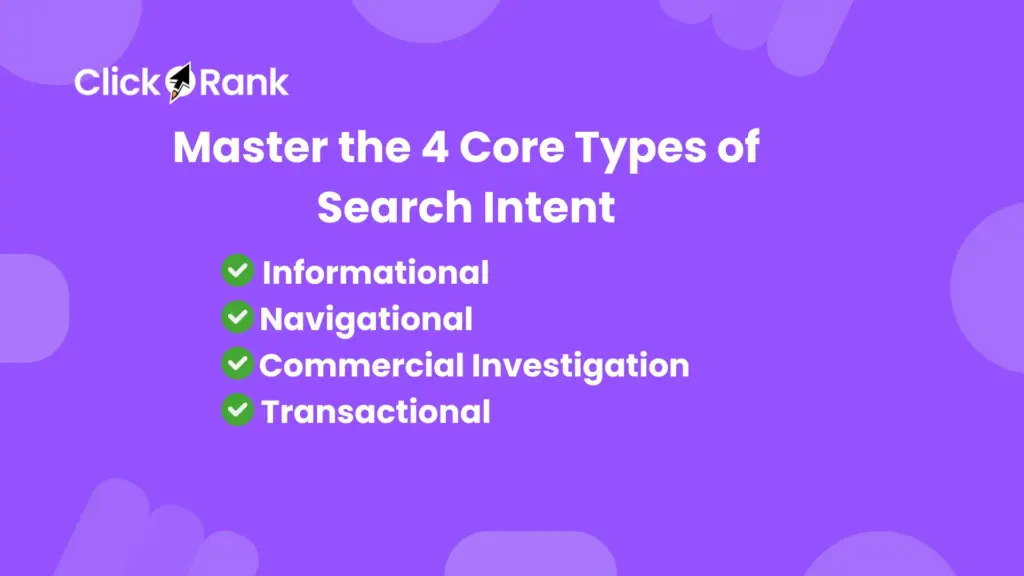
To master search intent analysis, SEOs categorize user queries into four primary types. These categories are not rigid boxes but rather a framework for understanding the user’s mental state and progression through the consumer journey. Each type—Informational, Navigational, Transactional, and Commercial Investigation—requires a completely different content approach, format, and optimization strategy. Correctly classifying a target keyword into one of these types is the pivotal decision that dictates the success or failure of the content piece. Understanding these core search intent tools is necessary to organize your entire content ecosystem.
What Is Informational Search Intent and When Does It Occur?
Informational search intent occurs when a user is looking to learn something, find an answer to a question, or understand a concept. This is the “awareness” stage of the funnel. Queries often revolve around “what is,” “how to,” “why,” or simple facts. The user is in research mode and is not yet ready to buy anything; they are seeking knowledge. This type of intent is characterized by a desire for comprehensive, neutral, and educational content. Examples include “what is search intent meaning,” “how to cook pasta,” or “why is the sky blue.” For an SEO expert, recognizing this intent means knowing that the content must be authoritative, detailed, and structured for easy learning, often utilizing long-form text, tutorials, and deep guides, which can be easily achieved when you check search intent and find an informational SERP.
What Content Formats Best Serve Informational Intent?
The content formats that best serve Informational search intent are those that prioritize education and clarity. These formats are generally long-form and aim to be the definitive resource on a topic.
- Long-Form Articles and Guides: These allow for deep exploration of complex topics.
- “How-To” Tutorials and Step-by-Step Instructions: Perfect for users seeking to complete a task.
- FAQs and Knowledge Base Articles: Excellent for answering specific, common questions quickly.
- Visual Content (Infographics, Educational Videos): Aids in explaining complex concepts.
The key is completeness. The user should leave the page feeling they have gained the full answer they sought, which is why focusing on an article that addresses all facets of search intent in seo is vital.
How Do Users Behave When Seeking Informational Content?
When seeking informational content, users typically exhibit behavior that suggests a long-term commitment to learning. They tend to scroll deeply, bookmark the page, and might navigate to related internal links (e.g., related cluster pages) for further reading. They are generally tolerant of longer load times if the content promises significant value. A satisfied user will spend a long time on the page and may share the article on social media. Conversely, if the content is too shallow or immediately jumps into a sales pitch, the user will quickly bounce back to the search results, a strong signal of a search intent mismatch to Google.
What Is Navigational Search Intent and Why Does It Matter?
Navigational search intent is the simplest type: the user is trying to find a specific website or web page. They already know where they want to go, but they are using the search engine as a convenient shortcut. Examples include “Gmail login,” “Amazon,” or “Apple customer service.” This intent is highly specific and often includes a brand name. For an SEO professional, this intent matters because while you generally cannot rank your site for another brand’s navigational query, it’s crucial for your own brand terms. You must ensure your own website’s pages—the homepage, contact page, or key product pages—rank instantaneously and prominently for your brand’s navigational terms. When you check search intent for your own brand name, the search result must be dominated by your properties.
What Signals Indicate That a Keyword Is Navigational?
The clearest signal that a keyword is navigational is the presence of a brand name or a highly specific, unique product name (e.g., “Google Analytics login,” “clickrank.ai pricing”). Other signals include:
- Absence of modifiers: Queries are often short, like “Twitter” or “Walmart.”
- High expected CTR on the top result: Users are looking for the one specific site.
- Branded sitelinks in the SERP, which Google uses to help the user navigate the site directly from the search page.
Navigational queries usually have very low competition from other, non-brand websites, confirming that the dominant search intent is to reach a known destination.
How Does Google Recognize Brand-Driven Queries?
Google recognizes brand-driven queries primarily through historical user behavior and the keyword itself. If a query consistently results in 90%+ of users clicking on the same specific domain, Google learns that the search intent is navigational for that domain. It then prioritizes that domain for the top result and often presents large, prominent sitelinks and a Knowledge Panel for the brand. This recognition is why it is difficult to compete with a major brand on their navigational terms, as Google is simply providing the single most satisfying result based on the collective behavior of millions of previous users.
What Is Transactional Search Intent and What Makes It Powerful?
Transactional search intent is when the user is ready to take a final action—to buy, sign up, or download. This is the “conversion” or “bottom-of-funnel” stage. The user is past the research phase and is actively looking for the place to complete the transaction. Keywords are highly specific and often contain modifiers like “buy,” “price,” “coupon,” “sale,” or “download.” This intent is powerful because it represents immediate revenue opportunity. A page targeting this intent, such as one optimized for “buy SEO search intent tools,” must be a product page or a dedicated landing page designed purely for conversion, with minimal distraction and a very clear path to checkout. This type of content requires meticulous attention to the sales process.
How Can Product Pages Serve Transactional Intent Better?
Product pages are the optimal choice to serve Transactional search intent because they are designed to facilitate the final step: the purchase. To serve this intent better, product pages must:
- Display Price and Availability Clearly: The user is ready to buy and needs this information instantly.
- Feature Prominent, Unambiguous CTAs: The “Add to Cart” or “Buy Now” button must be the page’s focal point.
- Include Strong Social Proof: Reviews, ratings, and security badges build immediate trust.
- Minimize Distractions: Avoid navigational elements or related blog posts that might pull the user away from the conversion goal.
By focusing on clarity and conversion, the page perfectly matches the user’s search intent to transact.
Why Do CTAs Matter in Transactional Intent Keywords?
Call-to-Action (CTA) elements are paramount for Transactional search intent because the user is actively seeking the final step. A poorly designed or hidden CTA creates friction and results in a lost sale, even if the user has found the right product. The CTA must align with the user’s expected action. If the intent is “download,” the CTA should say “Download Now” and not “Learn More.” Effective CTAs for transactional keywords are:
- Action-Oriented: Use verbs like “Buy,” “Get,” “Sign Up.”
- Urgency-Based (where appropriate): “Limited Time Offer,” “Complete Order.”
- Visually Dominant: Contrasting colors and placement ensure they are immediately seen.
The CTA is the fulfillment of the user’s explicit search intent.
What Is Commercial Investigation Intent and How Is It Identified?
Commercial Investigation search intent is the bridge between informational and transactional intent. The user is actively researching a product or service with the intent to buy soon, but they are currently in the comparison or evaluation phase. Keywords are often characterized by modifiers like “best,” “top 10,” “review,” “vs,” “comparison,” or specific model numbers. This type of search intent is identified by a user’s need for neutral, in-depth evaluation to inform a future purchase. For instance, a user searching for “best search intent tools 2024” or “Tool A vs. Tool B” is engaged in commercial investigation. Content targeting this intent must be balanced, honest, and facilitate a confident decision.
What Kind of Content Matches Commercial Comparison Queries?
The content that matches commercial comparison queries must be comprehensive, structured, and objective. The goal is to facilitate the user’s decision-making process.
- Comparison Posts: Direct “A vs. B” articles with clear pros and cons.
- In-Depth Reviews: Unbiased, detailed assessments of a single product.
- “Best of” Lists: Curated rankings of top products in a category, often using comparison tables.
- Detailed Case Studies: Showing real-world results using a product.
This content serves the dual purpose of satisfying the user’s need for information and subtly guiding them toward a preferred solution by thoroughly covering the topic of search intent meaning within the context of the tools.
Why Do “Best” and “Vs.” Queries Fit This Intent Type?
The presence of “best,” “vs.,” “review,” or similar terms directly signals a user’s intent to evaluate options before committing money. “Best” implies a desire for a curated list and comparison, while “vs.” explicitly states the need for a head-to-head comparison. These users are typically highly qualified leads because their search intent is unequivocally commercial. They are no longer asking “what is it” but are asking “which one should I buy,” placing them closer to the bottom of the marketing funnel than users with purely informational intent. This makes understanding how to check search intent for these phrases immensely valuable for lead generation.
How Can You Identify Search Intent Accurately in SEO?
Accurately identifying search intent is the most critical skill for a modern SEO content writer. It moves the process from guesswork to strategic execution. The most reliable method is not guessing what a keyword might mean, but rather observing what Google believes the keyword means, as evidenced by the SERP itself. This is done through meticulous SERP analysis, recognizing the power of keyword modifiers, and analyzing real-world user behavior data. Using these search intent tools in combination provides a robust framework for intent classification and content planning.
How Can SERP Analysis Help You Understand Search Intent?
SERP (Search Engine Results Page) analysis is your window into Google’s current, definitive understanding of a query’s search intent. By examining the top 10 organic results, the presence of specific SERP features, and the titles/formats of the ranking pages, you can reverse-engineer the dominant intent.
- Content Format: Are the top results predominantly listicles, product pages, deep guides, or forums? The recurring format tells you what type of content satisfied past users.
- Title Tags and H1s: Do they contain words like “definition,” “buy,” “review,” or “official website”? These signal the page’s purpose and the user’s expected outcome.
- Diversity of Results: A mix of results (e.g., a few informational and a few commercial) might indicate a mixed intent query, requiring content that attempts to satisfy both primary needs.
This simple yet powerful technique to check search intent eliminates assumptions and grounds your content strategy in verifiable data.
Why Are Featured Snippets a Strong Signal of Informational Intent?
Featured Snippets—the summary boxes that appear at the top of the SERP—are one of the strongest indicators of Informational search intent. Google displays a Featured Snippet when it believes a single, concise answer or clear list can satisfy the user’s query immediately. These snippets often appear for “what is,” “how to,” and “definition” queries (e.g., “what is search intent meaning”). Their presence signals that the content format should be a quick-to-read, definitive answer, often structured as a paragraph, list, or table, making the content easy for Google to extract and display. Seeing a Featured Snippet means you should structure your content to directly and concisely answer the implied question near the top of the article.
Why Do Shopping Ads Reveal Transactional Intent?
The presence of Shopping Ads (Product Listing Ads) at the top of the SERP is a clear and undeniable signal of Transactional or strong Commercial Investigation search intent. Google only serves these high-cost, product-specific ads when it has a high degree of confidence that the user is in a buying state of mind. Queries that trigger Shopping Ads almost always include product names, models, or modifiers like “buy,” “for sale,” or “price.” If the SERP includes a Shopping Carousel, your content should not be an informational blog post; it should be a product page or a highly conversion-focused landing page designed to capture that immediate purchase intent. This is one of the most reliable ways to instantly check search intent for commercial viability.
How Can Keyword Modifiers Reveal User Intent?
Keyword modifiers—the words added to the core head term—are explicit linguistic clues to the user’s search intent. These small, often-overlooked words fundamentally change the meaning and purpose of a query. Identifying and segmenting your keywords based on these modifiers is a fundamental part of effective keyword research and intent mapping, and it allows for much more granular content planning and targeting in your On-Page SEO strategy.
Why Do Words Like “How,” “Why,” and “When” Suggest Informational Intent?
Words such as “how to,” “why,” “what is,” and “when” are direct linguistic markers of an educational or informational need. They signal that the user is trying to learn, understand a process, or grasp a concept.
- “How to…” suggests a need for a step-by-step tutorial or guide.
- “Why…” indicates a need for an explanation or rationale.
- “What is…” demands a clear definition (like “what is search intent in seo”).
Content targeting these modifiers must prioritize educational clarity and depth. The user is in “learner” mode, and the content must adopt a helpful, instructional tone, using clear headings and logical flow to satisfy the informational search intent.
What Modifiers Indicate Buying or Comparison Behavior?
Modifiers that indicate buying or comparison behavior are the signposts of Commercial Investigation and Transactional intent. These are the keywords that bring you closest to a conversion.
- Transactional Modifiers: “buy,” “coupon,” “discount,” “price,” “cheap,” “download,” “sign up.”
- Commercial Investigation Modifiers: “best,” “review,” “top,” “vs,” “alternative,” “comparison,” “list.”
When you find a keyword with these modifiers, you know the content must serve a decision-making or conversion purpose. You’ll need to use persuasive language, strong calls to action, and objective data (reviews, comparisons) to guide the user’s final decision, which is a necessary part of the comprehensive set of search intent tools in a content writer’s arsenal.
How Does User Behavior Data Support Intent Detection?
User behavior data, often gathered through Google Analytics or Search Console, provides the necessary validation for your initial assumptions about search intent. The way users interact with your existing pages and competitors’ pages is the ultimate feedback loop for how well you have matched the intent. If a page is getting thousands of clicks but has a 90% bounce rate, the traffic is meaningless—the title and meta description promised one thing, but the content failed to deliver on the user’s true intent. Using these metrics allows you to move beyond theory and confirm or refute your hypotheses on what the user truly wants.
How Can Bounce Rate Help You Validate Intent Mismatch?
A high bounce rate is often the most glaring signal of an search intent mismatch. If a user clicks a result and immediately returns to the SERP (pogo-sticking), it means the content did not meet their expectation. For example, if a user searches for “search intent tools” (Commercial Investigation/Transactional) and lands on a purely theoretical article on the “search intent meaning,” the high bounce rate tells you the content failed. Bounce rate validation requires you to go back and reassess the SERP, analyze your page’s format, and ensure the content type (e.g., listicle vs. product page) aligns perfectly with the dominant intent shown by the highest-ranking pages.
Why Is Time-on-Page a Reliable Intent Signal?
Time-on-Page, or dwell time, is a reliable positive signal of satisfied search intent. If a user spends five to ten minutes reading your article, it suggests the content was engaging, in-depth, and successfully answered their question or guided their decision. For informational content, a long time-on-page is the gold standard. For transactional content, a short time-on-page followed by a conversion (moving to the next page, like checkout) is the positive signal. In contrast, a low time-on-page paired with a quick exit is a strong negative signal, even if the bounce rate isn’t 100%, indicating that the page did not fully meet the user’s expectation or only partially addressed their need regarding a complex topic like search intent in seo.
How Does Search Intent Shape Content Strategy and SEO Planning?
Search intent is not a post-writing optimization; it is the strategic starting point for all content and SEO planning. Building a content strategy around intent means you are prioritizing the user experience and the most valuable keywords, ensuring every piece of content has a strategic place in the overall topical architecture. It dictates which topics get written, the format they take, and how they are internally linked. A solid foundation built on correctly identified search intent is what allows a website to build true topical authority.
Why Should You Build a Content Strategy Around Search Intent?
Building a content strategy around search intent ensures that your content addresses every stage of the customer journey, from initial awareness (Informational) to final purchase (Transactional). It prevents the common pitfall of only creating content for one stage (e.g., only informational blog posts) and missing out on high-value commercial and transactional opportunities. By organizing your strategy around the user’s motivation, you create a cohesive and conversion-focused path. This methodical approach ensures that every piece of content has a high chance of ranking because it meets the fundamental criteria for success: absolute relevance to the user’s needs.
How Does Intent Prioritization Improve Keyword Targeting?
Intent prioritization dramatically improves keyword targeting by forcing you to categorize keywords by their potential value and placement in the funnel. Instead of simply targeting high-volume keywords, you prioritize keywords that show clear Commercial Investigation or Transactional search intent, as these lead directly to revenue. Informational keywords are then targeted to build authority and capture top-of-funnel traffic, which can later be channeled to the high-value pages. This allows for a more focused allocation of resources, ensuring that the highest-impact keywords (those with clear transactional intent) receive the highest quality content. It moves your SEO efforts from a volume game to a value game.
How Does Intent Mapping Optimize Topic Clusters?
Intent mapping is crucial for optimizing topic clusters because it ensures that each supporting “cluster” article serves a unique and non-overlapping purpose, all while feeding authority back to the Pillar Page. In a cluster focused on On-Page SEO, the Pillar Page might target the broad informational query “On-Page SEO.” The cluster articles would then be mapped to specific sub-intents, such as:
- Informational: “what is search intent meaning”
- Commercial Investigation: “best search intent tools”
- Transactional: “On-Page SEO checklist download”
This explicit intent-based mapping prevents keyword cannibalization, where two pages target the same intent and compete for the same ranking, ensuring that the content ecosystem is logically structured and authoritative for every aspect of search intent in seo.
How Does Search Intent Influence Content Structure and Format?
Search intent is the primary driver of content structure and format. The structure of a page should directly reflect the quickest, most satisfying way to deliver the answer or solution the user is seeking. A user with Informational intent needs clear headings and educational depth, while a user with Transactional intent needs prominent product details and conversion elements. Misaligning the structure with the intent—for example, writing a long, discursive article for a transactional query—is a guarantee of low engagement and poor conversion. The structure must be optimized for the specific type of user experience the intent demands.
How Does Intent Determine the Best Heading Layout?
The heading layout (H-tags) must be tailored to the user’s search intent.
- Informational Intent: Requires descriptive, question-based H2s and H3s (“Why does search intent matter?”, “How to check search intent?”) to guide the user through a logical learning path.
- Transactional Intent: Headings should focus on value proposition, urgency, and benefits (“Features,” “Customer Reviews,” “Special Offer,” “Ready to Buy?”).
- Commercial Investigation Intent: Headings should be comparison-focused (“Pros vs. Cons,” “Pricing Breakdown,” “Tool A vs. Tool B”).
The heading layout should instantly confirm to the user (and to Google) that the page structure matches their query’s purpose.
Why Does Intent Affect Paragraph Length and Depth?
Search intent directly influences paragraph length and the necessary depth of content.
- Informational Content: Often requires deeper, more comprehensive paragraphs to fully explain complex concepts, such as a detailed explanation of “what is search intent in seo.” The length is justified by the need for authority.
- Transactional Content: Paragraphs should be short, punchy, and benefit-driven, focusing on persuasion and quick facts. The user is ready to buy and doesn’t want to wade through dense text.
- Navigational Content: Paragraphs are often minimal, focusing only on the necessary description to confirm the user is in the right place.
Matching paragraph style to intent ensures the content is easily consumable by the target audience, regardless of whether they are learning or buying.
How Does Search Intent Guide Content Distribution Channels?
Understanding search intent is also critical for choosing the right content distribution channel. The channel needs to align with where the user expects to find that specific type of information or experience. Distributing transactional content on a purely educational platform or informational content on a high-pressure sales platform will lead to poor results, proving that the method of distribution is as important as the content itself.
Why Does Informational Content Work Best in Blogs and Guides?
Informational search intent is best served in channels like blogs, long-form guides, and knowledge bases because these platforms are inherently designed for education, exploration, and building authority. Users seeking to learn are expecting a neutral, non-sales environment. Placing detailed guides and tutorials that explain concepts like “what is search intent meaning” on a blog establishes your expertise and allows you to capture top-of-funnel traffic that can be nurtured over time. The expectation of a blog is content depth, making it the perfect match for the user’s informational need.
How Does Transactional Intent Fit Better in Landing Pages?
Transactional search intent fits perfectly in dedicated landing pages, product pages, and checkout flows. These pages are architecturally designed to minimize distraction and maximize conversion. Users with this intent are not looking for a lengthy article; they are looking for the path to purchase. A landing page ensures the entire layout, from the headline to the CTA, is focused entirely on the transaction, providing an optimal user experience for immediate conversion. For keywords like “search intent tools purchase,” a product landing page is non-negotiable.
How Do You Match Content to User Intent Effectively?
Matching content to user intent is the process of translating your intent analysis into a tangible, high-performing page. It goes beyond the words themselves to encompass the structure, the features, and the ultimate goal of the content. Effective matching requires deliberate choices about the content type, structure, and supporting elements to satisfy the user’s “why” with precision. When you successfully align content with search intent, you create a page that Google’s algorithm is eager to rank.
What Content Types Best Match Informational Intent?
Informational search intent requires content types that prioritize education, authority, and comprehensive coverage. The user needs to feel fully informed, and the content must provide a level of depth that answers not only the primary query but also likely follow-up questions. This focus on long-form, educational content is the backbone of establishing E-E-A-T (Experience, Expertise, Authoritativeness, and Trustworthiness) for any topic.
Why Do Long-Form Articles Perform Well for Informational Queries?
Long-form articles perform exceptionally well for Informational search intent because they allow for the comprehensive treatment of a complex topic, such as a deep dive into the evolution of search intent in seo. When a user has a complex question, a superficial answer is unsatisfying. A detailed, 3,000+ word guide can:
- Cover every facet of the topic, leaving no stone unturned.
- Build authority by demonstrating deep expertise.
- Include rich internal links to supporting cluster content, improving topical coverage.
- Provide multiple opportunities for Google to extract featured snippets and rich results.
The length is a by-product of the necessary depth to satisfy the user’s learning goal.
How Can Tutorials and FAQs Satisfy Informational Needs?
Tutorials and FAQs are excellent tools to satisfy specific informational needs within a broader topic. Tutorials address the “how-to” search intent, providing step-by-step guidance that is highly practical and immediately actionable. FAQs, on the other hand, are perfect for addressing common, short-tail questions quickly and efficiently, often appearing as structured data results on the SERP. Both formats allow content creators to target niche informational long-tail queries, making the overall cluster more authoritative and ensuring that every possible informational sub-query is addressed within your site’s architecture. These are essential search intent tools for building out a detailed knowledge base.
What Content Types Fit Commercial Investigation Intent?
Commercial Investigation search intent requires content that is balanced, comparative, and highly detailed, focusing on helping the user make a confident pre-purchase decision. The content must act as a trusted advisor, not a salesperson. This is the moment to showcase expertise and trustworthiness by providing objective data and side-by-side comparisons for products, helping users determine the best search intent tools for their needs.
Why Do Comparison Tables Increase Trust and Engagement?
Comparison tables are highly effective for Commercial Investigation search intent because they visually and concisely present the key data points required for decision-making. Users comparing products (like “Tool A vs. Tool B”) want to see features, pricing, pros, and cons side-by-side without having to jump between multiple web pages. This format:
- Increases Trust: By presenting objective, easy-to-verify data.
- Increases Engagement: By making the decision-making process quick and frictionless.
- Reduces Bounce Rate: The user’s specific need for comparison is instantly met.
A well-structured comparison table is often the perfect content match for a “vs.” query, proving you truly understand the user’s search intent.
How Do Buying Guides Support Decision-Making Intent?
Buying Guides are crucial for supporting the Commercial Investigation intent associated with broad categories (e.g., “best laptops for students”). They address the user’s need for advice before they have settled on a specific product. A strong Buying Guide:
- Educates the user on what features matter (combining informational and commercial intent).
- Segments products by use case, budget, or level of expertise.
- Provides clear recommendations, guiding the user to the next logical step (the transactional page).
By providing this structured decision-support, you position your content as the authoritative resource, capturing the user just as they are ready to convert.
What Content Types Work Best for Transactional Intent?
Transactional search intent requires content types that are singularly focused on conversion. The user has made the decision and needs a clear, seamless path to completion. All design, copy, and structural elements must be streamlined to facilitate the final action, whether it is a purchase, a sign-up, or a download. Distractions are the enemy of transactional intent.
Why Are Product Pages Crucial for Conversion Intent?
Product Pages are crucial for Conversion search intent because they provide the necessary infrastructure for the transaction: a shopping cart, payment gateway integration, and inventory management. Unlike a blog post, a product page’s sole purpose is the sale. They must clearly display:
- The product image and description.
- The price and availability.
- The prominently placed “Add to Cart” or “Buy Now” button.
- Security and return policy assurances.
Any keyword that suggests a readiness to purchase must land the user directly on a product page or a dedicated service page to perfectly match their search intent.
How Do Offer Pages and Coupons Sharpen Transactional Content?
Offer Pages and coupons sharpen Transactional search intent by providing the final incentive to convert. When a user searches for a specific coupon code or a deal (e.g., “search intent tools coupon”), their intent is clear: they want the product at a discount. The content must directly deliver the promised offer. Offer pages are highly specific landing pages that:
- Lead with the discount or special offer.
- Have a hyper-focused, immediate call-to-action.
- Have an element of urgency (e.g., a countdown timer).
These pages perfectly match the user’s specific transactional intent for a value-based purchase.
How Does Search Intent Improve Keyword Research and Mapping?
Search intent transforms keyword research from a simple volume exercise into a strategic planning process. By integrating intent into the initial research phase, you ensure that every keyword selected has a high potential to convert or build authority effectively. This structured approach to intent identification and mapping is vital for preventing content dilution and building a cohesive, powerful site structure that search engines can easily understand and reward.
Why Should Keyword Research Start with Intent Identification?
Keyword research must start with search intent identification because it establishes the true value and required content format for every single keyword before content creation even begins. Starting with volume or difficulty alone is misleading; a high-volume keyword with ambiguous or mixed intent can be a resource trap. By identifying the intent first, you know precisely:
- The Content Type: Is it a blog post or a product page?
- The Conversion Potential: Is it a high-value transactional keyword or a low-value informational keyword?
- The Competition: What is the dominant intent the top competitors are serving?
This intent-first approach ensures that resources are allocated to keywords with the highest potential return on investment, which is a key part of leveraging advanced search intent tools.
How Does Intent Filtering Reduce Keyword Cannibalization?
Intent filtering is highly effective at reducing keyword cannibalization, a common SEO pitfall. Cannibalization occurs when multiple pages on your site target the same keyword and, crucially, the same search intent. For example, two different blog posts both targeting the informational query “what is search intent meaning” will compete against each other. By applying intent filtering, you ensure:
- One Primary Page per Intent: Only one page is designated to target a specific keyword/intent pairing.
- Intent Differentiation: You can map one page to the informational intent and another to the commercial investigation intent for similar terms (e.g., “search intent meaning” vs. “best tools to check search intent”).
This systematic segmentation ensures that every page serves a unique purpose and has a clear ranking opportunity.
Why Does Intent Improve Keyword Grouping Accuracy?
Intent improves keyword grouping accuracy by providing a logical, user-focused framework for clustering related terms. Keywords that share the same search intent and topic should be grouped together and addressed on a single, comprehensive page, or across a specific, tightly interlinked cluster. For example, all informational keywords related to “On-Page SEO” and search intent in seo would be grouped under the “Informational Intent Cluster.” This approach ensures that the content is as semantically rich as possible, addressing all related sub-queries without creating unnecessary or competing pages.
How Should You Map Keywords Based on Search Intent?
Keyword mapping based on search intent is the process of assigning every keyword to a specific piece of content, based on its purpose in the user journey. The map becomes the core operational blueprint for the content team. The map should clearly label each keyword with its identified intent (I, N, T, C) and assign it to a specific URL and content format. This provides clarity and prevents content creators from misinterpreting a keyword’s true purpose.
How Does Intent Mapping Prevent Content Overlap?
Intent mapping prevents content overlap by explicitly stating the intent that each piece of content is designed to satisfy. If the map shows a clear distinction—for instance, Page A targets “what is search intent meaning” (Informational) and Page B targets “buy search intent tools” (Transactional)—it is impossible for the two pages to overlap in content, format, or goal. This clarity eliminates the guesswork and ensures that every new content idea must first be mapped to an unaddressed search intent within the site’s architecture.
Why Does Intent Mapping Strengthen Topic Clusters?
Intent mapping strengthens topic clusters by creating a deliberate, hierarchical flow of authority and user progression. The Pillar Page addresses the broad, often Informational, head term. The cluster pages then address the specific sub-intents (Commercial, Transactional, etc.). The internal linking structure is then designed to move users logically through these intent stages, channeling authority from the informational content toward the higher-value transactional pages. This flow makes the entire cluster a powerful, semantically connected entity that dominates the search results for the entire topic area.
How Can You Build a Keyword Funnel Based on Intent Stages?
Building a keyword funnel based on intent stages is the most effective way to align your SEO strategy with the sales and marketing funnels (TOFU, MOFU, BOFU). This approach ensures that you are capturing traffic at every stage of the user’s journey and guiding them logically toward conversion. The funnel is built using the four intent types as the distinct stages.
How Does Intent Support TOFU, MOFU, and BOFU Planning?
Intent is the direct link to the TOFU, MOFU, and BOFU stages:
- TOFU (Top of Funnel): Dominated by Informational Search Intent (e.g., “what is search intent meaning”). The goal is awareness and education. Content includes guides and blog posts.
- MOFU (Middle of Funnel): Dominated by Commercial Investigation Intent (e.g., “best search intent tools”). The goal is evaluation and comparison. Content includes reviews and comparison guides.
- BOFU (Bottom of Funnel): Dominated by Transactional Search Intent (e.g., “buy search intent tools now”). The goal is immediate conversion. Content includes product pages and special offer pages.
This clear intent-to-funnel mapping ensures that your content is always providing the right message at the right time.
Why Do Funnels Improve Organic Conversions?
Intent-based funnels dramatically improve organic conversions because they eliminate the content mismatch that causes users to drop out. A user is never served a sales pitch when they are looking for information, nor are they served a long article when they are ready to buy. By guiding the user with intent-aligned internal links from a high-authority informational page to a high-conversion transactional page, you create a seamless and natural user journey that maximizes the probability of conversion. This systematic approach is far more effective than hoping a generic blog post will accidentally drive sales.
How Does Search Intent Affect On-Page SEO Optimization?
Search intent is the invisible hand that guides all effective On-Page SEO optimization. It dictates not just the content itself but the technical elements like H-tags, meta descriptions, and internal linking structure. Optimizing these elements to reflect the identified search intent signals to both the user and the search engine that the page is the perfect match for the query. A misalignment in any of these areas can cause a high-quality page to fail because it is sending mixed or incorrect signals about its purpose.
How Should You Adjust H-Tags to Align with Search Intent?
H-tags are not just for structure; they are critical signaling tools for search intent. They must align with the user’s need. The H1 should be the ultimate, clear promise to satisfy the user’s intent. The subsequent H2s and H3s should provide a logical path toward that satisfaction, whether it is a learning path (informational) or a buying path (transactional).
Why Do Question-Based H-Tags Improve Informational SEO?
Question-based H-tags (e.g., H2: “How can I check search intent?”) are highly effective for Informational search intent because they precisely reflect how a user thinks and searches. These tags:
- Improve Clarity: The user can instantly scan the page to find the specific question they need answered.
- Increase Featured Snippet Potential: They perfectly frame the answer required for a question-based snippet.
- Boost Engagement: By acknowledging the user’s exact query in the structure.
Using questions in your H-tags for informational content creates a highly user-friendly and search-engine-friendly structure.
How Does Intent Affect H1 Structure?
The H1 tag is the most important on-page signal of search intent. It must immediately confirm to the user that they have found what they were looking for.
- Informational H1: Should be a title that promises a definitive guide or explanation (e.g., “The Ultimate Guide to Search Intent Meaning and Analysis”).
- Transactional H1: Should feature the product name and a clear value proposition (e.g., “Buy [Product Name] – 25% Off Today”).
- Commercial H1: Should be comparison-focused (e.g., “Top 5 Search Intent Tools: In-Depth Comparison”).
A generic H1 for a page with clear transactional intent is a guarantee of a high bounce rate.
How Does Search Intent Influence Meta Tags and Snippets?
Meta titles and descriptions are the first points of contact between your content and the user, and their primary job is to satisfy and confirm the user’s search intent before the click. A compelling meta snippet that misrepresents the content’s true intent will result in a high click-through rate but a catastrophic bounce rate. Therefore, meta tags must accurately reflect the page’s purpose and format, as dictated by the identified intent.
Why Should Meta Titles Reflect User Intent?
Meta titles should reflect user intent because they are the single biggest driver of Click-Through Rate (CTR) from the SERP. The title is the promise.
- Informational Title: Promises an answer (“Answered: What Is Search Intent in SEO?”).
- Transactional Title: Promises a deal or product (“Buy [Product Name] Now | Official Store”).
- Commercial Title: Promises a definitive comparison (“Best Search Intent Tools for 2024 | Reviews & Pricing”).
By integrating the specific intent into the title, you pre-qualify the user, ensuring that only users with the correct search intent click through, thereby improving CTR quality.
How Does Intent Affect CTR Optimization?
Intent affects CTR optimization by ensuring that the meta description and title align with the user’s mental model of what a satisfying result should look like for their query. For example, a user searching for a comparison knows that a good result will mention “review,” “vs.,” or “best.” By including these keywords and promising the correct content format in the meta description (e.g., “See our in-depth comparison table…”), you maximize the likelihood of a high-quality click-through. A well-optimized snippet based on search intent acts as an assurance that the user’s search goal will be met.
How Can Internal Linking Support Intent Matching?
Internal linking is one of the most powerful and often underutilized search intent tools. It is the connective tissue of your content ecosystem, and its purpose should be to guide the user (and Google) through the logical progression of their intent journey. Intent-aligned internal linking helps build a cohesive topical model that clearly demonstrates the site’s authority.
How Does Intent-Aligned Linking Improve Topic Authority?
Intent-aligned internal linking improves topic authority by creating a clear, intentional link graph where lower-funnel, intent-specific pages (e.g., transactional) receive link authority from higher-funnel, broader informational pages. When an article explaining “what is search intent meaning” links to a page detailing “best search intent tools,” Google sees a logical flow of information that covers the topic comprehensively and guides the user toward a solution. This structure signals deep topic expertise and strengthens the overall authority of the cluster.
Why Should Internal Links Reflect Funnel Stage?
Internal links should explicitly reflect the funnel stage and the next logical search intent step.
- Informational Page (TOFU): Links should go to other related informational pages or MOFU (Commercial Investigation) comparison guides.
- Commercial Investigation Page (MOFU): Links should go directly to BOFU (Transactional) product pages.
- Transactional Page (BOFU): Links should point to checkout pages or confirmation pages, minimizing links back to purely informational content.
This deliberate linking creates a user flow that perfectly matches the buyer’s journey, maximizing the chance of converting traffic acquired through organic search.
How Does Search Intent Impact User Experience and Engagement?
Search intent is inextricably linked to User Experience (UX) and engagement metrics. A successful page is one where the user feels no friction and immediately finds what they need. This seamless experience is directly achieved by matching the page layout, visual hierarchy, tone, and style to the user’s underlying search intent. Good UX, driven by intent, is what produces the positive user signals—low bounce rate, high dwell time—that algorithms prioritize.
How Does Intent Influence Page Layout and Visual Hierarchy?
Search intent should be the primary factor influencing page layout and visual hierarchy. The page layout must prioritize the elements that the user is most urgently seeking.
- Informational Layout: Prioritizes readability, clear headings, table of contents, and minimal distracting sidebars. The primary content is front and center.
- Transactional Layout: Prioritizes product imagery, the CTA button, and pricing. Descriptive text is often minimized, and conversion elements dominate the top fold.
The visual hierarchy ensures that the elements most critical to satisfying the user’s intent (e.g., the definition paragraph, the “Buy Now” button) are the most prominent on the page.
Why Should Pages Load Different UI Elements Based on Intent?
Pages should load different UI (User Interface) elements based on intent because different intents require different tools.
- Informational Intent: May require UI elements like a sticky table of contents, pop-ups for related guides, or a subscription form for further learning.
- Transactional Intent: Requires conversion-focused UI elements like a secure checkout button, trust badges, a prominent display of the limited-time offer, or a clear “size/color selector.”
Trying to fit a complex informational UI onto a clean transactional page creates friction, resulting in a poor experience and a strong signal to Google that the search intent has been poorly executed.
How Does Intent Affect CTA Placement?
CTA placement is entirely dependent on search intent.
- Informational CTA: Placed discreetly at the end of the article or after a major section, focused on a soft conversion (e.g., “Download this free guide on search intent in seo”).
- Transactional CTA: Must be in the top fold, often repeated as the user scrolls, and designed to capture immediate interest (e.g., “Add to Cart”).
- Commercial Investigation CTA: Placed immediately following the comparison table or at the end of a product review, guiding the user to the recommended solution.
Proper CTA placement ensures that the content fulfills the final, desired action implied by the user’s query.
How Does Intent Affect Content Tone and Writing Style?
The content’s tone and writing style must adapt to the user’s psychological state, which is determined by their search intent. A mismatch in tone can instantly alienate a user, even if the information is technically correct. A user looking to buy needs confidence and urgency, while a user looking to learn needs patience and expertise.
Why Does Informational Intent Require Clear, Educational Language?
Informational search intent requires clear, educational, and authoritative language. The tone should be one of a knowledgeable expert or teacher—helpful, objective, and patient. The writing style should prioritize clarity and depth over salesmanship. Overly promotional language in an informational article (e.g., a guide on “what is search intent meaning”) immediately erodes trust and signals a poor match for the user’s learning goal, leading to a high bounce rate.
How Does Transactional Intent Require Persuasive Messaging?
Transactional search intent requires highly persuasive, confident, and action-oriented messaging. The tone should be one of urgency and assurance. The writing style focuses on benefits, solving immediate pain points, and building confidence in the purchase decision. Language should be short, punchy, and focused on value (e.g., “Stop wasting time. Get the best search intent tools today.”). The content is selling a solution, and the tone must reflect that high-stakes, conversion-focused environment.
Why Is Search Intent Critical for Reducing Bounce Rate?
Search intent is critical for reducing bounce rate because a high bounce rate is almost always a sign of a mismatch between the user’s expectation (formed by the search query and the SERP snippet) and the reality of the page content. By flawlessly aligning the content type, structure, and tone to the intent, you instantly satisfy the user upon arrival. If a user finds exactly what they were looking for—the definition, the comparison, or the purchase option—they have no reason to “pogo-stick” back to the search results, resulting in a low bounce rate and a positive signal to Google.
How Does Intent Matching Increase Session Duration?
Intent matching increases session duration (Time-on-Page) by ensuring the content is engaging and relevant from the first word. For informational queries, a perfect intent match results in the user reading deeply into the comprehensive answer. For commercial investigation queries, it results in the user spending time analyzing the comparison tables and review details. If a page fails to satisfy the user’s primary search intent within the first few seconds, they will leave, meaning a direct and accurate intent match is the only reliable mechanism for maximizing session duration and demonstrating content quality.
Why Does Intent Improve User Satisfaction Signals?
Intent improves all user satisfaction signals—dwell time, low bounce rate, and high CTR—because it fundamentally solves the user’s problem. A satisfied user will not only spend more time on the page but is also more likely to click internal links, share the content, and potentially convert. Google’s algorithms are primarily designed to measure and reward user satisfaction. Therefore, a focus on perfect search intent alignment is, by proxy, a strategy for optimizing the user satisfaction signals that underpin top organic rankings.
How Does Search Intent Connect to Topic Clusters and Pillar Pages?
The Topic Cluster model, the most advanced way to structure a website, is powered entirely by search intent. The pillar and the clusters are simply different pieces of content, each optimized for a distinct search intent, all working together to establish domain-wide authority on a core subject. Intent is the organizing principle that links all these pages together, ensuring that the entire site architecture is semantically rich, easy for Google to understand, and highly effective for guiding the user through the funnel.
Why Is Search Intent Essential in Building Pillar–Cluster Architecture?
Search intent is essential in building the Pillar–Cluster architecture because it defines the role of every page in the system. The Pillar Page targets a broad, high-volume keyword with predominantly Informational intent, providing a high-level overview (e.g., a guide on “On-Page SEO”). The cluster pages then target highly specific, lower-volume, often Commercial Investigation or Transactional queries (e.g., “best search intent tools” or “buy search intent tools”). This clear division of labor, based on intent, ensures that the structure is comprehensive, authoritative, and non-cannibalistic.
How Does Intent Strengthen the Authority of the Pillar Page?
Intent strengthens the authority of the Pillar Page because the cluster pages, each targeting a specific sub-intent, provide deep, focused coverage of the subtopics. When the Pillar Page links to dozens of highly specific, intent-aligned cluster pages (using appropriate anchor text), it demonstrates to Google that the Pillar Page is the most comprehensive resource on the core topic. The collective authority generated by satisfying every possible search intent around a subject is channeled back to the Pillar Page, greatly enhancing its overall E-E-A-T and ranking potential for the broad head term.
Why Does Intent Improve Cluster Interlinking?
Intent improves cluster interlinking by providing a logical, user-centric flow for links. Instead of random links, the interlinking structure moves the user from a general, informational search (Pillar Page) to a specific, action-oriented search (Cluster Page). This linking is done with clear anchor text that reflects the transition in intent (e.g., anchor text “compare search intent tools” linking from the Pillar Page to the Commercial Investigation Cluster Page). This logical, intent-driven linking structure is what makes a topic cluster so effective at building a semantically strong content hub.
How Do Cluster Pages Support Different Search Intent Levels?
Cluster pages are designed to support different search intent levels by addressing the granular needs of the user that the broad Pillar Page cannot satisfy in detail. For example, a Pillar Page on “Search Intent” might briefly define the four types of intent. The cluster pages then provide a deep dive into each one: one cluster page on “what is search intent meaning” (Informational), another on “best search intent tools” (Commercial Investigation), and so forth. Each cluster is a deep, authoritative dive into a distinct sub-intent of the core topic.
Why Should Each Cluster Page Target Only One Intent Type?
Each cluster page should strictly target only one search intent type to prevent content cannibalization and ensure maximum ranking focus. A page that attempts to be both an informational guide and a transactional product page will satisfy neither intent well and will fail to rank highly. By dedicating a page to a single intent (e.g., only Informational for “how to check search intent”), you can perfectly tailor the content, structure, and tone for that specific user need, maximizing the chances of ranking for that long-tail keyword and reinforcing the topic cluster’s authority.
How Does Intent Prevent Content Dilution Across Clusters?
Intent prevents content dilution by clearly defining the boundaries of each cluster. Content dilution occurs when the same topic is covered multiple times across different clusters with similar intent. Intent mapping ensures that a piece of content on “best marketing tools” (Commercial Intent) is clearly separated from a piece on “how to use marketing tools” (Informational Intent), even if they use similar head terms. This separation, based on the search intent, maintains the integrity and focus of each cluster, making the overall site architecture robust and easy for search engines to process.
How Does Search Intent Improve Semantic Relevance in Topic Clusters?
Search intent is a powerful lever for improving semantic relevance within topic clusters. Semantic relevance is about the contextual meaning and relationship between words and concepts. By organizing content around intent, you group semantically related concepts (e.g., “what is search intent meaning,” “why search intent is important,” “how to check search intent”) under the broader umbrella of “Search Intent,” showing Google the depth of your knowledge.
Why Does Intent Create More Contextual SEO Signals?
Intent creates more contextual SEO signals because a cluster of pages, each perfectly aligned with a specific search intent, provides Google with hundreds of highly focused, context-rich keywords and phrases. For example, the collection of keywords (e.g., “comparison,” “review,” “best,” “pricing,” “vs.”) on the Commercial Investigation cluster page strongly signals a commercial context. When the Pillar Page links to this cluster using relevant anchor text, the context is transferred, strengthening the semantic understanding of the entire topic area for search engines.
How Does Intent Boost E-E-A-T Across the Cluster?
Intent boosts E-E-A-T (Experience, Expertise, Authoritativeness, and Trustworthiness) across the cluster by demonstrating a comprehensive, user-focused mastery of the topic. By providing the right content for every stage of the user’s search journey—from the initial question to the final purchase—you establish unmatched authority. A user who finds a clear answer on “what is search intent in seo,” a balanced review of the “best search intent tools,” and a smooth purchase experience on a product page will perceive the site as the ultimate authority, and this positive user perception is what Google’s E-E-A-T guidelines are designed to reward.
How Can You Measure Search Intent Success and Optimize It Continually?
Measuring the success of your search intent alignment is vital. It moves content optimization from a one-time task to a continuous, data-driven process. Success is not just measured by rankings, but by user engagement and conversion—the ultimate indicators of a perfect intent match. By using the right metrics, tools, and testing methodologies, you can continually refine your content to keep pace with evolving user behavior and algorithm updates.
What Metrics Reveal Search Intent Alignment?
The most important metrics that reveal successful search intent alignment are those that focus on user behavior after the click, rather than just the ranking position. These are the direct signals that tell the search engine whether or not the content successfully delivered on the promise of the query.
Why Are Engagement Metrics Key Indicators of Intent Match?
Engagement metrics are the key indicators of a successful intent match because they quantify user satisfaction.
- Low Bounce Rate / Pogo-Sticking: A direct sign that the user’s intent was met instantly.
- High Time-on-Page / Dwell Time: Shows the content was relevant, comprehensive, and engaging enough to hold the user’s attention.
- Conversion Rate: For transactional and commercial intent, a high conversion rate is the ultimate metric of a successful intent match.
A high ranking with poor engagement suggests a meta tag promise that the content failed to deliver on, signaling a fatal flaw in your search intent execution.
How Does Structural Depth Indicate Content Quality?
Structural depth, measured by things like scroll depth and internal link clicks, indicates not just content quality but also a successful match with Informational search intent. If a user scrolls to the bottom of a 3,000-word article, it means the content was perceived as highly relevant and valuable. This deep engagement signals that the user’s comprehensive need for information was met. For transactional content, structural depth may be low, but the indicator of quality shifts to the speed and efficiency with which the user reaches the conversion goal.
How Can You Test Search Intent on Existing Content?
Testing search intent on existing content is a proactive way to ensure your pages remain relevant. It involves a systematic review and testing process, often focused on validating your intent assumptions against real-world data and user feedback. This continuous optimization is necessary because user search habits and the competitive landscape are constantly changing.
What Tools Help Evaluate Intent Signals?
A number of search intent tools help evaluate intent signals effectively. These tools move beyond basic keyword volume to provide crucial behavioral and competitive insights:
- Google Search Console: Provides the most direct data on CTR and query performance, helping you identify queries where the page is ranking but failing to get clicks (signaling a potential intent mismatch in the snippet).
- Google Analytics: Provides the deep dive into user behavior: Time-on-Page, Bounce Rate, and conversion paths.
- SEO Software (e.g., Ahrefs, SEMrush): Essential for analyzing the SERP features and content formats of your top-ranking competitors, allowing you to check search intent against the industry standard.
- Heatmap/Session Recording Tools: Provide a visual understanding of how users are interacting with the page’s structure and CTAs, revealing friction points caused by intent mismatch.
How Can A/B Testing Validate Intent-Driven Changes?
A/B testing is the most powerful method to validate intent-driven changes, particularly for commercial and transactional queries. You can test variations of a page against the original to see which one better satisfies the user’s underlying goal.
- Test 1 (Transactional Intent): A/B test a page with a short, highly persuasive copy versus a longer, feature-focused copy to see which drives a higher conversion rate.
- Test 2 (Informational Intent): A/B test a question-based H-tag layout versus a statement-based one to see which increases Time-on-Page.
A/B testing removes guesswork, providing empirical data on which content structure and style best match the user’s search intent and lead to the desired outcome.
Why Is Continuous Optimization Necessary for Intent Accuracy?
Continuous optimization is necessary for search intent accuracy because both user behavior and search engine algorithms are in a constant state of flux. What satisfied the user last year may not satisfy them today. New SERP features, new competitors, and subtle shifts in the dominant intent for a keyword require constant vigilance. Stagnant content is perceived as obsolete content, making a commitment to check and adjust your intent strategy vital for long-term organic success.
How Does Algorithm Evolution Affect Search Intent?
Algorithm evolution constantly affects how search engines interpret and rank for search intent. Major updates like BERT and MUM, for example, have significantly improved Google’s ability to understand the context and nuance of a query rather than just the literal words. This means that a page that previously ranked simply by keyword density now has to genuinely satisfy the user’s need. This evolution forces content creators to move from tactical keyword matching to strategic, intent-focused problem-solving, making continuous re-evaluation of your content a necessity.
Why Should Intent Be Rechecked After Every Major Update?
Intent should be rechecked after every major algorithm update because the update may have fundamentally changed the dominant search intent of your target keywords. For example, an update might decide that a query that was previously considered purely informational is now primarily commercial investigation, leading to a SERP overhaul. If your content still targets the old, informational intent, it will plummet in the rankings. Rechecking the SERP and user data post-update allows you to quickly pivot and adjust your content format to align with the search engine’s new understanding of user need.
What Is the Difference Between Search Intent and Keyword Intent?
There is no meaningful difference; the terms are often used interchangeably. Search intent is the formal term referring to the user's goal when searching. Keyword intent is a more colloquial term referring to the intent inferred from the keyword itself. Both relate to the user's 'why.'
How Can You Check Whether Your Content Matches User Intent?
The most reliable way to check search intent match is by analyzing your content's key engagement metrics: look for a low bounce rate, high dwell time, and, for commercial content, a high conversion rate. A quick SERP check to see if your content format (e.g., a guide) aligns with the top-ranking results (e.g., all guides) is also essential.
What Tools Help Analyze Search Intent Effectively?
Effective search intent tools include Google Search Console (for CTR and query performance), Google Analytics (for on-page behavior metrics like dwell time and bounce rate), and competitive SEO platforms (like Ahrefs or SEMrush) for detailed SERP and competitor analysis.
Why Does Google Prioritize Intent Over Keyword Density?
Google prioritizes search intent over keyword density because its core mission is to satisfy the user, and user satisfaction is determined by relevance and utility, not word count or keyword stuffing. Intent is the measure of relevance; density is an outdated measure of simple matching.
How Does Search Intent Affect SEO Content Strategy?
Search intent forms the foundation of content strategy by mapping content to the customer journey (TOFU, MOFU, BOFU). It dictates the required content format, depth, and tone for every piece of content, ensuring strategic targeting and preventing content cannibalization within topic clusters.
What Happens When a Page Targets Multiple Search Intent Types?
When a page targets multiple search intent types (e.g., trying to be both an in-depth informational guide and a transactional product page), it often fails to rank or perform well for any of them. It leads to user confusion, poor engagement signals, and signals a mixed, confusing purpose to the search engine, leading to lower rankings.
Why Does Misaligned Search Intent Lead to Lower Rankings?
Misaligned search intent leads to lower rankings because it results in poor user satisfaction signals (high bounce rate, low dwell time). Google interprets these negative signals as a failure to deliver the expected result, leading the algorithm to demote the page in favor of a competitor whose content better matches the user's goal.
How Can You Identify Intent from SERP Features?
You can identify search intent from SERP features: Featured Snippets suggest Informational intent; Shopping Ads and Product Listing Ads suggest Transactional/Commercial intent; and the presence of a Knowledge Panel for a brand suggests Navigational intent.
What Is the Role of User Behavior Signals in Intent Detection?
User behavior signals (CTR, dwell time, bounce rate) are the validation of intent detection. They provide the ultimate feedback loop to the search engine on whether a page successfully matched the user’s goal, reinforcing successful pages and penalizing those that fail to satisfy the user's underlying search intent.
How Does Search Intent Influence Content Length?
Search intent determines the necessary content length. Informational intent usually requires long-form, comprehensive content to fully satisfy the user's need to learn (e.g., a detailed explanation of the search intent meaning). Transactional intent requires short, punchy, persuasive content to drive the final action.


Which core activities should I focus on to effectively improve my Google ranking?
To effectively improve your Google ranking, you must focus on three core areas: technical SEO, content quality, and link building. Ensure your site loads fast (Core Web Vitals) and is easily crawlable (technical). Create comprehensive, high-quality content that thoroughly answers user intent (quality). Finally, acquire high-authority backlinks from reputable sources, which serve as strong signals of trust and authority to Google.