Your website ranks on page five of Google. Your competitors dominate the first page. You’re creating content regularly, but it’s not driving traffic or conversions. Sound familiar?
SEO copywriting has evolved dramatically in 2026. It’s no longer just about stuffing keywords into paragraphs and hoping for the best. Today’s search algorithms are sophisticated enough to understand context, user intent, and content quality at levels that seemed impossible just a few years ago.
This guide reveals everything you need to master SEO copywriting from foundational principles to advanced strategies that actually move the needle. You’ll discover how to create content that satisfies both search engines and human readers, turning organic traffic into measurable business results.
What you’ll learn from this comprehensive guide:
- The fundamental principles that make SEO copywriting effective in 2026
- Proven techniques for keyword research and natural integration
- Conversion-focused copywriting formulas that drive real results
- How to balance technical optimization with compelling storytelling
- Advanced strategies used by top-performing content creators
Understanding SEO Copywriting
What is SEO Copywriting?
SEO copywriting is the practice of creating content that ranks well in search engines while persuading readers to take specific actions. Unlike traditional writing, it requires balancing two distinct goals: satisfying search algorithms and converting human visitors.
At its core, this discipline combines keyword research, search intent analysis, and persuasive writing techniques. When done correctly, your content appears in front of people actively searching for solutions you provide, then guides them toward becoming customers or subscribers.
The dual nature of SEO copywriting means you’re constantly making strategic decisions. Which keywords deserve priority? How do you incorporate them without disrupting natural flow? Where should calls-to-action appear? These questions shape every piece you create.
What is the Difference Between SEO and Copywriting?
Traditional copywriting focuses exclusively on persuasion. A classic sales letter or advertisement doesn’t worry about search rankings it aims to convert readers who’ve already found it. The language is often emotional, urgent, and action-oriented without considering how search engines interpret the content.
SEO copywriting adds technical optimization to this persuasive foundation. You’re writing for two audiences simultaneously: the algorithms that determine rankings and the humans who ultimately convert. This means incorporating specific keywords, structuring content for easy scanning, and addressing the exact questions people type into search engines.
The overlap occurs in understanding audience psychology and crafting compelling messages. Both disciplines require deep knowledge of what motivates your target market and how to communicate value effectively.
What is the Difference Between SEO Copywriting and Content Writing?
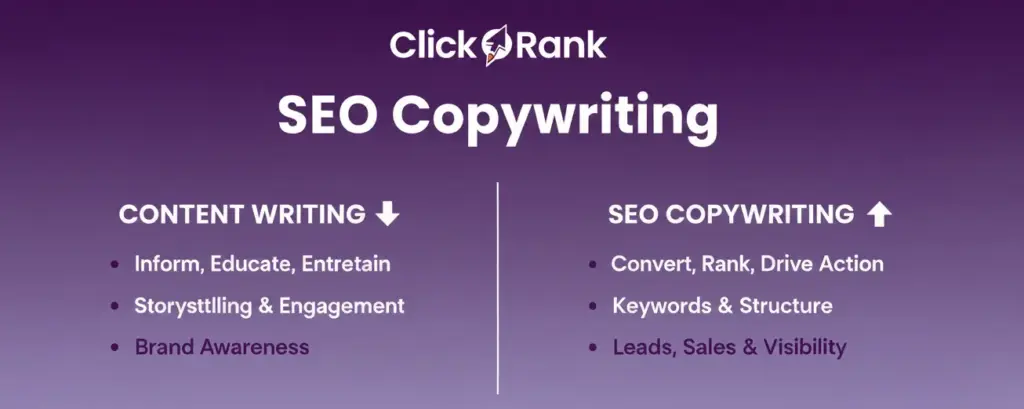
Content writing typically aims to inform, educate, or entertain without explicit conversion goals. A content writer might create an engaging blog post about industry trends, focusing on readability and value without necessarily optimizing for specific keywords or calls-to-action.
The SEO copywriting vs content writing distinction becomes clear in execution. Content writers prioritize storytelling and engagement. SEO copywriters strategically place keywords, structure headings for featured snippets, and guide readers toward conversion points—all while maintaining that same engaging quality.
Use cases differ significantly. Content writing excels for brand awareness, thought leadership, and audience education. SEO copywriting drives measurable business outcomes like lead generation, sales, and organic visibility. We’ll explore this comparison in detail in our dedicated guide on SEO copywriting vs content writing.
Why is SEO Copywriting Important?
Consider this: 68% of online experiences begin with a search engine. If your content doesn’t rank, it doesn’t exist for the vast majority of potential customers. SEO copywriting puts your solutions in front of people actively looking for them.
The financial impact is substantial. Organic search drives 53% of all website traffic, and leads from organic search have a 14.6% close rate compared to just 1.7% for outbound marketing. Unlike paid advertising that stops generating results the moment you stop paying, well-optimized content continues attracting qualified visitors for months or years.
Beyond traffic numbers, SEO copywriting builds authority. When your content consistently ranks for valuable keywords, searchers perceive your brand as a trusted expert. This credibility translates directly into higher conversion rates and customer loyalty.
The cost-effectiveness advantage cannot be overstated. While you invest time upfront in creating quality content, the ongoing returns far exceed traditional advertising spend. One well-ranked article can generate thousands of qualified leads without additional investment.
How Does SEO Copywriting Work?
Search engines use complex algorithms to match queries with relevant content. When someone searches “how to write SEO copywriting,” Google analyzes billions of pages to determine which best answer that specific question. Your content competes for visibility based on relevance, authority, and user experience signals.
SEO copywriting works by aligning your content with three critical factors. First, keyword relevance signals to search engines what topics you cover. Second, content quality and depth demonstrate expertise worth ranking. Third, user engagement metrics like time on page and bounce rate confirm your content satisfies searcher intent.
The ranking and conversion funnel operates in stages. Initial visibility brings clicks from search results. Engaging content holds attention and builds trust. Strategic calls-to-action convert interested visitors into leads or customers. Each element requires deliberate optimization.
User intent matching is crucial. Search engines now understand whether someone wants information, seeks a specific website, plans to purchase, or compares options. Your SEO copywriting must align with these intent types to rank well and convert effectively.
Core Principles of SEO Copywriting
What Makes Good SEO Copywriting?
Quality and relevance trump all other considerations. Google’s algorithms have become exceptionally skilled at identifying thin, low-value content designed purely for ranking. Good SEO copywriting provides genuine value that answers questions comprehensively and helps readers accomplish their goals.
Natural keyword integration separates amateur from professional work. When keywords appear forced or repetitive, both readers and search engines notice. Effective copywriters weave target terms seamlessly into sentences where they enhance rather than interrupt the message.
A reader-focused approach means understanding your audience’s problems, questions, and desires before writing a single word. You’re not just creating content you’re solving problems and addressing specific needs. This perspective shift elevates your work from generic to genuinely helpful.
Balancing technical and creative elements requires practice. You need enough optimization to rank but sufficient creativity to engage. Too much focus on algorithms produces robotic content. Too little optimization leaves great writing buried where no one finds it.
How Do You Write SEO Friendly Copy?
Understanding your target audience is the foundation. Create detailed buyer personas that outline demographics, pain points, goals, and search behavior. This knowledge informs every decision from keyword selection to tone of voice.
Solving problems through content positions you as a valuable resource rather than just another business seeking attention. Address specific challenges your audience faces and provide actionable solutions. This approach builds trust and authority naturally.
Creating scannable text acknowledges how people actually read online. Use short paragraphs, descriptive subheadings, bullet points for lists, and bold text to highlight key concepts. Readers should extract value even when skimming quickly.
Maintaining brand voice while optimizing ensures consistency across all customer touchpoints. Your SEO copywriting should sound like your brand, not like a generic corporate website. Inject personality, use appropriate language for your audience, and stay authentic.
What are the Key Elements of Effective SEO Copy?
Compelling headlines and hooks determine whether anyone reads beyond the first line. Your title must promise value, include your target keyword naturally, and create curiosity or urgency. The opening paragraph should immediately engage and set clear expectations.
Clear structure and flow guide readers through your content logically. Each section should connect naturally to the next, building toward your ultimate goal. Transitional phrases help maintain momentum and prevent readers from bouncing.
Strategic keyword placement involves more than sprinkling terms randomly. Place your primary keyword in the title, first paragraph, at least one subheading, and naturally throughout the body. Use variations and related terms to signal topic relevance without repetition.
Strong calls-to-action convert interest into action. Be specific about what you want readers to do and why they should do it now. Vague CTAs like “learn more” underperform compared to specific benefits like “download your free keyword research template.”
Trust and credibility signals include data citations, expert quotes, case studies, and social proof. When readers trust your expertise, they’re more likely to follow your recommendations and convert.
Keyword Research for SEO Copywriting
How Do You Do Keyword Research for SEO Copywriting?
Keyword research for SEO copywriting starts with understanding what your audience actually searches. Tools like Google Keyword Planner, SEMrush, and Ahrefs reveal search volumes, competition levels, and related terms you might not discover otherwise.
Finding short-tail and long-tail keywords serves different strategic purposes. Short-tail terms like “SEO copywriting” have high search volume but intense competition. Long-tail phrases like “how to learn SEO copywriting for beginners” attract fewer searches but convert better because they match specific intent.
Analyzing search volume and competition helps prioritize your efforts. High-volume keywords with low competition represent ideal opportunities. However, don’t ignore lower-volume terms if they align perfectly with your services or products.
Keyword difficulty assessment prevents wasting time on impossible targets. If you’re a new website competing against established authorities, focus on achievable keywords first. Build authority gradually through consistent, quality content on realistic targets.
What is Search Intent and Why Does it Matter?
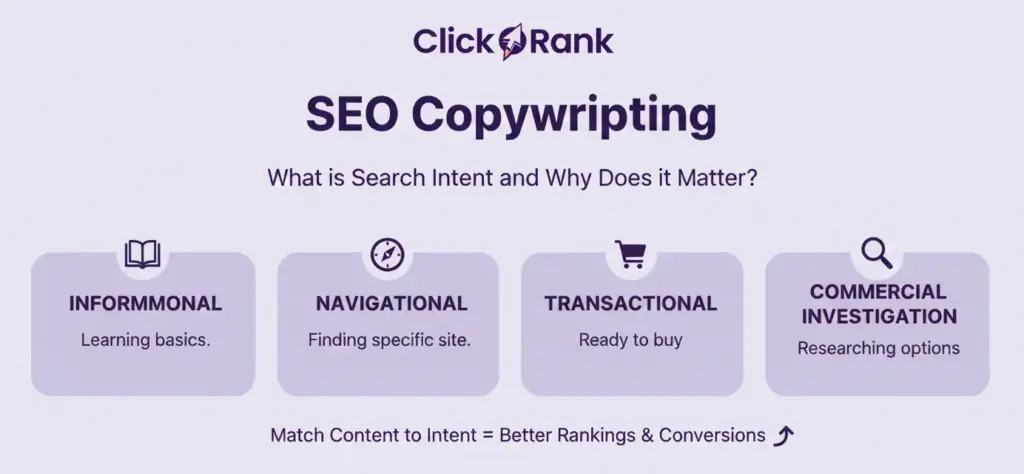
Search intent represents the underlying goal behind a query. Understanding whether someone wants information, seeks a specific website, plans to purchase, or compares options shapes everything about your content.
Informational intent drives traffic to educational content. Queries like “what is SEO copywriting” indicate someone learning basics. Your content should comprehensively explain concepts without heavy sales pitches.
Navigational intent means someone searches for a specific website or page. These searches typically include brand names. Optimize branded content to capture these visitors efficiently.
Transactional intent signals readiness to purchase. Terms like “SEO copywriting services pricing” or “hire SEO copywriter” indicate high conversion potential. Your content should facilitate the buying decision with clear options and calls-to-action.
Commercial investigation represents the research phase before purchasing. Queries like “best SEO copywriting tools” or comparisons indicate evaluation mode. Provide thorough, honest comparisons that help decision-making.
Matching content to intent dramatically improves both rankings and conversions. Search engines reward content that satisfies the specific intent behind queries. We cover this extensively in our complete keyword research guide for SEO copywriting.
How Do You Use Keywords Naturally in Copy?
Avoiding keyword stuffing requires restraint and creativity. The days of repeating your target phrase 20 times per article are long gone. Focus on readability first, optimization second.
Semantic keywords and LSI terms provide context without repetition. If your target is “SEO copywriting techniques,” naturally incorporate related terms like “optimization methods,” “content strategies,” and “ranking tactics.” Search engines understand these relationships.
Keyword density myths cause unnecessary anxiety. There’s no magic percentage that guarantees rankings. Aim for how to use keywords naturally in copy by writing first, then ensuring your target appears enough times to signal relevance typically 1-2% of total words.
Natural language integration techniques include using keywords in questions, within explanations, and as part of longer sentences. If you’re straining to fit a keyword, rewrite the sentence entirely rather than forcing awkward phrasing.
Where Should You Place Keywords in Your Content?
Title and headline optimization requires including your primary keyword near the beginning when possible. “SEO Copywriting: Complete Guide” works better than “Complete Guide: Everything About SEO Copywriting” because the target term appears first.
First 100 words importance cannot be overstated. Search engines weight opening content more heavily because it typically introduces your main topic. Naturally work your primary keyword into your introduction.
Strategic placement throughout means distributing keywords across different sections rather than clustering them. Include your target in subheadings where relevant, within body paragraphs naturally, and in your conclusion when summarizing.
How to write meta descriptions for SEO involves crafting compelling 150-160 character summaries that include your primary keyword and encourage clicks. While meta descriptions don’t directly impact rankings, they significantly influence click-through rates.
Alt text for images provides both accessibility and SEO benefits. Describe images accurately while incorporating relevant keywords when appropriate. Never stuff keywords into alt text artificially.
SEO Copywriting Techniques That Work
How Do You Write Compelling Headlines for SEO?
How to optimize headlines for SEO starts with understanding that your title serves two masters: human readers and search algorithms. The best headlines accomplish both goals simultaneously.
Headline formulas that convert include numbers (“10 SEO Copywriting Techniques“), questions (“What is SEO Copywriting?”), how-to phrases (“How to Write SEO Copywriting”), and benefit-driven statements (“SEO Copywriting That Doubles Your Traffic”).
Including target keywords naturally means not forcing them awkwardly. If “SEO copywriting tips for beginners” feels clunky in your headline, rework the entire title rather than accepting poor phrasing.
Power words and emotional triggers boost click-through rates. Terms like “ultimate,” “proven,” “essential,” “secret,” and “powerful” add impact when used appropriately. Avoid overuse that makes headlines feel manipulative.
Optimal headline length balances SEO with readability. Aim for 50-60 characters to avoid truncation in search results. Mobile users see even fewer characters, so place the most important words first.
Using numbers and brackets catches attention in crowded search results. “7 SEO Copywriting Best Practices 2026 [Updated Guide]” stands out more than generic titles without these elements.
How Do You Optimize Meta Descriptions for SEO?
Meta descriptions serve as your elevator pitch in search results. Though they don’t directly impact rankings, compelling descriptions dramatically increase click-through rates, which does influence rankings indirectly.
Purpose and character limits matter because Google truncates descriptions beyond 150-160 characters. Make your most compelling points early. Focus on benefits and include a clear reason to click.
Including keywords and CTAs makes descriptions actionable. When searchers see their query terms highlighted in your description, relevance becomes obvious. Adding calls-to-action like “Learn how” or “Discover” encourages clicks.
Creating click-worthy descriptions requires emphasizing unique value. What makes your content different from the nine other results on the page? Highlight that distinction clearly.
Mobile vs desktop considerations mean previewing how descriptions appear on different devices. Mobile shows fewer characters, making brevity even more critical.
How Do You Structure Content for SEO?
How to structure content for SEO employs the inverted pyramid approach from journalism. Present the most important information first, then provide supporting details and background. This structure serves both readers who skim and those who read thoroughly.
Using H1, H2, H3 tags effectively creates clear hierarchy. Your H1 (title) states the main topic. H2s divide content into major sections. H3s break down subsections. This structure helps both readers navigate and search engines understand your content organization.
Paragraph length best practices suggest keeping paragraphs to 3-4 sentences maximum for online reading. Long text blocks intimidate readers and reduce engagement. Short paragraphs with white space improve readability significantly.
Creating logical content flow means each section builds on previous ones. Avoid jumping between unrelated topics. Guide readers through your content with a clear beginning, middle, and end.
Internal linking strategy connects related content across your website. Link to relevant articles using descriptive anchor text. This helps search engines understand your site structure and keeps visitors engaged longer.
What are SEO Copywriting Formulas That Convert?
SEO copywriting formulas that convert provide proven structures for persuasive content. These frameworks guide readers from problem awareness to taking action.
AIDA formula (Attention, Interest, Desire, Action) remains timeless. Grab attention with a compelling headline, build interest with relevant information, create desire by highlighting benefits, and prompt action with clear CTAs.
PAS formula (Problem, Agitate, Solution) works exceptionally well for pain-point-driven content. Identify the problem your audience faces, agitate it by exploring consequences of inaction, then present your solution as the answer.
FAB formula (Features, Advantages, Benefits) connects product attributes to customer outcomes. Features describe what something does, advantages explain why that matters, and benefits show how it improves the customer’s life.
The 4 Ps (Promise, Picture, Proof, Push) builds trust while persuading. Make a clear promise, paint a picture of success, provide proof through testimonials or data, and push toward action.
When to use each formula depends on your content type and audience awareness level. Use PAS for audiences aware of their problem. Try AIDA for those discovering solutions. Test different approaches to find what resonates. We explore these extensively in our guide on 10 SEO copywriting techniques that actually work.
How Do You Write Introductions That Hook Readers?
First sentence importance determines whether anyone continues reading. Start with a surprising fact, provocative question, bold statement, or relatable scenario. Avoid generic openings like “In today’s digital world…”
Addressing the reader directly creates immediate connection. Use “you” frequently to make content feel personally relevant. “Your website struggles to rank” engages more than “Websites often struggle to rank.”
Setting expectations clearly tells readers what they’ll gain. List specific outcomes or questions you’ll answer. This transparency builds trust and helps readers decide if your content matches their needs.
Incorporating primary keywords early signals relevance to both readers and search engines. Work your target term into the first paragraph naturally, confirming that your content addresses the search query.
How Do You Create Effective Calls-to-Action?
Action-oriented language specifies exactly what you want readers to do. “Download your free guide” outperforms vague CTAs like “Click here” because it clearly states the action and benefit.
Creating urgency and value motivates immediate action. “Start your free trial today” combines urgency (today) with value (free trial). Without urgency, people postpone action indefinitely.
Placement strategy matters significantly. Include CTAs at natural decision points after demonstrating value, solving a problem, or building desire. Don’t wait until the very end to ask for action.
Testing different CTAs reveals what resonates with your specific audience. Try various wording, colors, placements, and formats. Small changes often produce dramatically different conversion rates.
What is the Ideal Content Length for SEO?
Word count guidelines by content type vary considerably. Blog posts typically perform well between 1,500-2,500 words. Pillar pages and comprehensive guides work best at 3,000-5,000 words. Product descriptions need just 300-500 words focused on benefits.
Quality vs quantity debate has a clear winner: quality. A thoroughly researched 2,000-word article outperforms a thin 5,000-word piece stuffed with fluff. Focus on comprehensively addressing your topic rather than hitting arbitrary word counts.
Comprehensive coverage importance means answering all relevant questions about your topic. If competitors cover 10 aspects and you cover 15 with greater depth, you’re more likely to rank higher.
Matching competitor content depth provides a competitive baseline. Analyze top-ranking content for your target keywords. If they average 2,500 words, aim for at least that length while providing superior value.
Technical SEO Copywriting Elements
How Do You Optimize Images for SEO Copywriting?
Alt text best practices require describing images accurately while incorporating relevant keywords naturally. “SEO copywriting workflow diagram” works better than “image123” or keyword-stuffed alternatives.
File names and descriptions provide another optimization opportunity. Name files descriptively before uploading: “keyword-research-process.jpg” rather than “IMG_0847.jpg.”
Image compression for speed prevents large files from slowing page load times. Slow sites rank poorly and frustrate users. Tools like TinyPNG or ImageOptim reduce file sizes without visible quality loss.
Using images to enhance copy breaks up text, illustrates concepts, and improves engagement. Strategic image placement keeps readers scrolling and increases time on page.
What Role Do Internal Links Play in SEO Copy?
Strategic anchor text usage helps both users and search engines understand link destinations. Descriptive phrases like “complete keyword research guide for SEO copywriting” work better than “click here.”
Building content clusters organizes related content around pillar pages. Create comprehensive main articles on broad topics, then link to detailed posts covering specific subtopics. This structure demonstrates topic authority.
Improving site architecture through internal linking distributes ranking power across your website. Every page should be reachable within 3-4 clicks from your homepage.
User experience benefits include keeping visitors engaged longer and guiding them to relevant information. Each internal link offers additional value and reduces bounce rates.
How Do You Make Content Mobile-Friendly?
Short paragraphs for mobile prevent overwhelming mobile readers with large text blocks. What looks reasonable on desktop becomes difficult to scan on small screens.
Readable font sizes ensure legibility without zooming. Aim for at least 16px font size for body text. Test on actual mobile devices to confirm readability.
Mobile-first writing approach means creating content optimized for small screens first, then ensuring it works well on desktop. This reflects how most people now access content.
Testing on multiple devices reveals issues you might miss on your primary device. Different screen sizes and browsers can display content differently.
What is Readability and Why Does it Matter for SEO?
Flesch Reading Ease score measures how easily your writing can be understood. Scores of 60-70 indicate plain English easily understood by 13-15 year olds. Higher scores mean simpler text.
Grade level considerations ensure your content matches your audience’s reading level. Technical audiences tolerate complexity. General consumers prefer simpler language.
Sentence and paragraph length directly impact readability. Vary sentence length to maintain rhythm. Keep most sentences under 20 words. Limit paragraphs to 3-4 sentences.
Active vs passive voice affects clarity and engagement. “We optimized the content” (active) reads stronger than “The content was optimized” (passive). Aim for 80% active voice.
SEO Copywriting Best Practices 2026
What are the Current SEO Copywriting Best Practices?
E-E-A-T principles (Experience, Expertise, Authoritativeness, Trust) dominate Google’s quality evaluation. Demonstrate first-hand experience, showcase expertise through depth, build authority with citations and credentials, and establish trust through transparency and accuracy.
User experience signals increasingly influence rankings. Metrics like time on page, scroll depth, and interaction rates tell search engines whether content satisfies visitors. Focus on engagement, not just optimization.
Core Web Vitals impact reflects Google’s emphasis on page speed, interactivity, and visual stability. Fast-loading, responsive content ranks better than slow, clunky alternatives.
AI content considerations matter as more creators use AI writing tools. Google doesn’t penalize AI content specifically but does penalize low-quality content regardless of creation method. Use AI as a tool, not a replacement for expertise.
How Has AI Changed SEO Copywriting in 2026?
AI writing tools and their role continue evolving. Tools like ChatGPT and Claude assist with research, outline creation, and first drafts. However, they cannot replace human creativity, expertise, and strategic thinking.
Maintaining human touch remains essential. AI-generated content often lacks personality, specific examples, and nuanced understanding. Add personal insights, real experiences, and brand voice to make content authentically yours.
Google’s stance on AI content focuses on quality rather than creation method. Their guidance emphasizes helpful, people-first content regardless of how it’s produced. Quality and value matter more than whether a human or AI wrote the first draft.
Best practices for AI-assisted writing include using AI for research and structure, but adding substantial human editing, fact-checking, and personalization. Never publish AI-generated content without thorough review and enhancement.
What is Semantic SEO and How Do You Implement It?
Beyond exact-match keywords, semantic SEO recognizes that search engines understand concepts and relationships. Optimize for topics, not just individual keywords.
Topic clusters and pillar pages organize content around comprehensive main articles (pillars) linked to detailed subtopic posts (clusters). This structure demonstrates thorough topic coverage and builds authority.
Entity-based optimization focuses on people, places, things, and concepts rather than just keywords. Help search engines understand the entities you discuss through clear, consistent references.
Natural language processing enables search engines to understand context, synonyms, and intent. Write naturally for humans, and modern algorithms will recognize relevance without keyword stuffing.
How Do You Optimize for Featured Snippets?
Types of featured snippets include paragraphs, lists, tables, and videos. Different query types favor different snippet formats. “What is” questions often generate paragraph snippets. “How to” queries favor numbered lists.
Structuring content for snippets means providing clear, concise answers early in your content. Answer questions directly in 40-60 words, then expand with additional detail.
Question-based optimization involves using actual questions as subheadings. If people ask “What is the difference between SEO copywriting and content writing?” use that exact phrase as your H2 or H3.
Lists, tables, and definitions work exceptionally well for snippets. Format information clearly with bullet points, numbered steps, or structured data that’s easy for search engines to extract and display.
How Do You Write for Voice Search?
Conversational tone importance reflects how people speak rather than type. Voice searches sound like questions you’d ask a friend: “Hey, what’s the difference between SEO copywriting and content writing?”
Long-tail question keywords dominate voice search. Optimize for complete questions like “how to write meta descriptions for SEO” rather than fragmented terms.
Natural language patterns mean writing how people actually talk. Avoid overly formal or technical language unless your audience expects it.
Local SEO considerations matter because many voice searches include location. “SEO copywriting services near me” or “best SEO copywriter in Chicago” represent common voice search patterns.
Different Types of SEO Copywriting
How Do You Write SEO Copy for Blog Posts?
SEO copywriting for blog posts requires balancing educational value with optimization. Structure posts with clear headlines, subheadings, and scannable formatting. Focus on answering specific questions thoroughly.
Blog structure and formatting should include engaging introductions, well-organized body sections with H2 and H3 headings, practical examples, and clear takeaways. Use images, bullet points, and short paragraphs.
Balancing information and keywords means prioritizing reader value while naturally incorporating target terms. Avoid forcing keywords into every paragraph. Instead, write naturally and ensure your main keywords appear in strategic locations.
Creating shareable content increases reach and builds backlinks. Include original insights, actionable tips, compelling statistics, or entertaining elements that motivate sharing.
Updating and refreshing old posts maintains their ranking power. Add new information, update statistics, improve formatting, and strengthen optimization on posts that already perform well.
What is SEO Copywriting for E-commerce?
SEO copywriting for e-commerce focuses on product descriptions that both inform and persuade. Highlight benefits over features, address common objections, and include relevant keywords naturally.
Product descriptions that sell combine search optimization with conversion psychology. Describe the product clearly, explain who it’s for, highlight what problems it solves, and include strong calls-to-action.
Category page optimization requires unique, valuable content rather than just product listings. Describe the category, explain how to choose products, and incorporate relevant keywords naturally.
Using persuasive language means appealing to emotions and desires while maintaining accuracy. Paint vivid pictures of how products improve customers’ lives.
Handling duplicate content issues matters because many e-commerce sites use manufacturer descriptions. Write unique descriptions for important products or use canonical tags to avoid penalties.
How Do You Write Landing Page Copy for SEO?
Above the fold optimization ensures your most compelling message and primary CTA appear immediately. Visitors should understand your value proposition within seconds of arrival.
Conversion-focused elements include clear headlines, benefit-driven copy, trust signals like testimonials or security badges, and prominent calls-to-action. Every element should guide toward conversion.
Keyword targeting strategies for landing pages focus on commercial and transactional intent. Target phrases like “SEO copywriting services pricing” or “hire SEO copywriter” that indicate purchase readiness.
A/B testing copy variations reveals what resonates with your specific audience. Test different headlines, value propositions, CTA wording, and page layouts to optimize conversion rates.
What Makes Effective Homepage Copy for SEO?
Balancing brand message and keywords challenges many businesses. Your homepage must communicate your brand identity while incorporating enough relevant keywords to rank for your primary terms.
Clear value proposition answers the fundamental question: why should visitors care? State what you do, who you help, and what makes you different within the first few seconds.
Strategic keyword placement on homepages requires subtlety. Work primary keywords into your headline, subheadings, and body copy naturally without compromising your brand message.
Navigation and user flow guide visitors to relevant pages based on their needs. Clear menu structure, logical categories, and strategic internal links improve both user experience and SEO.
How Do You Optimize Service Pages for SEO?
Service-specific keywords target what people search when needing your services. Research terms like “[your service] + near me,” “[your service] + cost,” or “[your service] + reviews.”
Local SEO elements include location-specific keywords, service areas, contact information, and local testimonials. These signals help you rank for geographically-targeted searches.
Trust signals and testimonials build credibility. Include client reviews, case studies, certifications, and social proof that demonstrates your expertise and reliability.
Clear service descriptions explain what you offer, who it’s for, what problems it solves, and why someone should choose you. Be specific rather than vague about deliverables and benefits.
SEO Copywriting Checklist
Pre-Writing Checklist
Before writing any SEO copywriting piece, complete these essential steps:
- Keyword research completed – Identify primary and secondary keywords with appropriate search volume and difficulty for your authority level.
- Search intent identified – Determine whether your target keywords indicate informational, navigational, transactional, or commercial investigation intent.
- Competitor analysis done – Review top-ranking content for your target keywords to understand what’s working and identify content gaps you can fill.
- Content outline created – Structure your content with clear sections, subheadings, and key points before writing to ensure logical flow and comprehensive coverage.
During Writing Checklist
While creating your content, verify these elements:
- Primary keyword in title – Include your main target keyword in the H1 title, preferably near the beginning, while keeping it natural and compelling.
- Keywords in first paragraph – Work your primary keyword into the introduction within the first 100 words to signal immediate relevance.
- Proper header tag hierarchy – Use H1 for title, H2 for main sections, H3 for subsections. Maintain logical structure without skipping levels.
- Natural keyword distribution – Incorporate primary and secondary keywords throughout content naturally without forced repetition or stuffing.
- Internal links included – Add 3-5 relevant internal links using descriptive anchor text to connect related content and improve site architecture.
- Images with alt text – Include relevant images with descriptive, keyword-optimized alt text that accurately describes the image content.
Post-Writing Checklist
After completing your draft, review these critical elements:
- Meta description optimized – Craft a compelling 150-160 character meta description including your primary keyword and clear value proposition.
- URL slug checked – Ensure your URL is short, descriptive, and includes your primary keyword with hyphens separating words.
- Readability score reviewed – Check that your content achieves appropriate readability scores (60-70 Flesch Reading Ease for general audiences).
- Grammar and spelling checked – Proofread thoroughly using tools like Grammarly to eliminate errors that undermine credibility.
- Mobile preview tested – View your content on mobile devices to confirm proper formatting, readability, and user experience.
- Call-to-action included – Verify you’ve included clear, compelling CTAs that guide readers toward your desired action.
Tools for SEO Copywriting
What Tools Do I Need for SEO Copywriting?
- Keyword research tools form the foundation of effective SEO copywriting. Google Keyword Planner provides free keyword data directly from Google. SEMrush and Ahrefs offer comprehensive keyword databases, competitor analysis, and ranking tracking.
- Content optimization tools analyze your draft against top-ranking competitors. Surfer SEO provides keyword density recommendations and content structure suggestions. Clearscope and Frase identify related terms and topics to include for comprehensive coverage.
- Readability checkers ensure your content remains accessible. Hemingway Editor highlights complex sentences and suggests simplifications. Grammarly checks grammar, spelling, and tone while offering improvement suggestions.
- SEO analysis tools like Yoast and Rank Math integrate with WordPress to provide real-time optimization feedback. They analyze keyword usage, readability, meta descriptions, and technical SEO elements.
- Plagiarism checkers like Copyscape verify your content’s originality, which is crucial for rankings and legal compliance.
Which Free Tools are Best for Beginners?
Google Search Console provides invaluable data about how your content performs in search. Monitor which keywords drive traffic, identify ranking opportunities, and discover technical issues affecting visibility.
Google Keyword Planner offers keyword ideas and search volume data free for anyone with a Google Ads account. While you don’t need to run ads, creating an account unlocks this powerful research tool.
AnswerThePublic visualizes questions people ask about topics. This tool helps identify content opportunities and long-tail keywords you might miss through traditional research.
Hemingway Editor improves readability by highlighting complex sentences, passive voice, and adverb overuse. The free web version provides excellent value for beginning writers.
Grammarly free version catches basic grammar, spelling, and punctuation errors. While paid versions offer more features, the free tier provides sufficient value for starting out.
What are the Best Paid SEO Copywriting Tools?
Comprehensive platforms comparison reveals different strengths. SEMrush excels at competitor analysis and keyword research. Ahrefs dominates backlink analysis and content gap identification. Surfer SEO specializes in content optimization with precise keyword density recommendations.
ROI and pricing considerations matter when selecting tools. SEMrush and Ahrefs start around $100-120/month. Surfer SEO begins at $69/month. Evaluate whether increased rankings and traffic justify these investments.
Feature comparison helps identify which tool fits your workflow. Some platforms emphasize research, others focus on optimization, and some provide comprehensive solutions covering the entire content creation process.
When to invest in paid tools depends on your commitment and content volume. If you’re creating multiple pieces monthly and serious about results, paid tools typically pay for themselves quickly through improved rankings.
Measuring SEO Copywriting Success
What Metrics Should You Track?
Organic traffic growth indicates whether your SEO copywriting efforts increase overall visibility. Monitor traffic trends over time, focusing on upward trajectories rather than day-to-day fluctuations.
Keyword rankings show progress on specific target terms. Track rankings for your primary and secondary keywords weekly or monthly to identify wins and opportunities.
Time on page and engagement metrics reveal whether content resonates with visitors. Longer time on page and higher scroll depth indicate quality content that holds attention.
Bounce rate reflects how many visitors leave after viewing just one page. Lower bounce rates suggest your content meets expectations and encourages further exploration.
Conversion rates measure your ultimate success. Track how many visitors complete desired actions like subscribing, downloading, purchasing, or contacting you.
Click-through rates from SERPs indicate how compelling your titles and meta descriptions are. Higher CTR means more clicks from the same ranking position, which can improve rankings over time.
How Do You Analyze Content Performance?
Using Google Analytics reveals detailed visitor behavior. Monitor which pages attract most traffic, where visitors come from, how long they stay, and which content drives conversions.
Search Console insights show exactly which queries bring visitors. Discover unexpected keywords you rank for and identify opportunities to optimize further for those terms.
Heat maps and user behavior tools like Hotjar or Crazy Egg visualize where visitors click, how far they scroll, and where they abandon pages. This data informs optimization decisions.
A/B testing results provide concrete evidence of what works. Test different headlines, CTAs, layouts, or content structures to continuously improve performance.
How Long Does it Take to See Results from SEO Copywriting?
Realistic timeline expectations prevent discouragement. New content typically takes 3-6 months to reach its ranking potential. Established websites see faster results than brand new ones.
Factors affecting ranking speed include domain authority, competition levels, content quality, and backlink profile. Highly competitive keywords require more time and effort than niche terms.
Quick wins vs long-term gains balance your strategy. Some low-competition keywords deliver traffic within weeks. Major competitive terms might take a year or more of consistent effort.
Patience and consistency importance cannot be overstated. SEO copywriting rewards sustained effort over time. Publishing quality content regularly beats sporadic bursts of activity.
Learning SEO Copywriting
How to Learn SEO Copywriting?
How to learn SEO copywriting starts with foundational knowledge of both SEO principles and persuasive writing techniques. Understand how search engines work, what makes content rank, and how to influence reader behavior.
Best learning path for beginners involves three stages. First, learn SEO fundamentals keywords, on-page optimization, and user intent. Second, study copywriting principles persuasion, psychology, and conversion tactics. Third, practice combining both skills through real projects.
Practice and real-world application matter more than theoretical knowledge. Create your own blog, offer to write for friends’ businesses, or contribute to publications. Experience teaches lessons no course can.
Staying updated with changes requires following industry blogs, testing new techniques, and adapting to algorithm updates. SEO copywriting evolves constantly, making continuous learning essential.
What are the Best SEO Copywriting Courses Online?
Free courses and resources provide excellent starting points. Google’s SEO Starter Guide offers foundational knowledge directly from the source. HubSpot Academy provides free content marketing and SEO courses with certifications.
Paid certification programs from Coursera, Udemy, and specialized platforms offer structured learning paths. Look for courses covering both SEO technical elements and copywriting techniques, not just one or the other.
Platform recommendations include Copyblogger for copywriting fundamentals, Moz Academy for SEO education, and Coursera for comprehensive digital marketing programs that include SEO copywriting.
Course selection criteria should include instructor credentials, student reviews, curriculum comprehensiveness, practical assignments, and whether you receive actionable frameworks you can apply immediately.
Can I Learn SEO Copywriting for Free?
Free resources and blogs abound for motivated learners. Websites like Search Engine Journal, Neil Patel’s blog, Backlinko, and Copyblogger publish valuable content regularly covering both SEO and copywriting.
YouTube channels and tutorials provide visual learning opportunities. Channels like Brian Dean (Backlinko), Neil Patel, and Ahrefs offer comprehensive video guides on SEO copywriting techniques.
Practice projects and exercises accelerate learning. Rewrite existing web pages, create content for imaginary businesses, or analyze successful content to understand what makes it work.
Building a portfolio demonstrates your skills to potential clients or employers. Even unpaid projects create samples showcasing your abilities and approach to SEO copywriting.
How Long Does it Take to Learn SEO Copywriting?
Beginner to competent timeline varies by commitment level. With daily practice, expect 3-6 months to develop solid foundational skills. Mastery takes years of continued learning and application.
Daily practice recommendations include writing at least 500 words, analyzing one high-ranking article, reading industry content, and experimenting with new techniques. Consistency beats occasional intensive sessions.
Skill development stages progress from understanding basics, to applying techniques mechanically, to developing intuition about what works, to innovating with creative approaches.
Continuous learning mindset recognizes that SEO copywriting constantly evolves. Algorithm updates, changing user behavior, and new technologies require ongoing adaptation and skill refinement.
How to Improve SEO Copywriting Skills?
How to improve SEO copywriting skills requires deliberate practice focusing on weak areas. If keyword integration feels forced, practice variations until it becomes natural. If persuasion lacks impact, study copywriting psychology.
Reading and analyzing top content teaches through example. Identify why certain articles rank first and convert well. What patterns do they share? How do they structure information? What makes their copy compelling?
Writing daily practice builds proficiency faster than sporadic effort. Set a consistent schedule and word count goal. Even 30 minutes daily compounds into significant skill development.
Getting feedback and critiques reveals blind spots. Join writing communities, hire coaches, or exchange critiques with peers learning SEO copywriting alongside you.
Experimenting with techniques helps discover what resonates with your specific audience. Test different formulas, styles, and structures. Track results to identify your most effective approaches.
Following industry experts keeps you current with best practices. Subscribe to newsletters from leaders like Brian Dean, Neil Patel, Ann Handley, and Joanna Wiebe. We cover advanced strategies in our comprehensive guide on how to learn SEO copywriting.
SEO Copywriting Services and Pricing
How Much Does SEO Copywriting Cost?
SEO copywriting services pricing varies dramatically based on experience, specialization, and project scope. Understanding typical rates helps budget appropriately and evaluate proposals.
Pricing models include per-word rates (typically $0.10-$1.00+ per word), per-project fees ($200-$5,000+ depending on scope), and hourly rates ($50-$250+ per hour based on expertise).
Industry standard rates for competent professionals typically range from $0.15-$0.30 per word for blog content, $500-$2,000 for landing pages, and $1,000-$5,000 for comprehensive pillar content.
Factors affecting cost include writer experience and expertise, project complexity, research requirements, revision rounds included, turnaround time, and whether strategy and keyword research are included.
Budget expectations should align with quality expectations. Extremely cheap rates often deliver generic content with minimal optimization. Premium rates typically include thorough research, strategic thinking, and polished execution.
When Should You Hire an SEO Copywriter?
In-house vs outsourcing decision depends on volume, expertise, and resources. Hiring full-time makes sense for consistent high-volume needs. Outsourcing works better for occasional projects or specialized expertise.
Red flags of poor copywriters include guaranteed rankings (impossible to guarantee), portfolios with thin or generic content, reluctance to show samples, and prices that seem too good to be true.
What to look for in professionals includes portfolios demonstrating results, understanding of your industry, clear processes, strong communication, and ability to discuss strategy beyond just writing.
Evaluating portfolios means looking beyond writing quality to strategic thinking. Do they choose appropriate keywords? Structure content effectively? Create compelling CTAs? Demonstrate understanding of user intent?
What are the Best SEO Copywriting Services?
Top agencies and freelance platforms offer different advantages. Agencies provide teams with specialized skills but cost more. Freelance platforms like Upwork or Contently offer flexibility and varied expertise.
Service comparison criteria include expertise demonstrated through portfolios, client testimonials and case studies, communication and process clarity, pricing transparency, and whether they offer strategy in addition to execution.
Reading reviews and testimonials reveals past client experiences. Look for specific results mentioned (traffic increases, ranking improvements, conversion gains) rather than vague praise.
Making the right choice requires clarifying your needs, budget, and expectations before evaluating options. Match provider capabilities to your specific requirements rather than choosing based solely on cost.
How Do Freelance SEO Copywriting Jobs Work?
Finding clients and opportunities involves networking, building online presence, leveraging platforms like Upwork, responding to job posts, and asking for referrals from satisfied clients.
Setting rates and packages requires researching market rates, calculating your desired income, factoring in business expenses, and positioning yourself appropriately based on experience and results.
Building client relationships emphasizes communication, meeting deadlines, exceeding expectations, and maintaining professionalism. Long-term clients provide steady income and referrals.
Growing a copywriting business means consistently delivering quality, asking for testimonials, building a portfolio showcasing diverse projects, and positioning yourself as an expert through content creation and thought leadership.
Common SEO Copywriting Mistakes
What Mistakes Hurt Your SEO Copy?
Over-optimization and keyword stuffing remain common errors even in 2026. When content reads unnaturally due to forced keyword repetition, both readers and search engines notice. Focus on readability first.
Ignoring user intent creates content that ranks poorly or attracts wrong visitors. If someone searches with transactional intent and your content is purely informational, conversions suffer even if you rank well.
Duplicate content issues arise when multiple pages target identical keywords or contain substantially similar text. This confuses search engines about which page to rank and can dilute your ranking power.
Poor readability and structure frustrates readers and increases bounce rates. Long paragraphs, complex sentences, lack of subheadings, and unclear organization make content difficult to consume.
Weak or missing CTAs represent missed conversion opportunities. Even perfectly optimized content fails if you don’t guide readers toward desired actions with clear, compelling calls-to-action.
How Do You Avoid Sounding Robotic in SEO Copy?
Writing for humans first, algorithms second, prevents robotic prose. Create content you’d genuinely want to read. Then optimize strategically without compromising natural flow.
Natural conversation flow uses varied sentence structures, transitions that guide thinking, and language that sounds like someone speaking rather than a robot generating text.
Brand personality integration ensures your SEO copywriting sounds distinctively yours. Inject appropriate humor, tell relevant stories, use industry-specific language, and maintain consistent voice across content.
Balancing optimization with authenticity means knowing when to include keywords and when prioritizing natural expression matters more. Not every sentence needs optimization.
What are Black-Hat SEO Copywriting Tactics to Avoid?
Keyword cloaking involves showing different content to search engines than to users. This deceptive practice violates search engine guidelines and results in penalties when detected.
Hidden text like white text on white backgrounds or text positioned off-screen attempts to manipulate rankings without affecting visible content. Search engines easily detect these tactics.
Doorway pages created solely to rank for specific keywords and funnel users elsewhere provide no real value. They violate quality guidelines and risk severe penalties.
Content spinning uses software to automatically rewrite existing content by replacing words with synonyms. The result reads poorly and provides no unique value, leading to poor rankings and user experience.
Consequences of black-hat techniques include ranking penalties, complete de-indexing from search results, damaged reputation, and wasted resources on tactics that don’t provide sustainable results.
Advanced SEO Copywriting Strategies
How Do You Create Content Clusters?
Pillar page strategy involves creating comprehensive main articles covering broad topics thoroughly. These pillar pages link to multiple detailed cluster articles addressing specific subtopics.
Topic clustering methodology groups related content around central themes. Identify your main topics (pillars), list subtopics (clusters), create comprehensive content for each, and link strategically between related pieces.
Internal linking architecture connects clusters to pillars using relevant anchor text. This structure helps search engines understand topical relationships and distributes ranking power effectively.
Authority building approach through clusters demonstrates comprehensive expertise on topics. When you thoroughly cover a subject from multiple angles, search engines recognize your authority and may rank you higher.
What is Copywriting for Local SEO?
Location-based keywords target geographic areas where you operate. Include city names, neighborhoods, regions, and “near me” variations in your SEO copywriting naturally.
Google Business Profile optimization requires consistent business information, regular posts, customer reviews, and photos. Your profile description should include relevant keywords and clear value proposition.
Local landing pages for each service area help capture geographically-targeted searches. Create unique content for each location rather than duplicating text with different city names.
Community-focused content builds local relevance. Write about local events, partner with area businesses, address regional concerns, and demonstrate genuine community involvement.
How Do You Repurpose Content for SEO?
Updating old content maintains and improves existing rankings. Add new information, update statistics, refresh examples, improve optimization, and enhance formatting on posts that already rank.
Content format transformation extends reach across channels. Turn blog posts into videos, infographics, podcasts, or social media content. Each format attracts different audience segments.
Cross-platform optimization means adapting content appropriately for each channel while maintaining core message. LinkedIn posts differ from Instagram captions, which differ from blog articles.
Maximizing content ROI through repurposing means creating once, publishing everywhere. A single comprehensive blog post can generate dozens of social posts, several videos, an infographic, and an email newsletter.
How Do You Write for Multiple Keywords?
Balancing primary and secondary keywords requires strategic distribution. Focus content around one primary keyword while naturally incorporating several related secondary terms.
Creating comprehensive content naturally accommodates multiple keywords. When you thoroughly cover a topic, you’ll naturally discuss related concepts and include associated keywords.
Avoiding cannibalization means ensuring different pages target sufficiently different keywords. Multiple pages competing for identical terms splits ranking power and confuses search engines.
Strategic keyword mapping assigns specific keywords to specific pages. Create a spreadsheet documenting which pages target which keywords to prevent overlap and identify gaps.
SEO Copywriting Tips for Beginners
What are the Top SEO Copywriting Tips?
SEO copywriting tips for beginners start with thorough research before writing. Understand your topic, audience, keywords, and competing content before drafting your first word.
Write for humans, optimize for search engines. Create genuinely valuable content that helps readers, then add optimization elements strategically without compromising quality or readability.
Focus on value and quality over keyword density or word count. Content that truly helps readers naturally attracts engagement, links, and rankings.
Use keywords naturally rather than forcing them into awkward positions. If incorporating a keyword feels unnatural, rephrase the sentence or skip that instance.
Structure content logically with clear headings, short paragraphs, and scannable formatting. Organization helps both readers navigate and search engines understand your content.
Edit and optimize before publishing. Review for clarity, check keyword placement, optimize meta elements, add internal links, and ensure proper formatting.
Update content regularly to maintain relevance and rankings. Add new information, refresh examples, and improve optimization on existing content performing well.
Monitor and improve based on data. Track performance metrics, identify what works, and continuously refine your approach based on actual results.
How to Get Started with SEO Copywriting Today?
First project recommendations include rewriting your own website’s pages, creating comprehensive guides on topics you know well, or offering to help friends’ businesses with content.
Building confidence through practice means accepting that early work won’t be perfect. Each piece teaches valuable lessons. Focus on steady improvement rather than immediate perfection.
Learning from mistakes accelerates development. When content underperforms, analyze why. Poor keyword targeting? Weak structure? Insufficient depth? Each failure informs future success.
Tracking your progress motivates continued effort. Document your rankings, traffic, and conversions. Celebrate improvements and use setbacks as learning opportunities.
What Beginner Mistakes Should You Avoid?
Overthinking optimization paralyzes many beginners. Don’t obsess over exact keyword density percentages or perfect technical implementation. Focus on creating helpful content first.
Copying competitors exactly produces derivative content without unique value. Analyze successful content for lessons but create your own distinctive approach.
Neglecting user experience in pursuit of rankings backfires. Search engines increasingly reward content that satisfies users. Prioritize reader needs alongside optimization.
Not testing and iterating limits improvement. Experiment with different approaches, measure results, and refine based on data rather than assumptions.
Expecting instant results leads to discouragement. SEO copywriting delivers compounding returns over time. Commit to consistent effort for months before expecting significant results.
Future of SEO Copywriting
How Will AI Impact SEO Copywriting?
AI tools role in content creation continues expanding. Tools assist with research, outlines, first drafts, and optimization suggestions. However, human creativity, expertise, and strategic thinking remain irreplaceable.
Human creativity importance increases as AI-generated content becomes common. Your unique perspective, specific experiences, and original insights differentiate your content from generic AI output.
Hybrid approach benefits combine AI efficiency with human expertise. Use AI to accelerate research and drafting, then add substantial human editing, fact-checking, personalization, and strategic optimization.
Staying relevant in AI era requires developing skills AI cannot replicate: strategic thinking, deep expertise, authentic voice, and creative innovation that goes beyond pattern recognition.
What Trends are Shaping SEO Copywriting?
Video and multimedia content increasingly appear in search results. Optimize video titles, descriptions, and transcripts. Create content across multiple formats to maximize visibility.
Interactive content like calculators, quizzes, and tools engage users differently than static text. These experiences create longer sessions and higher engagement signals.
Personalization and dynamic content adapt based on user behavior, location, or preferences. Personalized experiences increase relevance and conversion rates.
Zero-click searches impact means some queries get answered directly in search results without clicking through. Optimize for featured snippets while ensuring valuable content awaits those who do click.
How to Stay Updated with SEO Copywriting Changes?
Industry blogs and resources like Search Engine Journal, Moz Blog, Search Engine Land, and Backlinko publish updates on algorithm changes, new techniques, and industry trends.
Google algorithm updates occur frequently, though major updates are announced. Follow Google Search Central blog for official guidance on optimizing for their algorithms.
Testing and experimentation reveal what works for your specific audience and niche. Don’t blindly follow every trend test new approaches and measure actual impact.
Community engagement through forums, social media groups, and conferences connects you with peers facing similar challenges. Share experiences and learn from collective knowledge.
Is SEO Copywriting Worth Learning?
Career opportunities for skilled SEO copywriters remain strong. Businesses need content that ranks and converts. Professionals combining writing skill with SEO knowledge command premium rates.
Business growth potential through SEO copywriting is substantial. Companies that invest in quality optimized content consistently outperform competitors relying solely on paid advertising.
Skill versatility means SEO copywriting abilities transfer across industries and formats. These skills apply to blogs, websites, e-commerce, social media, email, and more.
Long-term value makes SEO copywriting knowledge increasingly valuable over time. As you build expertise and portfolio, opportunities and earnings potential grow.
Your SEO Copywriting Action Plan
Getting Started Steps
Start by auditing existing content to identify optimization opportunities. Review your top pages and improve them before creating entirely new content.
Conduct keyword research for your core topics and create a master list organized by priority, difficulty, and strategic importance.
Develop content templates incorporating SEO copywriting best practices to streamline your creation process and maintain consistency.
Set up tracking systems for rankings, traffic, and conversions so you can measure the impact of your efforts.
30-60-90 Day Roadmap
Days 1-30: Focus on foundational learning. Study SEO copywriting principles, analyze top-ranking content in your niche, and optimize 3-5 existing pages on your website.
Days 31-60: Create your first original optimized pieces. Write 4-6 comprehensive articles targeting carefully researched keywords. Begin building internal linking structure.
Days 61-90: Refine based on early results. Analyze performance data, update underperforming content, expand on successful topics, and establish consistent publishing schedule.
Resources and Tools Recap
Essential resources for ongoing success include keyword research tools (Google Keyword Planner, free alternatives), content optimization platforms (even free trials provide value), and analytics platforms (Google Analytics and Search Console are free).
Join communities like Reddit’s SEO and content writing subreddits, follow industry leaders on social media, and subscribe to quality newsletters keeping you updated.
Next Steps for Success
Your journey to mastering SEO copywriting begins with your next piece of content. Apply the principles, techniques, and strategies covered in this guide immediately.
Remember that SEO copywriting rewards consistency over time. Commit to regular content creation, continuous learning, and data-driven refinement.
Monitor your progress, celebrate wins, learn from setbacks, and persistently refine your craft. The skills you develop create long-term value for your career or business.
Struggling to turn rankings into traffic? ClickRank helps you identify what Google actually rewards so your content ranks, engages, and converts.
What percentage of online experiences begin with a search engine?
About 68% of all online experiences begin with a search engine, showing how crucial SEO visibility is for discovery.
How much of website traffic comes from organic search?
Organic search drives roughly 53% of all website traffic, making it the largest channel for long-term visibility.
Why is SEO copywriting important for conversions?
SEO copywriting not only improves rankings but also attracts high-intent visitors who are more likely to convert, because they’re actively searching for your solutions.
Do people go past the first page in search results?
Less than 1% of users go to the second page of search results, so ranking on page one is vital for visibility.
What role does search intent play in SEO copywriting?
Search intent determines whether content satisfies what users are really looking for, and aligning copy with intent improves both rankings and conversions. (Industry standard principle)
How does quality content impact SEO performance?
High-quality, in-depth content typically earns more traffic, shares, and backlinks than shallow content, making it more likely to rank well.
What is the click-through rate (CTR) for top organic results?
The #1 organic result on Google earns significantly more clicks than lower positions, often capturing ~39-42% of clicks on page one.
How does SEO compare to paid traffic in ROI?
Organic search generally delivers a higher ROI than paid search because optimized content continues attracting traffic and leads without ongoing ad spend.
Why is keyword research essential for SEO copywriting?
Keyword research reveals what searchers actually type, helping you target terms that align with user intent and that your audience is searching for.
How does mobile usage affect SEO copywriting?
Because a large majority of searches are done on mobile devices, mobile-friendly content and formatting improve user engagement and search performance.