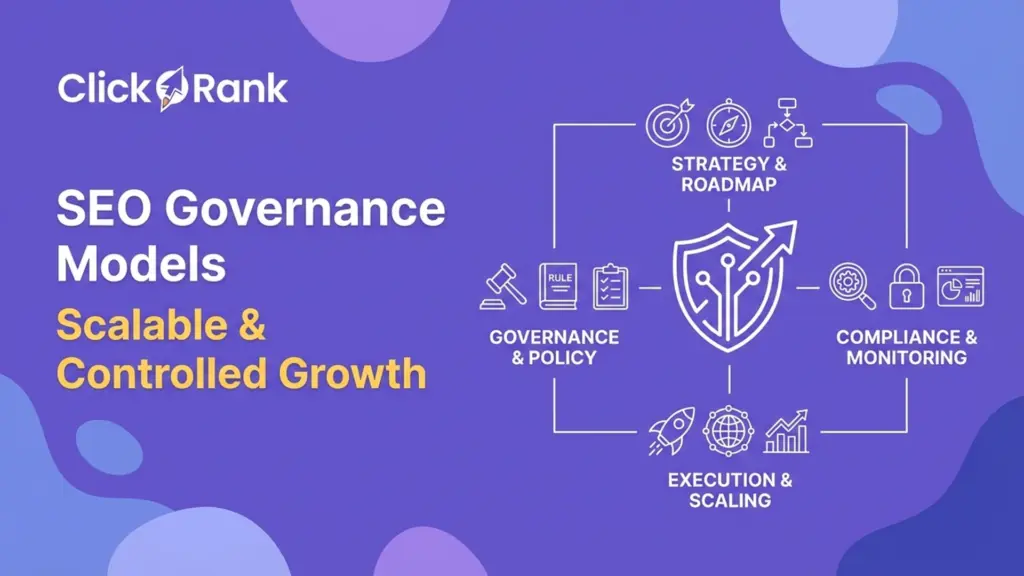
SEO Governance Maturity Models help organizations measure, structure, and scale their SEO processes systematically. They provide a clear framework to move from chaotic, reactive SEO efforts to structured, optimized performance systems.
Many SEO teams struggle not because of poor tactics, but because of weak governance. Without defined ownership, workflows, and performance controls, even strong SEO strategies fail to scale. This is why SEO Governance Maturity Models are becoming essential in modern organizations.
In this guide, you’ll learn how governance maturity works, how to assess your current level, and how to build a roadmap toward optimized SEO operations. SEO strategy helping you connect governance with long-term search growth.
SEO Governance Maturity Models: Concept, Scope, and Relevance
SEO Governance Maturity Models define how structured, controlled, and scalable an organization’s SEO operations are. They provide a framework to evaluate how strategy, technical processes, content workflows, and reporting systems are managed across teams.
Many companies invest in SEO but fail to scale results because governance is weak or undefined. Without clear ownership, approval systems, and performance tracking, SEO becomes reactive instead of strategic. That limits long-term growth.
SEO Governance Maturity Models help organizations move from informal execution to structured systems that support sustainable rankings. They clarify responsibilities, reduce risk, and improve alignment with business goals. When governance is strong, SEO becomes predictable, measurable, and scalable instead of dependent on individual effort.
What Is an SEO Governance Maturity Model?
An SEO Governance Maturity Model is a structured framework used to measure how organized and scalable SEO processes are within an organization. It evaluates governance across strategy, technical control, content standards, workflows, and reporting systems.
| Maturity Level | Characteristics | SEO Governance State |
|---|---|---|
| Level 1: Initial | Chaotic, reactive, no documentation. | Ad-hoc: No defined ownership. |
| Level 2: Managed | Project-based, some tracking. | Siloed: SEO sits only in Marketing. |
| Level 3: Defined | Documented workflows, standard KPIs. | Structured: Cross-team alignment. |
| Level 4: Predictable | Data-driven, automated checks. | Integrated: Part of the Dev/CMS cycle. |
| Level 5: Optimized | Continuous improvement, ROI-focused. | Strategic: Board-level accountability. |
At lower maturity levels, SEO tasks are handled informally. Decisions may depend on one person, and processes are rarely documented. At higher maturity levels, SEO is embedded into development cycles, content production, and executive planning.
For example, a low-maturity team may publish content without keyword validation. A high-maturity team follows documented guidelines, approval workflows, and performance tracking. This model helps organizations identify gaps and build repeatable systems that support long-term growth instead of short-term wins.
Why Are SEO Teams Struggling Without Governance?
SEO teams struggle without governance because there is no clear structure for accountability, approvals, and risk control. Work becomes reactive, and performance depends on individual effort instead of standardized systems.
Common problems include delayed technical fixes, inconsistent content optimization, and unmanaged site changes that impact rankings. Developers may deploy updates without SEO review. Content teams may publish pages without alignment to strategy.
Without governance, reporting also becomes unclear. Leadership cannot measure impact or justify investment. This leads to underfunded SEO programs and slow growth.
SEO Governance Maturity Models solve this by defining roles, processes, and checkpoints. When governance is structured, teams collaborate efficiently, risks are reduced, and SEO performance becomes more stable and predictable.
How Does Governance Influence Long-Term SEO Performance?
Governance directly influences long-term SEO performance by ensuring consistency, risk control, and strategic alignment. Strong governance prevents ranking losses caused by unmanaged changes and supports continuous optimization.
When governance is mature, technical updates follow review processes. Content creation aligns with keyword strategy. Reporting connects SEO outcomes to business metrics. This consistency builds authority and trust with search engines over time.
For example, websites with governance standards avoid accidental noindex tags, broken internal links, or duplicate content issues. These small controls protect long-term visibility.
SEO Governance Maturity Models ensure SEO is treated as a strategic function, not a set of isolated tasks. Over time, this leads to stronger domain authority, better cross-team collaboration, and more reliable organic growth.
Who Should Use an SEO Governance Maturity Framework?
Any organization that wants scalable, predictable SEO growth should use an SEO Governance Maturity Framework. It is especially important for enterprise websites, multi-team environments, and fast-growing companies.
Small businesses benefit by building structured systems early. Mid-sized companies use it to reduce workflow confusion. Enterprises rely on it to coordinate developers, content teams, marketing leaders, and executives across departments.
For example, an eCommerce company managing thousands of product pages needs clear technical governance to prevent crawl issues. A SaaS company needs content governance to maintain topical authority.
SEO Governance Maturity Models provide clarity on where the organization stands and what must improve. This framework helps leadership reduce risk, increase efficiency, and scale SEO performance systematically.
Understanding SEO Governance in Modern Organizations
SEO governance in modern organizations means creating clear rules, workflows, and accountability systems that guide how SEO is executed. It ensures SEO is not random, but controlled, documented, and aligned with business goals.
As websites grow, multiple teams touch the site developers, content writers, UX teams, and marketing leaders. Without governance, these changes can conflict and harm performance. That is why SEO Governance Maturity Models focus heavily on structure, approval systems, and cross-team alignment.
In modern environments, SEO governance connects strategy with execution. It defines who approves changes, how updates are reviewed, and how risks are controlled. When governance is mature, SEO becomes part of organizational systems instead of an isolated marketing task.
What Does SEO Governance Really Mean in Practice?
SEO governance in practice means having documented processes, defined ownership, and structured review systems for all SEO-related changes. It turns SEO from a set of tasks into a managed operational framework.
In real terms, this includes:
- Clear approval workflows for technical changes
- Content guidelines aligned with keyword strategy
- Defined KPIs and reporting standards
- Assigned SEO accountability across departments
For example, before a website update goes live, it must pass an SEO review. Content teams follow structured optimization checklists. Developers work within SEO-friendly templates.
SEO Governance Maturity Models measure how consistently these systems are applied. Governance is not theory it is about repeatable, controlled execution that protects rankings and supports long-term growth.
How Is SEO Governance Different from SEO Management?
SEO governance defines the rules and structure, while SEO management focuses on daily execution. Governance sets the framework; management runs the operations within that framework.
SEO management includes tasks like keyword research, content optimization, and link building. Governance determines how those tasks are approved, documented, and measured.
For example, management might create a content calendar. Governance ensures that calendar aligns with business objectives, follows review workflows, and tracks ROI.
Without governance, management becomes reactive. With governance, execution becomes consistent and scalable. SEO Governance Maturity Models help organizations move from task-based management to system-based governance, which supports predictable growth instead of isolated wins.
Why Is Governance Becoming Critical in Enterprise SEO?
Governance is critical in enterprise SEO because large organizations have complex websites and multiple decision-makers. Without structured control, even small changes can create large ranking losses.
Enterprise sites often manage:
- Thousands of URLs
- Multiple subdomains
- Global teams
- Frequent technical deployments
In such environments, unmanaged changes can break templates, remove metadata, or create crawl issues. Governance ensures every major update follows review protocols.
SEO Governance Maturity Models are especially valuable at enterprise scale because they reduce chaos. They align developers, content teams, and executives under shared standards. Without governance, enterprise SEO becomes unstable. With governance, it becomes predictable and scalable.
How Does Governance Reduce SEO Risk and Dependency?
Governance reduces SEO risk by standardizing processes and reducing reliance on individual expertise. It creates systems that prevent mistakes instead of fixing them after traffic drops.
When SEO depends on one specialist, risk increases. If that person leaves, knowledge gaps appear. Governance documents processes, assigns roles, and embeds SEO into workflows.
This reduces risks such as:
- Accidental deindexing
- Broken internal linking
- Unoptimized new content
- Poor migration planning
SEO Governance Maturity Models focus on shifting from person-dependent execution to system-driven control. When governance is mature, SEO performance remains stable even when teams change.
How Do Poor Approval Processes Harm SEO?
Poor approval processes create delays, inconsistencies, and missed optimization opportunities. When technical or content updates require unclear or slow approvals, SEO tasks remain pending for weeks. This slows implementation of critical fixes such as metadata updates or internal linking improvements.
In some cases, changes go live without SEO review because approval systems are unclear. This increases the risk of broken redirects, duplicate pages, or incorrect canonical tags. Over time, these errors accumulate and weaken rankings.
Strong governance introduces structured approval checkpoints. It defines who reviews what, when it must be approved, and how documentation is stored. This clarity reduces errors and ensures SEO improvements are implemented consistently and on time.
Why Do Uncontrolled Changes Affect Rankings?
Uncontrolled website changes can negatively impact rankings because search engines rely on consistent structure and signals. When developers modify templates, URLs, or navigation without SEO review, they may unintentionally remove critical elements like title tags, schema markup, or internal links.
Even small changes such as altering heading structure or blocking pages in robots.txt can disrupt crawling and indexing. Without governance controls, these risks increase as site complexity grows.
SEO governance ensures that every major change follows a review protocol. Testing environments, documentation logs, and rollback plans protect visibility. Controlled execution helps maintain ranking stability, especially during redesigns or migrations.
How Do Silos Create SEO Inefficiencies?
Silos create SEO inefficiencies because teams work independently without shared goals or communication. Content teams may focus on publishing volume, while developers prioritize speed, and marketing focuses on paid campaigns. Without coordination, SEO opportunities are missed.
For example, a content team may produce articles without technical optimization support. Developers may release features without considering crawlability. Leadership may not see SEO data in executive reports.
Governance breaks silos by defining shared KPIs, cross-team workflows, and communication channels. When SEO Governance Maturity Models are applied, teams operate within a unified structure. This alignment improves efficiency, reduces duplication, and strengthens long-term search performance.
Why SEO Maturity Matters for Sustainable Growth
SEO maturity matters because it determines whether organic growth is stable, scalable, and predictable. Organizations with higher maturity levels operate through systems, not guesswork.
When SEO is immature, results depend on short-term tactics. When maturity increases, governance, measurement, and structured execution drive long-term authority. This is the core purpose of SEO Governance Maturity Models they help organizations move from reactive fixes to strategic growth systems.
Sustainable growth requires consistent optimization, risk management, and cross-team alignment. SEO maturity ensures technical updates are controlled, content follows clear standards, and reporting connects performance to business outcomes. Without maturity, growth fluctuates. With maturity, performance compounds over time.
How Does SEO Maturity Impact Business Performance?
SEO maturity directly improves business performance by increasing traffic stability, conversion quality, and ROI predictability. Structured governance ensures SEO efforts align with revenue goals, not just rankings.
At higher maturity levels:
- Keyword targeting aligns with business priorities
- Technical errors are minimized
- Content supports customer journeys
- Reporting links SEO to revenue metrics
For example, a mature organization tracks not just traffic, but assisted conversions and pipeline value. This makes SEO measurable at the executive level.
SEO Governance Maturity Models help companies shift from traffic-focused reporting to business-impact reporting. When maturity improves, SEO becomes a revenue driver instead of a support channel.
What Happens When SEO Remains at Low Maturity Levels?
When SEO remains at low maturity levels, growth becomes inconsistent and risky. Execution depends on individuals, processes are undocumented, and mistakes frequently occur.
Common problems include:
- Duplicate content issues
- Delayed technical fixes
- Unstructured content production
- Poor cross-team communication
Without structured governance, rankings fluctuate with every site update. Teams spend more time fixing errors than building authority.
Low maturity also makes forecasting difficult. Leadership cannot confidently invest in SEO because performance is unpredictable. SEO Governance Maturity Models exist to solve this by defining clear progression steps toward stability and scalability.
Why Do High-Maturity Teams Outperform Competitors?
High-maturity teams outperform competitors because they operate through systems that compound results over time. They reduce risk, increase efficiency, and align SEO with long-term strategy.
These teams:
- Follow documented workflows
- Use structured approval systems
- Align content and technical strategy
- Monitor performance proactively
For example, during a site migration, a high-maturity team follows a governance checklist, preventing traffic loss. A low-maturity competitor may experience ranking drops due to poor planning.
SEO Governance Maturity Models create competitive advantage by turning SEO into an operational discipline. Over time, this structured execution builds stronger domain authority and sustainable visibility.
How Does Maturity Improve Decision-Making?
SEO maturity improves decision-making by providing reliable data, clear accountability, and structured evaluation frameworks. Decisions are based on performance trends instead of assumptions.
At higher maturity levels, organizations use:
- Defined KPIs tied to business goals
- Standardized reporting dashboards
- Regular governance reviews
- Documented change logs
This structure allows leadership to prioritize investments with confidence. Instead of reacting to traffic drops, teams proactively adjust strategy based on measurable signals.
SEO Governance Maturity Models strengthen decision quality by connecting governance systems with performance metrics. This reduces guesswork and increases long-term strategic clarity.
How Does Maturity Affect Budget Allocation?
SEO maturity improves budget allocation because investments are guided by data and structured planning. When governance systems are mature, leadership can see which initiatives generate measurable returns. This allows funding to shift toward high-impact activities such as technical optimization, content expansion, or automation tools.
In low-maturity environments, budgets are often reactive. Teams request resources after traffic drops or algorithm updates. This creates unstable spending patterns. Mature governance introduces forecasting models and performance benchmarks, which support long-term financial planning.
When SEO Governance Maturity Models are applied, budgeting becomes strategic instead of emotional. Organizations allocate resources based on growth potential, risk reduction, and competitive positioning rather than short-term urgency.
How Does It Improve Stakeholder Confidence?
SEO maturity improves stakeholder confidence because performance becomes transparent, measurable, and predictable. Executives trust programs that show consistent reporting, documented processes, and clear ROI indicators. Governance reduces uncertainty.
When leadership sees structured workflows, defined KPIs, and risk controls, SEO gains credibility as a strategic function. This increases executive support and cross-department collaboration.
Low-maturity SEO often struggles to secure buy-in because results appear inconsistent. High-maturity governance changes that perception. Through structured evaluation and reporting frameworks, organizations build trust across teams. This confidence enables long-term investment and strengthens the role of SEO within overall business strategy.
Core Dimensions of SEO Governance Maturity
The core dimensions of SEO Governance Maturity define the areas that must be structured, measured, and controlled to achieve scalable SEO performance. These dimensions ensure governance is not limited to strategy alone but embedded across technical systems, content workflows, and operational processes.
SEO Governance Maturity Models evaluate organizations across multiple pillars to identify strengths and weaknesses. Without assessing these dimensions, governance becomes incomplete and reactive. Each pillar works together to create stability and long-term growth.
By understanding these core dimensions, organizations can diagnose governance gaps, reduce operational risk, and create structured systems that protect rankings while supporting expansion. Strong maturity requires alignment across strategy, technology, and execution.
What Are the Key Pillars of SEO Governance?
The key pillars of SEO governance include strategic alignment, technical control, content standards, workflow management, and performance measurement. These pillars create a complete governance structure.
The main pillars are:
- Strategic Governance – Alignment with business goals
- Technical Governance – Control over site infrastructure and deployments
- Content Governance – Standardized editorial and optimization rules
- Workflow Governance – Documented approval and execution processes
- Measurement Governance – KPI tracking and reporting systems
SEO Governance Maturity Models measure how well each pillar is defined and enforced. Weakness in any pillar creates instability. Strong governance requires balance across all dimensions to ensure SEO is scalable and protected.
How Is Strategic Governance Evaluated?
Strategic governance is evaluated by measuring how closely SEO aligns with business objectives and long-term growth plans. It ensures SEO is not operating independently from revenue, brand positioning, or market strategy.
Evaluation typically includes:
- Alignment between keyword strategy and revenue goals
- Executive involvement in SEO planning
- Defined long-term SEO roadmap
- Clear ownership of strategic direction
If SEO operates separately from leadership planning, maturity is low. High maturity means SEO is integrated into annual planning and performance forecasting.
SEO Governance Maturity Models assess whether strategy drives execution or whether SEO is reacting to short-term tasks.
Is SEO Aligned With Business Objectives?
Alignment means SEO targets reflect business priorities such as revenue growth, market expansion, or product launches. If SEO focuses only on traffic volume without considering profitability or customer intent, strategic governance is weak.
High alignment connects keyword clusters to product categories, service lines, and customer acquisition goals. Reporting dashboards reflect pipeline contribution and conversion value, not just impressions.
When SEO Governance Maturity Models show strong alignment, organizations experience consistent ROI growth. Alignment reduces wasted effort and ensures optimization work supports measurable business outcomes.
Are Long-Term SEO Goals Clearly Defined?
Clear long-term goals define where SEO performance should be in one, two, or three years. These goals may include authority growth, expansion into new keyword categories, or international visibility.
Without documented long-term objectives, SEO becomes reactive. Teams chase short-term ranking wins without building structured authority.
Mature governance defines milestones, resource planning, and measurable targets tied to strategy. SEO Governance Maturity Models assess whether these goals exist and whether progress is tracked. Clear direction strengthens prioritization and supports sustainable growth instead of fragmented execution.
How Is Technical Governance Assessed?
Technical governance is assessed by examining how website changes are reviewed, documented, and controlled before deployment. It ensures site updates do not damage rankings.
Assessment includes:
- Formal SEO review before code releases
- Documented technical standards
- Migration protocols
- Crawl and index monitoring systems
If developers deploy changes without SEO oversight, maturity is low. High maturity includes pre-launch testing, rollback plans, and change logs.
SEO Governance Maturity Models measure how consistently technical controls are applied. Strong technical governance protects visibility and reduces ranking volatility caused by unmanaged changes.
Are Technical Changes Reviewed Systematically?
Systematic review means every significant change such as template updates, URL restructuring, or navigation changes passes through SEO validation. This prevents accidental removal of metadata, schema, or internal linking structures.
Low-maturity environments rely on informal communication. High-maturity organizations use documented checklists and staging environments.
When SEO Governance Maturity Models identify systematic review processes, risk is significantly reduced. Structured reviews prevent ranking losses and protect search visibility during ongoing development cycles.
Is SEO Integrated Into Development Cycles?
Integration means SEO is included in sprint planning, feature development, and deployment workflows. Developers consider crawlability, performance, and structure before releasing updates.
Without integration, SEO becomes an afterthought. Issues are discovered after traffic declines, increasing recovery costs.
High maturity embeds SEO guidelines into development documentation and project management tools. SEO Governance Maturity Models evaluate whether collaboration exists between SEO and engineering teams. Strong integration improves efficiency and ensures technical optimization supports long-term strategy.
How Is Content Governance Structured?
Content governance is structured by defining editorial standards, optimization rules, and approval workflows for all published content. It ensures consistency and quality at scale.
Structured governance includes:
- Documented content guidelines
- Keyword validation requirements
- Internal linking standards
- Content performance review cycles
Low maturity allows inconsistent optimization. High maturity enforces clear rules and structured publishing workflows.
SEO Governance Maturity Models assess whether content production is standardized or informal. Strong content governance strengthens topical authority and prevents duplication or cannibalization issues.
Are Editorial Guidelines Standardized?
Standardized editorial guidelines define tone, formatting, keyword usage, and linking practices. They reduce inconsistency and ensure content aligns with SEO objectives.
Without guidelines, writers may optimize pages differently, creating uneven quality. High-maturity teams maintain documented playbooks and update them regularly.
SEO Governance Maturity Models measure how consistently guidelines are applied. Standardization improves efficiency and strengthens search engine trust over time by maintaining quality signals across the website.
Is SEO Embedded in Content Creation?
Embedding SEO in content creation means optimization happens during drafting, not after publishing. Writers use keyword frameworks, intent analysis, and internal linking rules from the beginning.
Low maturity treats SEO as a final editing step. High maturity integrates SEO into planning, outlines, and performance evaluation.
When SEO Governance Maturity Models show strong integration, content supports strategic goals and builds authority systematically. This reduces rework, improves efficiency, and ensures every published asset contributes to long-term visibility growth.
How Is Workflow and Process Governance Managed?
Workflow and process governance are managed by creating structured, documented systems that control how SEO tasks move from planning to execution. This ensures consistency, accountability, and risk reduction across teams.
In mature organizations, every SEO initiative follows a defined path: planning, review, approval, implementation, and performance tracking. Project management tools are used to log tasks, assign ownership, and track deadlines. There are clear checkpoints before publishing content or deploying technical updates.
SEO Governance Maturity Models evaluate whether workflows are repeatable and documented or informal and inconsistent. Strong workflow governance reduces bottlenecks, prevents duplicated work, and protects rankings from rushed deployments. When processes are structured, SEO becomes scalable and less dependent on individual memory or ad hoc communication.
Are Approval Workflows Documented?
Documented approval workflows define how changes are reviewed, who signs off, and what criteria must be met before implementation. This prevents confusion and protects SEO quality standards.
In low-maturity environments, approvals happen through casual messages or verbal agreement. This increases the risk of missed steps. High-maturity governance includes written checklists, review templates, and mandatory validation before launch. These workflows are stored in shared documentation systems so all teams can follow them consistently.
SEO Governance Maturity Models assess whether approval processes are standardized or informal. When workflows are documented, organizations reduce delays, minimize mistakes, and ensure SEO best practices are applied across technical and content updates.
Is Responsibility Clearly Assigned?
Clear responsibility means every SEO-related task has a defined owner who is accountable for execution and quality. Without assigned ownership, tasks are delayed or overlooked.
High-maturity governance defines roles such as SEO lead, technical reviewer, content optimizer, and reporting manager. Each role has documented duties and performance expectations. Responsibility is visible within workflow systems, reducing confusion.
In contrast, low-maturity organizations often experience overlap or gaps in accountability. This creates inefficiencies and missed optimization opportunities. SEO Governance Maturity Models measure whether roles are formally assigned and understood. Clear accountability strengthens execution speed and ensures consistent performance across departments.
How Is Measurement and Reporting Governed?
Measurement and reporting are governed by defining structured KPIs, standardized dashboards, and consistent review cycles. Governance ensures performance tracking is accurate, aligned with business goals, and transparent across teams.
Mature organizations establish reporting frameworks that connect rankings, traffic, and conversions to revenue impact. Reports are delivered on a set schedule and reviewed by leadership. Data definitions remain consistent to avoid confusion.
SEO Governance Maturity Models evaluate whether reporting is structured or fragmented. When governance is strong, decision-making becomes data-driven. Teams can identify issues early, justify budget allocation, and measure strategic progress. Structured reporting transforms SEO from an activity-based function into a measurable growth channel.
Are KPIs Defined and Tracked?
Defined KPIs clarify what success looks like and how progress is measured. These indicators may include organic revenue, keyword visibility growth, crawl health metrics, or conversion rates from search traffic.
Low-maturity organizations track basic metrics such as traffic volume without linking them to business outcomes. High-maturity governance connects KPIs to strategic goals and tracks them consistently over time.
SEO Governance Maturity Models assess whether KPIs are documented, monitored regularly, and reviewed by stakeholders. Clear KPIs improve accountability and allow teams to adjust strategy proactively instead of reacting to performance declines.
Is Reporting Consistent Across Teams?
Consistent reporting means all departments rely on standardized dashboards, metric definitions, and review schedules. This prevents conflicting interpretations of performance data.
Without governance, marketing, content, and development teams may track different metrics, leading to confusion. High-maturity organizations align reporting structures so everyone measures progress using the same indicators.
SEO Governance Maturity Models examine whether reporting is centralized and uniform. When consistency exists, leadership gains confidence in performance trends. Teams collaborate more effectively because decisions are based on shared data, not isolated reports.
The SEO Governance Maturity Model Framework
The SEO Governance Maturity Model Framework defines structured levels that show how advanced and scalable an organization’s SEO governance is. It provides a roadmap from informal execution to fully optimized, system-driven governance.
SEO Governance Maturity Models are designed to help organizations understand where they stand and what improvements are required. Instead of guessing, teams can benchmark their governance practices across strategy, technical control, workflows, and reporting.
This framework is practical. It identifies risks at lower levels and highlights structured advantages at higher levels. By understanding each stage, organizations can plan controlled progression rather than making random improvements. The model creates clarity, alignment, and measurable advancement toward sustainable SEO growth.
How Many Levels Does the Model Contain?
The SEO Governance Maturity Model typically contains five progressive levels. Each level represents a shift from reactive execution to optimized, automated governance systems.
The five levels are:
- Ad Hoc Governance
- Basic Governance
- Managed Governance
- Integrated Governance
- Optimized and Automated Governance
These levels are not just labels. They describe how structured processes are, how clearly roles are defined, and how well risks are controlled.
SEO Governance Maturity Models use these levels to diagnose governance gaps. Most organizations fall between Level 1 and Level 3. Moving upward requires documentation, cross-team coordination, and measurable performance control. Each level builds on the previous one, strengthening stability and scalability.
What Does Each Maturity Level Represent?
Each maturity level represents the degree of structure, control, and strategic integration within SEO operations. Lower levels reflect informal and reactive practices, while higher levels reflect proactive and system-based governance.
At early levels, SEO depends on individuals. Processes are undocumented, and changes are risky. At mid-level maturity, workflows are documented and performance tracking improves. At advanced levels, governance is embedded across departments, supported by automation and predictive controls.
SEO Governance Maturity Models treat maturity as progressive improvement. Advancement means reduced risk, better collaboration, and stronger performance consistency. Each stage reflects a deeper integration of SEO into the organization’s operational systems.
Level 1 – Ad Hoc Governance
Level 1 represents informal, reactive SEO execution with little or no structured governance. Processes are inconsistent, undocumented, and dependent on individual effort.
At this stage, SEO Governance Maturity Models classify organizations as highly vulnerable to performance instability. There are no clear workflows, approval systems, or strategic alignment mechanisms.
What Does SEO Look Like at This Stage?
At Level 1, SEO tasks are handled sporadically. Keyword research may happen occasionally, but there is no structured roadmap. Technical updates go live without SEO review. Content is published without optimization guidelines.
Communication is informal, and reporting focuses only on surface metrics like traffic. There is no long-term strategy. SEO often reacts to ranking drops rather than preventing them.
This stage is common in small teams or organizations that treat SEO as secondary. Governance is minimal, and execution depends heavily on one person’s knowledge.
What Are the Main Risks?
The primary risks at Level 1 include ranking volatility, technical errors, and inconsistent content quality. Without review systems, simple mistakes such as broken redirects or duplicate pages can damage visibility.
There is also knowledge risk. If the main SEO specialist leaves, processes collapse because nothing is documented. Strategic alignment is weak, so SEO efforts may not support revenue goals.
SEO Governance Maturity Models classify this level as high-risk due to lack of control mechanisms. Small errors can have large consequences.
Why Is Growth Limited Here?
Growth is limited because execution lacks consistency and scalability. Without structured workflows, optimization efforts are irregular. Technical problems remain unresolved for long periods.
There is no systematic authority building. Content strategy is fragmented, and reporting lacks business alignment. As a result, improvements are temporary rather than compounding.
Organizations at this stage often experience traffic spikes followed by declines. Sustainable growth requires moving beyond informal execution toward documented governance systems.
Level 2 – Basic Governance
Level 2 represents early-stage governance where processes are starting to form but remain inconsistent. Some documentation exists, and awareness of SEO standards is improving.
At this level, SEO Governance Maturity Models identify partial structure but limited integration across teams. Governance exists, but it is not fully enforced.
How Are Processes Beginning to Form?
Processes at Level 2 begin to take shape through simple checklists and informal review steps. Teams may create keyword guidelines or basic technical documentation. Some approvals are required before publishing content.
However, these processes are not consistently followed. They depend on individual initiative rather than organizational enforcement. Project management tools may be used, but standards vary across departments.
This stage reflects progress from chaos toward control, but governance is still fragile and vulnerable to inconsistency.
What Documentation Exists?
Documentation at Level 2 often includes basic SEO guidelines, keyword research templates, and technical best-practice notes. There may be shared folders containing process outlines.
However, documentation is incomplete. Not all workflows are covered, and updates are irregular. New team members may struggle to understand standards due to limited onboarding materials.
SEO Governance Maturity Models classify this stage as transitional. Documentation exists, but it lacks depth, enforcement, and organization-wide adoption.
Where Do Bottlenecks Still Occur?
Bottlenecks at Level 2 typically occur in approvals, technical deployments, and cross-team coordination. Because governance is not fully standardized, tasks may stall when key individuals are unavailable.
For example, content may wait for technical implementation, or developers may delay SEO fixes due to unclear prioritization. Reporting inconsistencies can also slow decision-making.
These bottlenecks limit scalability. While governance is improving, structured integration is still missing. Advancing beyond this level requires stronger enforcement, clearer ownership, and consistent documentation practices.
Level 3 – Managed Governance
Level 3 represents structured and documented SEO governance where processes are standardized and consistently followed. At this stage, SEO is no longer reactive; it operates within defined systems and measurable controls.
Organizations at this level have moved beyond informal practices. SEO Governance Maturity Models classify Level 3 as the point where stability begins. Workflows are documented, responsibilities are assigned, and performance tracking is aligned with business objectives.
While governance is strong, integration across all departments may still be developing. However, execution is predictable, and risks are significantly reduced compared to earlier levels.
How Are SEO Processes Standardized?
At Level 3, SEO processes are documented and consistently applied. Teams use structured checklists for content optimization, technical releases, and keyword validation. Templates exist for audits, reporting, and implementation reviews.
These standards are stored in shared systems and updated regularly. New team members follow onboarding documentation to ensure consistency. Governance is not dependent on memory or informal communication.
SEO Governance Maturity Models consider this level stable because execution follows repeatable systems. Standardization reduces errors, improves efficiency, and strengthens long-term visibility by maintaining consistent optimization practices across the organization.
How Is Performance Tracked?
Performance at Level 3 is tracked through defined KPIs connected to business outcomes. Dashboards monitor organic traffic, keyword visibility, conversions, and technical health metrics.
Reporting cycles are scheduled and shared with stakeholders. Teams review trends regularly to identify risks or growth opportunities. Metrics are no longer isolated; they reflect broader strategic goals.
SEO Governance Maturity Models evaluate whether performance data drives decisions. At this level, tracking is consistent and structured. This allows organizations to detect problems early and refine strategy based on measurable insights rather than assumptions.
How Are Teams Coordinated?
Coordination at Level 3 happens through defined workflows and shared accountability. SEO teams collaborate with developers and content creators using project management systems that track responsibilities and deadlines.
Regular cross-team meetings align priorities and resolve bottlenecks. Documentation ensures everyone understands standards and expectations.
While coordination is structured, full integration across departments may still be improving. However, SEO Governance Maturity Models recognize Level 3 as the point where collaboration becomes organized and predictable, reducing inefficiencies and strengthening operational stability.
Level 4 – Integrated Governance
Level 4 represents fully integrated SEO governance where SEO is embedded across departments and proactively managed. SEO is part of organizational systems, not a separate function.
At this stage, SEO Governance Maturity Models identify strong cross-department alignment. Strategy, development, content, and reporting operate within shared governance standards.
SEO decisions are integrated into planning cycles, and risk prevention is proactive rather than reactive.
How Is SEO Embedded Across Departments?
SEO at Level 4 is integrated into marketing, development, UX, and product teams. SEO requirements are included in sprint planning, content calendars, and campaign launches.
Developers consult SEO standards before deploying changes. Content teams align topics with strategic keyword clusters. Leadership reviews SEO performance during business planning meetings.
This integration ensures SEO influences decisions early, not after execution. SEO Governance Maturity Models consider this a high-performance stage because collaboration reduces errors and supports scalable growth.
How Are Changes Governed Proactively?
Proactive governance means potential SEO risks are evaluated before implementation. Pre-launch audits, staging tests, and structured review protocols are standard practice.
Organizations maintain change logs and rollback plans. Risk scenarios are anticipated during redesigns or migrations. Governance is preventive, not corrective.
At Level 4, SEO Governance Maturity Models show strong control systems that protect rankings during frequent updates. This reduces volatility and builds long-term authority.
How Is Knowledge Shared Organization-Wide?
Knowledge sharing at this level is structured and continuous. SEO guidelines, best practices, and performance insights are documented in shared repositories.
Training sessions and internal workshops keep teams aligned. Updates to search engine behavior are communicated quickly across departments.
SEO Governance Maturity Models identify strong knowledge systems as a key factor in maintaining maturity. Shared learning prevents dependency on individuals and strengthens consistency across teams.
Level 5 – Optimized and Automated Governance
Level 5 represents fully optimized and automated SEO governance supported by advanced monitoring and continuous improvement systems. Governance is proactive, data-driven, and scalable.
At this highest level, SEO Governance Maturity Models classify organizations as resilient and highly competitive. Systems detect risks early and adapt to algorithm changes quickly.
SEO is deeply embedded in operational infrastructure and strategic planning.
How Is Automation Supporting Governance?
Automation at Level 5 monitors crawl health, detects ranking volatility, and flags technical issues in real time. Dashboards update automatically, reducing manual reporting.
Workflow tools trigger SEO review steps during development cycles. Alerts notify teams of sudden traffic shifts or indexing problems.
Automation supports governance by improving speed and accuracy. SEO Governance Maturity Models recognize automation as a force multiplier that enhances efficiency while maintaining structured control.
How Are Risks Prevented Systematically?
Systematic risk prevention involves continuous monitoring, predictive analysis, and strict review protocols. Technical deployments pass automated validation checks before release.
Algorithm impact analysis and scenario planning are part of governance strategy. Risk mitigation plans are documented and tested.
At this level, SEO Governance Maturity Models show minimal exposure to preventable errors. Risks are anticipated and controlled rather than discovered after damage occurs.
How Is Continuous Improvement Enabled?
Continuous improvement is enabled through regular audits, performance benchmarking, and structured experimentation. Data insights inform strategy updates, and lessons learned are documented.
Organizations conduct periodic governance reviews to identify optimization opportunities. Automation supports rapid testing without compromising stability.
SEO Governance Maturity Models position Level 5 as a dynamic system rather than a fixed endpoint. Governance evolves alongside search engine changes, ensuring sustainable and competitive SEO performance over time.
How to Assess Your Current SEO Governance Maturity
You can assess your current SEO Governance Maturity by systematically evaluating your strategy, technical controls, workflows, and reporting against defined maturity levels. The goal is to identify whether your SEO operations are reactive, structured, integrated, or optimized.
SEO Governance Maturity Models are not theoretical they are diagnostic tools. Assessment helps organizations uncover hidden risks, workflow gaps, and alignment problems before they damage performance.
A proper evaluation looks at documentation, accountability, review systems, KPI tracking, and cross-team coordination. The outcome should clearly show your current level and what improvements are required to move forward. Without assessment, governance improvements become random instead of strategic.
How Can Organizations Perform a Self-Assessment?
Organizations can perform a self-assessment by reviewing governance practices across all core dimensions and scoring them against maturity criteria. This requires structured evaluation, not guesswork.
A practical approach includes:
- Review documented SEO processes
- Evaluate technical approval workflows
- Analyze content governance standards
- Check reporting structure and KPI alignment
- Assess cross-team collaboration
Each area can be scored from Level 1 (ad hoc) to Level 5 (optimized). Leadership should compare actual execution with documented policies.
SEO Governance Maturity Models recommend using evidence-based scoring. Instead of asking “Do we have governance?”, ask “Is this documented, enforced, and consistently applied?” This ensures accurate maturity classification.
What Questions Should Be Asked at Each Level?
At each maturity level, organizations should ask structured questions that test documentation, consistency, and alignment. The goal is to measure real governance strength, not intention.
Examples include:
- Are SEO processes documented and followed consistently?
- Are technical changes reviewed before deployment?
- Are KPIs linked to business outcomes?
- Is accountability clearly assigned?
- Are risks monitored proactively?
Lower-level answers often reveal informal practices. Higher-level answers show system-driven execution.
SEO Governance Maturity Models use these diagnostic questions to expose governance weaknesses. The deeper and more evidence-based the answers, the more accurate the maturity evaluation becomes.
How Can Gaps Be Identified Accurately?
Gaps can be identified accurately by comparing documented governance standards with actual execution behavior. Many organizations believe processes exist, but daily operations reveal inconsistencies.
To identify gaps:
- Compare written guidelines with real workflow activity
- Review recent technical deployments for SEO validation
- Analyze reporting consistency across departments
- Conduct interviews with key stakeholders
Discrepancies between documentation and practice reveal maturity weaknesses. For example, a checklist may exist but not be enforced during urgent releases.
SEO Governance Maturity Models emphasize evidence-based evaluation. Accurate gap identification requires transparency, cross-team input, and review of real operational cases not assumptions.
How Often Should Maturity Be Reviewed?
SEO Governance Maturity should be reviewed at least annually, with additional reviews during major organizational or technical changes. Governance evolves as teams grow and websites expand.
Annual reviews allow organizations to measure progress and adjust roadmaps. However, significant events such as site migrations, leadership changes, or large-scale redesigns require immediate reassessment.
SEO Governance Maturity Models treat governance as dynamic. Regular review prevents stagnation and ensures processes adapt to algorithm updates, new tools, and structural growth.
Frequent review strengthens accountability and keeps governance aligned with strategic goals instead of becoming outdated documentation.
Which Teams Should Be Involved in Assessment?
Assessment should involve SEO leaders, developers, content managers, marketing stakeholders, and executive representatives. Governance affects multiple departments, so evaluation must reflect diverse perspectives.
SEO teams provide operational insights. Developers clarify deployment workflows. Content teams explain editorial standards. Leadership ensures strategic alignment.
Involving multiple teams prevents biased scoring and reveals hidden workflow gaps. SEO Governance Maturity Models emphasize cross-functional input because governance failures often occur between departments, not within a single team.
Comprehensive involvement improves assessment accuracy and builds shared accountability for governance improvements.
How Should Results Be Documented?
Results should be documented in a structured maturity report that includes scoring, identified gaps, risk levels, and recommended actions. This report should clearly define the current maturity level and outline steps required for progression.
Documentation must include evidence, not opinions. Screenshots of workflows, KPI dashboards, and process guidelines support accurate conclusions. Action items should be prioritized by impact and feasibility.
SEO Governance Maturity Models encourage storing these reports in centralized knowledge systems. Clear documentation enables leadership tracking, supports accountability, and provides a benchmark for future reviews. Without written records, maturity progress cannot be measured effectively.
SEO Governance Assessment Checklist
An SEO Governance Assessment Checklist is a structured list of control questions used to evaluate governance strength across strategy, technical systems, content, workflows, and reporting. It ensures organizations review all critical areas instead of focusing on isolated issues.
SEO Governance Maturity Models rely on structured checklists to measure consistency and risk exposure. Without a checklist, assessments become subjective and incomplete. A strong checklist highlights missing documentation, weak approval systems, and unclear accountability.
This checklist should be used during annual governance reviews or major operational changes. It provides a practical tool to benchmark current maturity and prioritize improvements. When applied consistently, it turns governance evaluation into a repeatable process rather than a one-time exercise.
What Strategic Governance Questions Should Be Asked?
Strategic governance questions should test alignment between SEO initiatives and business objectives. The focus is on direction, ownership, and long-term planning.
Key questions include:
- Is SEO aligned with revenue and growth targets?
- Are long-term SEO goals clearly documented?
- Is there executive sponsorship for SEO strategy?
- Are keyword priorities tied to business value?
- Is there a formal SEO roadmap?
SEO Governance Maturity Models emphasize that strategy must guide execution. If SEO operates independently from business planning, maturity is low. Clear strategic documentation and executive involvement indicate higher maturity levels and stronger scalability potential.
What Technical Governance Controls Should Exist?
Technical governance controls should ensure that all website changes are reviewed, tested, and documented before deployment. These controls protect rankings from accidental damage.
Essential controls include:
- Mandatory SEO review before code releases
- Staging environment validation processes
- Change logs for deployments
- Structured migration checklists
- Crawl monitoring and index tracking systems
If technical updates bypass SEO validation, governance risk increases significantly. SEO Governance Maturity Models measure whether controls are standardized and consistently enforced. Strong technical governance prevents ranking volatility and supports stable long-term growth.
What Content Governance Standards Are Required?
Content governance standards should define how content is planned, optimized, reviewed, and updated. These standards ensure consistency and strategic alignment.
Required elements include:
- Documented keyword research framework
- Editorial style and formatting guidelines
- Internal linking standards
- Content approval workflows
- Performance review cycles
Without clear standards, content quality varies and authority building becomes inconsistent. SEO Governance Maturity Models assess whether content governance is structured and scalable. Strong standards improve efficiency, reduce duplication, and strengthen search engine trust signals over time.
What Workflow Controls Must Be in Place?
Workflow controls must define how SEO tasks move from planning to execution with clear ownership and review checkpoints. These controls prevent bottlenecks and reduce errors.
Important workflow controls include:
- Assigned task ownership
- Defined approval hierarchies
- Project tracking systems
- Escalation procedures for urgent issues
- Documentation repositories
If workflows depend on informal communication, governance maturity remains low. SEO Governance Maturity Models evaluate whether processes are documented and repeatable. Strong workflow controls increase accountability, accelerate execution, and reduce dependency on individual knowledge.
What Reporting Structures Should Be Evaluated?
Reporting structures should be evaluated to ensure KPI alignment, consistency, and executive visibility. Reporting must connect SEO performance to business outcomes.
Evaluation should include:
- Defined KPI framework
- Standardized dashboards
- Scheduled reporting cycles
- Clear metric definitions
- Executive-level summaries
If departments track different metrics or reports lack strategic context, governance gaps exist. SEO Governance Maturity Models assess reporting consistency across teams. Strong reporting structures improve decision-making, justify investment, and strengthen stakeholder confidence in SEO as a growth channel.
KPIs and Metrics for SEO Governance Maturity
KPIs and metrics for SEO Governance Maturity measure how well governance systems protect performance, reduce risk, and support scalable growth. These indicators go beyond rankings and traffic. They evaluate process strength, compliance, and operational control.
SEO Governance Maturity Models require structured measurement to validate progress between levels. Without governance-focused KPIs, organizations may believe processes are working while hidden risks remain.
Effective measurement connects workflow discipline, technical stability, and strategic alignment to business outcomes. When governance metrics are tracked consistently, leadership gains visibility into operational health not just search visibility. Strong KPI frameworks turn governance from theory into measurable performance infrastructure.
Which KPIs Reflect Governance Quality?
KPIs that reflect governance quality focus on stability, compliance, and structured execution rather than just traffic growth. They measure how controlled and predictable SEO operations are.
Examples include:
- Percentage of technical releases reviewed by SEO
- Content compliance rate with optimization standards
- Average resolution time for SEO issues
- Frequency of ranking volatility after deployments
- Documentation coverage rate for workflows
SEO Governance Maturity Models emphasize operational reliability. If errors frequently follow deployments or guidelines are inconsistently followed, governance quality is weak.
High-quality governance KPIs show consistent review processes, minimal avoidable ranking drops, and stable performance trends over time.
How Should Process Compliance Be Measured?
Process compliance should be measured by auditing whether documented workflows are consistently followed in real execution. Compliance is not about having documentation it is about applying it.
Measurement methods include:
- Random audits of recent content publications
- Review of technical deployment logs
- Tracking approval timestamps in project tools
- Monitoring adherence to SEO checklists
For example, if only 60% of technical updates pass through SEO review, compliance maturity is low.
SEO Governance Maturity Models rely on compliance tracking to differentiate between theoretical governance and enforced governance. Consistent compliance indicates higher maturity and lower operational risk.
What Risk Indicators Should Be Tracked?
Risk indicators should track events that signal governance breakdown or instability. These indicators help detect early warning signs before traffic declines.
Important risk metrics include:
- Sudden indexing drops
- Increase in crawl errors
- Unauthorized page changes
- Duplicate content spikes
- Unexpected ranking volatility
High-risk environments often show frequent technical mistakes or unreviewed deployments.
SEO Governance Maturity Models treat risk monitoring as a core maturity signal. The more proactive and systematic the monitoring, the higher the governance level. Risk indicators allow teams to act early instead of reacting to major performance losses.
How Can Performance Trends Be Linked to Governance?
Performance trends can be linked to governance by analyzing how structured processes influence ranking stability and growth consistency. Governance should directly correlate with predictable improvement.
For example, after implementing structured technical reviews, ranking volatility should decrease. After standardizing content workflows, keyword coverage should expand consistently.
Organizations can compare performance periods before and after governance upgrades. Improvements in stability, issue resolution time, and growth rate often indicate rising maturity.
SEO Governance Maturity Models connect operational discipline with measurable performance outcomes. Strong governance creates fewer disruptions, faster implementation, and steady authority growth.
How Do Governance KPIs Differ by Maturity Level?
Governance KPIs evolve as maturity increases. At low levels, organizations may only track traffic and keyword rankings. These metrics do not reflect operational quality.
At mid-level maturity, compliance rates, issue resolution speed, and deployment review percentages become important. At advanced levels, predictive risk monitoring and automation accuracy are measured.
SEO Governance Maturity Models show that higher maturity requires deeper operational metrics. Governance KPIs shift from surface performance indicators to structural stability indicators that protect long-term growth.
How Should Metrics Be Reported to Leadership?
Metrics should be reported to leadership in simplified dashboards that connect governance indicators to business impact. Executives need clarity, not technical detail overload.
Reports should include:
- Governance compliance score
- Risk trend summary
- Performance stability indicators
- Business-aligned SEO KPIs
Visual summaries help leadership understand whether governance improvements are strengthening performance reliability.
SEO Governance Maturity Models emphasize executive visibility. When governance metrics are clearly communicated, leadership confidence increases, budget allocation improves, and SEO gains strategic importance within the organization.
Building an SEO Governance Roadmap
Building an SEO Governance roadmap means creating a structured plan to move from your current maturity level to a higher, more stable level. It turns insights from SEO Governance Maturity Models into practical action steps.
Without a roadmap, governance improvements stay theoretical. Teams know gaps exist but lack a clear sequence for fixing them. A roadmap defines phases, owners, timelines, and measurable outcomes.
This roadmap should align with business strategy, technical capacity, and available resources. It must focus on risk reduction first, then scalability. When structured correctly, the roadmap transforms governance from a reactive effort into a planned progression toward optimized and integrated SEO systems.
How Can Organizations Move Between Maturity Levels?
Organizations move between maturity levels by strengthening documentation, enforcing compliance, and improving cross-team integration step by step. Progression is gradual, not instant.
To move from Level 1 to Level 2, teams must document basic workflows and introduce approval checkpoints.
To move from Level 2 to Level 3, processes must be standardized and consistently enforced.
Advancing further requires deeper integration and automation.
SEO Governance Maturity Models show that improvement depends on discipline. Each maturity jump requires measurable evidence, such as improved compliance rates or reduced deployment errors.
The key is structured progression. Skipping foundational governance controls often creates instability later.
What Should a Governance Roadmap Include?
A governance roadmap should include maturity targets, gap analysis findings, prioritized initiatives, assigned ownership, and defined KPIs. It must clearly outline what will change and how success will be measured.
Core roadmap components include:
- Current maturity level assessment
- Target maturity level and timeline
- Identified governance gaps
- Action plan by pillar (strategy, technical, content, workflow, reporting)
- Assigned responsible stakeholders
- Success metrics and review schedule
SEO Governance Maturity Models emphasize structured planning. A roadmap without KPIs or accountability becomes a document that is never executed. Clear structure ensures governance improvements are measurable and realistic.
How Should Priorities Be Set?
Priorities should be set based on risk exposure, business impact, and feasibility. Not all governance gaps require immediate action.
High-risk areas such as unmanaged technical deployments or missing approval workflows should be addressed first. These weaknesses directly threaten rankings. Medium-priority initiatives may include reporting standardization or documentation upgrades.
SEO Governance Maturity Models recommend evaluating initiatives by:
- Risk reduction potential
- Revenue impact
- Implementation complexity
- Resource availability
This structured prioritization prevents teams from focusing on low-impact improvements while major risks remain unresolved. Effective sequencing accelerates maturity progression.
How Long Does Each Stage Usually Take?
The time required to move between maturity levels depends on organizational size, resources, and leadership commitment. There is no fixed timeline, but realistic expectations are essential.
Smaller organizations may move from Level 1 to Level 2 within three to six months. Mid-sized or enterprise organizations may require six to twelve months to standardize processes and improve compliance.
Advancing to higher maturity levels such as integration or automation often takes one to two years due to cultural and technical changes.
SEO Governance Maturity Models stress patience and consistency. Governance improvement is a structural transformation, not a short-term campaign.
How Can Resources Be Allocated Effectively?
Effective resource allocation requires aligning governance initiatives with strategic objectives and operational capacity. Leadership should assign dedicated time and personnel rather than expecting governance to happen alongside regular tasks.
Budget allocation should prioritize risk control measures first, such as technical validation systems or workflow documentation. After stabilizing governance, resources can support integration tools or automation systems.
Cross-functional collaboration also matters. Developers, content managers, and SEO leads must share responsibility. SEO Governance Maturity Models highlight that maturity progression fails when resources are underfunded or inconsistently assigned. Clear investment planning increases the likelihood of sustainable governance improvement.
How Should Change Management Be Handled?
Change management should be handled through clear communication, structured training, and phased implementation. Governance improvements often require cultural shifts, not just process updates.
Teams should understand why new approval workflows or documentation standards are necessary. Leadership must communicate the risk reduction and performance benefits. Training sessions help ensure compliance.
Phased rollout reduces resistance. Instead of implementing all changes at once, organizations can pilot new workflows in one department before scaling.
SEO Governance Maturity Models show that governance progression depends on adoption. Structured change management reduces resistance and ensures long-term sustainability of new governance systems.
Governance Roles and Responsibilities in SEO
Governance roles and responsibilities in SEO define who makes decisions, who executes controls, and who ensures compliance across the organization. Clear ownership prevents confusion, delays, and risk exposure.
SEO Governance Maturity Models emphasize that governance fails when roles are unclear. Without defined accountability, technical changes bypass review, content standards are ignored, and reporting becomes inconsistent. Strong governance assigns responsibility across leadership, SEO specialists, developers, content teams, and executives.
Each role must understand its scope and decision authority. Governance is not owned by one department alone it is a shared structure with centralized coordination. When responsibilities are clearly defined, SEO operations become stable, scalable, and less dependent on individual effort.
Who Owns SEO Governance?
SEO governance should be owned by a designated SEO leader or Head of SEO with cross-department authority. Ownership ensures accountability and consistent enforcement of standards.
The governance owner is responsible for:
- Defining SEO policies and workflows
- Ensuring compliance across teams
- Aligning SEO with business objectives
- Reporting governance performance to leadership
Without clear ownership, governance becomes fragmented. Teams may follow different standards or ignore review protocols.
SEO Governance Maturity Models show that maturity increases significantly when governance has a central owner. While execution is distributed, strategic control and oversight must remain clearly assigned.
What Is the Role of SEO Leaders?
SEO leaders are responsible for designing governance frameworks, enforcing standards, and aligning SEO with long-term strategy. They act as coordinators between technical, content, and executive teams.
Their responsibilities include:
- Creating structured workflows
- Defining KPIs and reporting systems
- Reviewing major technical changes
- Training teams on SEO best practices
SEO leaders also identify governance gaps and propose roadmap improvements. They ensure that SEO Governance Maturity Models are applied consistently and evaluated regularly.
Strong SEO leadership reduces risk and strengthens collaboration. Without proactive leadership, governance documentation may exist but remain unenforced.
How Do Developers Support Governance?
Developers support governance by integrating SEO standards into technical workflows and deployment processes. They ensure changes do not negatively affect crawlability, indexing, or site structure.
Their governance responsibilities include:
- Participating in pre-launch SEO reviews
- Following technical SEO checklists
- Maintaining structured data and metadata standards
- Supporting staging environment validation
In mature organizations, developers collaborate closely with SEO teams during sprint planning. SEO Governance Maturity Models highlight that technical governance cannot succeed without engineering involvement.
When developers understand SEO priorities and follow documented processes, ranking stability improves and risk exposure decreases significantly.
How Do Content Teams Participate?
Content teams participate in governance by following standardized editorial and optimization guidelines. Their role is to ensure every published asset aligns with keyword strategy and quality standards.
Responsibilities include:
- Using structured keyword research frameworks
- Following internal linking rules
- Adhering to formatting and metadata standards
- Reviewing performance data for updates
Content governance reduces inconsistency and prevents duplication issues. SEO Governance Maturity Models emphasize embedding SEO into content planning rather than treating optimization as a final step.
When content teams follow documented standards, authority builds systematically. This strengthens topical depth and supports long-term organic growth.
How Should Executive Oversight Work?
Executive oversight should provide strategic alignment, resource allocation, and accountability for SEO governance performance. Leadership ensures SEO is treated as a business priority, not a secondary function.
Executives should:
- Review governance KPIs regularly
- Approve roadmap investments
- Support cross-department collaboration
- Reinforce accountability structures
SEO Governance Maturity Models show that maturity stalls without executive involvement. Governance improvements often require budget, structural adjustments, and cultural change.
Strong oversight ensures SEO remains aligned with company objectives. When leadership actively monitors governance progress, SEO gains credibility, stability, and long-term strategic value.
Technology and Tools for SEO Governance
Technology and tools strengthen SEO governance by creating visibility, control, and automation across workflows and reporting systems. They reduce manual errors and improve compliance tracking.
SEO Governance Maturity Models show that governance becomes scalable only when supported by the right platforms. As organizations grow, manual tracking and informal communication create risk. Tools help standardize approvals, monitor performance, and document processes consistently.
However, technology does not replace governance it supports it. Tools must align with structured workflows and defined ownership. When integrated properly, platforms improve transparency, accelerate implementation, and protect rankings from preventable mistakes. Strong governance combines documented systems with controlled technology use.
How Do SEO Platforms Support Governance?
SEO platforms support governance by centralizing data, monitoring technical health, and tracking performance against defined KPIs. They create visibility across departments.
These platforms help by:
- Monitoring crawl errors and index coverage
- Tracking keyword performance trends
- Identifying technical SEO issues
- Providing structured reporting dashboards
SEO Governance Maturity Models rely on consistent data visibility. Without centralized platforms, reporting becomes fragmented and inconsistent.
For example, using structured dashboards ensures leadership sees stable metrics across review cycles. Platforms transform raw data into governance insights, allowing teams to detect risks early and maintain structured performance monitoring.
How Can Workflow Tools Improve Control?
Workflow tools improve control by formalizing task assignments, approval stages, and implementation timelines. They prevent informal communication from disrupting governance standards.
Project management systems allow:
- Clear task ownership
- Approval checkpoints before publishing
- Deadline tracking
- Escalation procedures
In low-maturity environments, approvals happen through emails or messages. Workflow tools enforce structure by requiring validation steps before task completion.
SEO Governance Maturity Models show that governance strengthens when workflows are embedded in task systems. Control increases because processes become visible and traceable rather than dependent on memory.
How Does Documentation Software Help?
Documentation software supports governance by storing policies, guidelines, and review checklists in centralized, accessible systems. It ensures consistency and knowledge retention.
Documentation tools help organizations:
- Maintain SEO playbooks
- Store technical standards
- Track governance updates
- Provide onboarding materials
Without centralized documentation, governance becomes person-dependent. Teams may follow outdated practices or inconsistent rules.
SEO Governance Maturity Models emphasize documentation maturity as a progression signal. When guidelines are structured, version-controlled, and regularly updated, governance becomes sustainable. Documentation software preserves institutional knowledge and reduces operational confusion.
How Can Automation Reduce Governance Risks?
Automation reduces governance risks by detecting errors, monitoring performance, and enforcing compliance in real time. It minimizes human oversight gaps.
Automation can:
- Trigger alerts for crawl errors
- Detect ranking volatility
- Monitor indexing anomalies
- Flag missing metadata
By automating repetitive checks, organizations reduce the likelihood of unnoticed technical mistakes.
SEO Governance Maturity Models classify automation as a high-level maturity indicator. However, automation must complement structured processes, not replace oversight. Properly implemented, it increases efficiency and strengthens operational resilience.
Which Processes Can Be Automated Safely?
Certain governance processes can be automated safely when rules are clearly defined. These include technical health monitoring, broken link detection, metadata validation, and ranking fluctuation alerts.
Automated dashboards can also generate periodic compliance reports. Workflow tools can automatically require approval before deployment. These automated checks reduce manual workload and prevent common technical errors.
SEO Governance Maturity Models recognize safe automation as a sign of operational efficiency. However, automation must be monitored to ensure it functions correctly. Regular validation prevents overreliance on automated systems.
Where Is Human Review Still Essential?
Human review remains essential for strategic decisions, content quality evaluation, migration planning, and complex technical changes. Automation cannot fully evaluate search intent alignment or brand messaging quality.
Major site updates, structural redesigns, and high-risk deployments require expert analysis. Governance frameworks depend on human judgment to interpret data and adjust strategy.
SEO Governance Maturity Models stress that mature governance balances automation with expert oversight. Automation improves speed and monitoring accuracy, but human expertise ensures strategic alignment and risk awareness.
Risk Management Through SEO Governance
Risk management through SEO governance prevents avoidable ranking losses by enforcing structured controls, review systems, and proactive monitoring. Governance turns SEO from a reactive discipline into a risk-controlled operational system.
SEO Governance Maturity Models treat risk prevention as a core objective. Many traffic drops are not caused by algorithms alone but by unmanaged technical updates, inconsistent content publishing, or poor deployment planning. Strong governance minimizes these internal risks.
When review workflows, documentation, and compliance monitoring are standardized, SEO performance becomes more stable. Governance does not eliminate all risk, but it significantly reduces preventable damage and accelerates recovery when issues occur.
What SEO Risks Can Governance Prevent?
Governance can prevent technical errors, content inconsistencies, indexing problems, and deployment-related ranking losses. Most operational SEO risks are avoidable with structured controls.
Common preventable risks include:
- Accidental noindex tags
- Broken redirects
- Duplicate content creation
- Internal linking disruptions
- Unreviewed template changes
SEO Governance Maturity Models highlight that low-maturity environments experience repeated technical mistakes. With structured approval systems and documented workflows, these errors decrease significantly.
Risk prevention begins with clarity clear ownership, clear checklists, and clear validation before deployment. Strong governance acts as a protective layer that safeguards search visibility.
How Does Governance Reduce Algorithm Impact?
Governance reduces algorithm impact by ensuring consistent quality standards and proactive monitoring. While algorithms cannot be controlled, risk exposure can be minimized.
Websites with structured content guidelines, technical validation processes, and stable authority signals are less vulnerable to ranking volatility. Governance ensures that optimization follows search engine best practices consistently.
SEO Governance Maturity Models emphasize continuous monitoring of performance trends and compliance metrics. When early warning indicators are tracked, organizations can adapt quickly after algorithm updates.
Strong governance builds resilience. Instead of reacting in panic, mature organizations evaluate data, identify root causes, and adjust strategically.
How Are Website Migrations Governed?
Website migrations are governed through structured planning, documented checklists, staged testing, and post-launch monitoring. Governance ensures visibility is protected during high-risk transitions.
A governed migration process typically includes:
- Pre-migration SEO audit
- URL mapping and redirect validation
- Staging environment testing
- Technical review before launch
- Post-launch crawl monitoring
SEO Governance Maturity Models classify migration governance as a high-risk evaluation point. Without structured planning, migrations often cause severe traffic drops.
Strong governance introduces accountability and step-by-step validation. This significantly reduces ranking instability during redesigns or platform changes.
How Are Emergency Changes Controlled?
Emergency changes are controlled through predefined escalation procedures and rapid review protocols. Even urgent updates must pass governance checkpoints.
In mature environments, emergency workflows include:
- Immediate risk assessment
- Shortened but mandatory SEO validation
- Documented change logs
- Post-deployment monitoring
SEO Governance Maturity Models show that low-maturity teams often bypass governance during emergencies, increasing damage. High-maturity organizations maintain control even under pressure.
Structured emergency governance prevents rushed decisions from creating long-term visibility problems.
How Should Crisis Response Be Structured?
Crisis response should follow a predefined governance framework that includes rapid diagnosis, clear ownership, and structured communication. Teams must first identify the root cause technical error, algorithm shift, or deployment issue.
Next, responsibilities are assigned for resolution. Documentation logs capture every corrective step. Leadership is informed through structured reporting to maintain transparency.
SEO Governance Maturity Models stress that preparation determines response quality. Organizations with predefined crisis protocols recover faster because they avoid confusion and duplication of effort.
How Can Recovery Be Accelerated?
Recovery can be accelerated by combining structured issue resolution with focused performance monitoring. Immediate technical fixes must be validated through crawl and index checks.
Content updates should address any identified quality gaps. Performance dashboards must track ranking and traffic trends daily during recovery phases.
SEO Governance Maturity Models highlight that recovery speed depends on documentation and coordination. When workflows are clear and accountability is defined, corrective actions happen faster. Structured governance transforms recovery from reactive scrambling into organized remediation.
Common Challenges in SEO Governance Maturity
Organizations struggle with SEO Governance Maturity because governance requires structure, discipline, and cross-team alignment. Many teams focus on tactics while ignoring operational systems that support long-term stability.
SEO Governance Maturity Models show that progression often slows due to cultural resistance, unclear ownership, and inconsistent enforcement. Even when documentation exists, it may not be applied consistently.
Governance maturity is not only about processes it is about behavior. Without leadership support and accountability, governance frameworks weaken over time. Understanding these common challenges helps organizations proactively address them and maintain steady progress toward higher maturity levels.
Why Do Organizations Get Stuck at Low Levels?
Organizations get stuck at low maturity levels because governance improvements are often deprioritized in favor of short-term results. Teams focus on traffic growth instead of operational structure.
Common reasons include:
- Lack of documented workflows
- Limited executive attention
- Underfunded SEO programs
- Overdependence on one specialist
Without structured investment, governance remains informal. SEO Governance Maturity Models reveal that stagnation often occurs when teams underestimate the impact of operational discipline.
Breaking out of low maturity requires leadership commitment and dedicated resources. Governance must be treated as a strategic initiative, not an optional improvement.
How Does Resistance to Change Affect Governance?
Resistance to change slows governance implementation because new workflows and controls often disrupt existing habits. Teams may see documentation or approval systems as additional workload.
Developers may resist mandatory SEO reviews. Content teams may avoid structured guidelines. Leadership may hesitate to allocate budget for governance tools.
SEO Governance Maturity Models emphasize that governance progression requires cultural adaptation. Without buy-in, compliance drops and processes weaken.
Clear communication about risk reduction and performance stability helps reduce resistance. Demonstrating measurable benefits such as fewer ranking losses builds confidence in governance systems.
Why Do Processes Break Down Over Time?
Processes break down over time when documentation is outdated, compliance is not monitored, or leadership oversight weakens. Governance requires continuous reinforcement.
Common breakdown factors include:
- Team turnover
- Rapid organizational growth
- Unmonitored workflow deviations
- Lack of periodic maturity reviews
Without regular audits, teams gradually bypass approval systems. Documentation becomes outdated, and governance loses effectiveness.
SEO Governance Maturity Models stress the importance of recurring evaluation. Governance must evolve with technical complexity and algorithm changes. Continuous monitoring prevents gradual decline in operational discipline.
How Can Leadership Gaps Be Addressed?
Leadership gaps can be addressed by assigning clear governance ownership and strengthening executive involvement. Without leadership accountability, governance lacks authority.
Solutions include:
- Appointing a Head of SEO governance
- Defining executive reporting requirements
- Linking governance KPIs to performance reviews
- Allocating budget for governance initiatives
SEO Governance Maturity Models show that leadership engagement directly influences maturity progression. When executives monitor compliance and performance stability, governance becomes embedded in organizational culture.
Strong leadership reinforces accountability, secures resources, and ensures SEO governance remains aligned with long-term business strategy.
Best Practices for Advancing SEO Governance Maturity
Advancing SEO Governance Maturity requires structured documentation, strong collaboration, continuous training, and ongoing process evaluation. Improvement does not happen automatically it must be managed intentionally.
SEO Governance Maturity Models show that organizations progress faster when governance is treated as a long-term operational upgrade, not a one-time fix. Each maturity jump requires reinforcement of standards, enforcement of workflows, and alignment across departments.
Best practices focus on creating systems that remain stable even as teams grow or change. When documentation is clear, collaboration is structured, and improvement cycles are consistent, governance becomes scalable. These practices help organizations move steadily toward integrated and optimized governance levels.
How Can Documentation Be Standardized?
Documentation can be standardized by creating centralized, version-controlled governance playbooks and enforcing consistent formatting. Standardization reduces confusion and improves onboarding efficiency.
Best practices include:
- Creating structured SEO policy documents
- Using shared templates for audits and reviews
- Defining naming conventions and version control
- Scheduling regular documentation updates
SEO Governance Maturity Models emphasize that documentation must be clear, accessible, and actively maintained. Outdated documents weaken governance effectiveness.
Standardization ensures every team follows the same rules. It transforms documentation from static reference material into an operational foundation that supports consistent execution and accountability.
How Can Cross-Team Collaboration Be Strengthened?
Cross-team collaboration can be strengthened by aligning KPIs, formalizing communication channels, and embedding SEO into planning cycles. Collaboration must be structured, not informal.
Effective practices include:
- Shared project management systems
- Cross-department planning meetings
- Unified KPI dashboards
- Defined escalation procedures
SEO Governance Maturity Models highlight that governance often fails between departments, not within them. Structured collaboration prevents silos and reduces workflow delays.
When teams share goals and reporting frameworks, decision-making becomes faster and more consistent. Strong collaboration strengthens governance maturity by ensuring every department operates within the same standards.
How Should Training Be Structured?
Training should be structured through scheduled sessions, updated guidelines, and role-specific education programs. Governance maturity depends on knowledge consistency.
Best practices include:
- Onboarding modules for new hires
- Quarterly SEO governance workshops
- Documentation walkthrough sessions
- Update briefings after algorithm changes
SEO Governance Maturity Models show that training prevents process erosion over time. Without structured education, teams may unknowingly bypass governance rules.
Training should be practical and focused on real workflows. Reinforcing standards regularly ensures compliance and strengthens maturity progression across all levels.
How Can Continuous Improvement Be Maintained?
Continuous improvement can be maintained through regular governance audits, KPI reviews, and structured feedback loops. Governance must evolve with organizational growth.
Effective maintenance includes:
- Annual maturity reassessments
- Compliance audits
- Post-project governance reviews
- KPI trend analysis
SEO Governance Maturity Models treat governance as dynamic. Continuous improvement prevents stagnation and identifies weaknesses early.
By reviewing processes regularly and refining documentation, organizations maintain stability while adapting to change. This discipline ensures maturity progression remains steady and sustainable.
Common Mistakes to Avoid in SEO Governance
Common mistakes in SEO governance include over-centralization, poor documentation, inconsistent reviews, and excessive reliance on tools. These errors weaken structured systems and reduce scalability.
SEO Governance Maturity Models reveal that governance fails not only from absence of structure but also from misapplied control. Avoiding these mistakes preserves operational balance and supports sustainable growth.
Strong governance requires flexibility within structure. Organizations must enforce standards while maintaining collaboration and adaptability. Recognizing common pitfalls helps teams protect their maturity progress.
Why Is Over-Centralization Risky?
Over-centralization is risky because it creates bottlenecks and reduces team agility. When all decisions require approval from a single authority, execution slows.
While governance needs ownership, excessive control discourages collaboration and delays implementation. Teams may bypass governance due to frustration.
SEO Governance Maturity Models encourage balanced authority. Strategic oversight should remain centralized, but operational execution must be distributed.
Balanced governance improves speed while maintaining control. Over-centralization reduces scalability and weakens team engagement.
How Does Under-Documentation Create Problems?
Under-documentation creates problems by increasing confusion, inconsistency, and knowledge dependency. Without clear guidelines, execution varies across teams.
Common issues include:
- Unclear optimization standards
- Inconsistent approval processes
- Knowledge loss during staff turnover
SEO Governance Maturity Models identify documentation gaps as a primary cause of maturity stagnation.
Strong documentation supports accountability and onboarding. Without it, governance becomes informal and vulnerable to breakdown over time.
Why Do Inconsistent Reviews Harm Performance?
Inconsistent reviews harm performance because unmanaged changes can introduce technical errors or content misalignment. Even small inconsistencies accumulate over time.
If some deployments pass SEO review while others do not, risk exposure increases. Governance depends on uniform enforcement.
SEO Governance Maturity Models emphasize compliance consistency as a maturity signal. Stable review processes reduce ranking volatility and improve performance predictability.
Consistency ensures governance functions as intended rather than as optional guidance.
How Does Tool Dependency Limit Governance?
Tool dependency limits governance when organizations rely on automation without structured processes and human oversight. Tools support governance but do not replace it.
Overreliance on platforms can create blind spots if alerts are ignored or misinterpreted. Governance requires judgment and strategic alignment.
SEO Governance Maturity Models stress that tools enhance visibility and efficiency but cannot enforce accountability alone.
Balanced governance combines structured workflows, documented standards, automation, and human expertise. Excessive dependency on tools without process discipline weakens maturity progression.
Implementing SEO Governance at Scale
Implementing SEO governance at scale requires structured coordination, standardized systems, and controlled flexibility across departments and regions. As organizations grow, informal governance collapses under complexity.
SEO Governance Maturity Models show that scaling introduces new risks multiple teams, international websites, and frequent deployments increase exposure. Governance must evolve from simple documentation to structured global frameworks.
At scale, the focus shifts to alignment, enforcement, and communication. Central oversight must work alongside regional execution. Without structured scaling, SEO becomes fragmented and inconsistent. With controlled expansion, governance strengthens authority while supporting global growth.
How Does Governance Change in Large Organizations?
In large organizations, governance shifts from team-level control to enterprise-level coordination and oversight. Decision-making becomes more layered and structured.
Large companies require:
- Formal governance committees
- Cross-department planning cycles
- Enterprise reporting dashboards
- Structured escalation procedures
SEO Governance Maturity Models show that complexity increases risk. Without enterprise governance, regional teams may implement inconsistent practices.
Large-scale governance introduces structured approvals, shared KPIs, and defined accountability frameworks. Execution remains distributed, but standards are centralized. This balance supports scalability without losing control.
How Should Global SEO Teams Be Coordinated?
Global SEO teams should be coordinated through centralized standards combined with regional execution authority. Clear communication systems are essential.
Best practices include:
- Global SEO playbooks
- Shared keyword frameworks
- Unified reporting dashboards
- Regular cross-region alignment meetings
SEO Governance Maturity Models emphasize clarity in role distribution. Global leadership sets standards; local teams adapt execution to language and market needs.
Coordination prevents duplication and conflicting strategies. Structured communication ensures consistency while supporting market-specific optimization efforts.
How Can Local Flexibility Be Maintained?
Local flexibility can be maintained by defining non-negotiable standards while allowing regional customization within structured boundaries. Governance should guide, not restrict unnecessarily.
For example, global metadata standards may be fixed, but local keyword targeting can vary by region. Technical structures remain standardized, but content tone may adapt culturally.
SEO Governance Maturity Models recommend separating core governance rules from adaptable practices. This approach preserves authority and consistency while enabling market responsiveness.
Flexibility within structure prevents rigid systems from limiting growth.
How Are Standards Enforced Across Regions?
Standards are enforced across regions through centralized documentation, compliance monitoring, and regular governance audits. Enforcement must be measurable.
Effective enforcement methods include:
- Compliance scorecards
- Periodic maturity assessments
- Structured reporting reviews
- Governance training sessions
SEO Governance Maturity Models highlight the importance of accountability. Regional teams should report compliance metrics to central leadership.
When enforcement mechanisms are transparent and consistent, governance remains strong even across multiple countries and departments.
Future Trends in SEO Governance Maturity
Future trends in SEO Governance Maturity will focus on AI-driven monitoring, automation, compliance control, and predictive risk management. Governance will become more proactive and data-driven.
SEO Governance Maturity Models are evolving as search ecosystems change. Increasing algorithm complexity, privacy regulations, and automation tools require stronger governance frameworks.
Organizations that invest in adaptive governance systems will remain competitive. The future of governance lies in combining automation with strategic oversight to maintain stability and scalability.
How Will AI Influence Governance Models?
AI will influence governance models by enhancing monitoring, forecasting, and compliance analysis. AI systems can detect patterns and anomalies faster than manual review.
AI can:
- Identify ranking volatility early
- Detect content gaps
- Predict technical risks
- Analyze performance trends
SEO Governance Maturity Models will integrate AI insights into governance dashboards. However, AI must support structured processes, not replace governance strategy.
Organizations that combine AI monitoring with documented workflows will strengthen maturity progression and reduce operational risk.
How Will Automation Reshape Approval Processes?
Automation will reshape approval processes by embedding compliance checks directly into workflows. Automated triggers can require validation before deployment.
For example, technical releases may not proceed without passing SEO validation scripts. Content management systems can enforce metadata requirements automatically.
SEO Governance Maturity Models recognize automation as a maturity accelerator. Automated approval checkpoints reduce human oversight gaps and improve efficiency.
However, human review remains essential for strategic decisions. Automation enhances speed and consistency but must align with structured governance frameworks.
How Will Privacy and Compliance Affect SEO Governance?
Privacy and compliance regulations will require stronger documentation, data transparency, and structured risk management within SEO governance. Governance must adapt to legal standards.
Organizations must ensure:
- Proper tracking consent management
- Data handling transparency
- Compliance reporting
- Secure analytics integration
SEO Governance Maturity Models will increasingly evaluate compliance readiness. Governance frameworks must align SEO performance tracking with privacy regulations.
Stronger compliance integration reduces legal risk and strengthens executive trust in SEO systems.
What Will High-Maturity SEO Look Like in the Future?
High-maturity SEO in the future will be fully integrated, automated, predictive, and aligned with enterprise strategy. Governance systems will monitor risk continuously.
Future high-maturity characteristics include:
- AI-driven anomaly detection
- Real-time compliance monitoring
- Predictive performance modeling
- Fully integrated cross-department workflows
SEO Governance Maturity Models will evolve into dynamic systems rather than static evaluations. Continuous adaptation will define top-performing organizations.
High-maturity SEO will operate as a structured operational discipline embedded across the organization, ensuring stable, scalable, and resilient organic growth.
Strategic Summary and Implementation Outlook
Organizations should treat SEO governance as a long-term strategic investment, not an operational afterthought. SEO Governance Maturity Models provide the structure needed to protect rankings, reduce risk, and scale growth sustainably.
Throughout this guide, we explored how governance impacts strategy, technical control, workflows, risk management, and performance reporting. Without structured governance, SEO remains reactive and unstable. With maturity, SEO becomes predictable, measurable, and aligned with business objectives.
The implementation outlook is clear: organizations that formalize governance today will outperform competitors tomorrow. Governance reduces volatility, strengthens collaboration, and builds long-term authority. The next step is structured action assessment, roadmap creation, and disciplined execution.
Why Should Organizations Invest in Governance Now?
Organizations should invest in governance now because search environments are more complex, competitive, and risk-sensitive than ever. Uncontrolled changes and inconsistent workflows can quickly damage visibility.
SEO Governance Maturity Models show that early governance investment reduces long-term recovery costs. Structured processes prevent avoidable ranking losses and improve cross-team coordination.
Waiting until traffic declines creates reactive spending and operational instability. Investing now strengthens resilience against algorithm updates, migrations, and organizational growth.
Governance transforms SEO from a fragile tactic into a durable business asset. Early adoption increases stability and improves long-term ROI predictability.
How Does Maturity Create Competitive Advantage?
SEO maturity creates competitive advantage by improving stability, scalability, and execution speed. Mature organizations compound growth while competitors struggle with inconsistency.
High-maturity governance ensures:
- Faster implementation cycles
- Fewer technical disruptions
- Better alignment with revenue goals
- Stronger authority accumulation
SEO Governance Maturity Models highlight that stability builds trust with search engines over time. Competitors operating at lower maturity levels experience volatility and missed opportunities.
Structured governance enables consistent optimization, better collaboration, and strategic forecasting. This creates sustainable differentiation in highly competitive markets.
What Are the Next Steps for Implementation?
The next steps for implementation are assessment, roadmap development, prioritization, and structured rollout. Governance improvement must follow a clear plan.
Start by conducting a formal maturity assessment. Identify gaps across strategy, technical control, content governance, workflows, and reporting. Then define a realistic target level and timeline.
Use a structured roadmap with measurable KPIs and assigned ownership. Begin with high-risk areas such as technical review processes or workflow documentation.
To strengthen planning clarity, use ClickRank’s Outline Generator to create structured governance documentation and process playbooks quickly. Clear structure accelerates maturity progression.
Ready to formalize your SEO systems?
Streamline your Free site audit . Identify governance gaps and protect your growth. Try it now!
What is an SEO Governance Maturity Model?
An SEO governance maturity model is a structured framework that helps organizations assess the strength and progression of their governance practices from informal or reactive SEO processes to formal, optimized, continuously improving practices. It breaks governance into defined levels so teams can evaluate where they stand and what actions are needed to advance.
Why Is Governance Important for SEO Success?
SEO governance ensures that optimization work is protected by documented standards, clear ownership, and defined review processes. Good governance prevents accidental SEO errors during product releases or site changes turning reactive firefighting into proactive decision-making and stable performance.
How Many Levels Are Typically in an SEO Governance Maturity Model?
Most governance maturity models include 4–5 levels, typically ranging from ad hoc or initial where processes are undocumented and reactive to optimized or sustained where governance is integrated, tracked, and continuously improved.
Who Can Benefit from Using a Governance Maturity Model?
Organizations of any size from small teams to large enterprises can benefit from a maturity model. Even teams with limited resources can use simple scorecards or checklists to map their current governance capabilities and decide what to prioritize next.
What Are Typical Domains Evaluated in a Governance Maturity Model?
A governance maturity model often assesses multiple domains such as strategic alignment, documented policies and standards, workflow governance, technical and content practices, and performance measurement. Each domain is scored to show weak spots and improvement opportunities.
How Does a Maturity Model Improve SEO Outcomes?
By providing a clear roadmap and checkpoints, an SEO governance maturity model helps reduce risk like unexpected traffic drops, improve cross-team alignment, document ownership, and embed SEO into core business processes leading to more stable and scalable SEO performance.