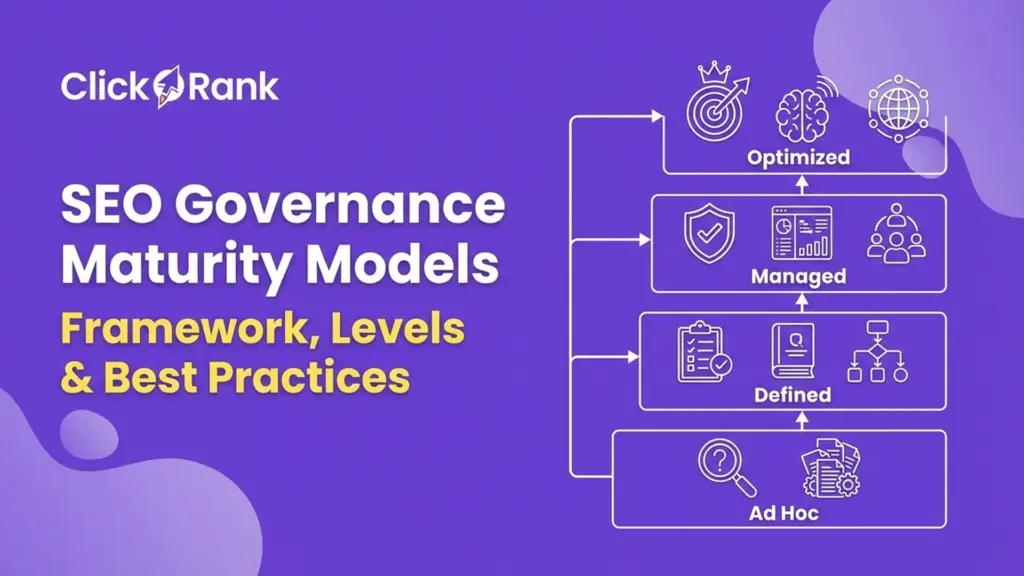
SEO Governance is a structured system of rules, roles, and workflows that dictates how SEO decisions are made and executed across an organization. Unlike daily management, SEO governance models establish long-term accountability, approval pipelines, and technical standards to ensure search efforts remain aligned with business goals and brand consistency.
What Is SEO Governance?
SEO governance is the structured system that defines how SEO decisions are made, approved, and monitored across an organization. It creates clear rules, ownership, and workflows so SEO efforts stay aligned with business goals and brand standards.
In simple terms, SEO governance models control who does what, who approves it, and how quality is maintained. Without governance, SEO becomes inconsistent, risky, and hard to scale. As companies grow, more teams touch content, code, and site structure. Governance ensures every change supports your broader SEO strategy , not just short-term wins.
Strong governance improves accountability, reduces costly errors, and makes SEO predictable. It turns SEO from a scattered activity into a controlled growth system that can scale across departments, regions, or product lines.
How does SEO governance differ from SEO management?
SEO governance defines the rules and decision rights, while SEO management handles daily execution. Governance controls structure; management controls tasks.
SEO management includes keyword research, on-page optimization, link building, and reporting. Governance, however, decides who approves technical changes, who owns content standards, and how conflicts are resolved. It creates accountability before execution begins.
For example, a manager may want to publish 50 new pages. Governance ensures those pages follow content guidelines, internal linking standards, and technical protocols. Without governance, teams act independently and create inconsistency.
Think of it this way: management drives the car; governance builds the traffic rules. Both matter, but governance keeps everything safe and aligned.
| Feature | SEO Governance (Strategy) | SEO Management (Execution) |
|---|---|---|
| Primary Goal | Define Rules & Guardrails | Execute Daily Tasks |
| Focus Area | Approval Workflows & Ownership | Keyword Research & Link Building |
| Stakeholders | C-Suite, IT, Legal, SEO Leads | Content Writers, SEO Specs, Devs |
| Risk Control | Prevents “Ranking Catastrophes” | Fixes On-Page Technical Errors |
| Analogy | The Building Codes (The “Law”) | The Construction (The “Work”) |
Why is governance critical for enterprise SEO success?
Governance is critical for enterprise SEO success because large organizations have multiple teams, complex websites, and higher risk exposure. Without structured SEO governance models, scale becomes chaos.
Enterprise sites often have thousands of pages and multiple stakeholders marketing, product, IT, legal, and regional teams. Governance creates clarity around ownership, approval pipelines, and technical standards. It ensures updates do not break templates, remove metadata, or create duplicate content.
It also protects brand consistency. When different teams publish content without shared standards, messaging becomes fragmented. Governance prevents this by enforcing unified SEO and content rules.
Most importantly, enterprise SEO governance reduces risk. Algorithm updates, technical errors, or unapproved changes can cost millions in traffic. Governance adds control and long-term stability.
What problems does poor SEO governance create?
Poor SEO governance creates inconsistency, ranking volatility, duplicated effort, and increased technical risk. It leads to short-term execution with long-term damage.
Common problems include:
- Multiple teams targeting the same keywords
- Unapproved technical changes affecting site structure
- Duplicate content across regions
- Inconsistent internal linking
- No clear ownership of SEO performance
Without governance, SEO becomes reactive instead of strategic. One team may redesign templates without SEO review. Another may publish AI content without quality checks. These actions increase algorithm risk and brand damage.
Over time, lack of governance reduces trust in SEO results. Leadership sees instability instead of predictable growth. Strong SEO governance models prevent these issues by creating clarity, control, and accountability from the start.
Why SEO Governance Matters in Modern Organizations
SEO governance models matter because modern organizations operate across multiple teams, channels, and regions that can easily create inconsistency and risk. Without governance, SEO efforts become fragmented, reactive, and difficult to control.
Today’s companies publish content at scale, launch new product pages weekly, and update technical systems often. Each change can impact rankings, brand voice, or site performance. Governance creates structure around approvals, workflows, and accountability so SEO aligns with business objectives.
In modern environments, SEO is no longer just a marketing task it touches IT, product, legal, and regional teams. Governance ensures everyone follows shared standards. This improves brand consistency, reduces mistakes, and protects long-term organic growth.
Strong SEO governance models turn complexity into controlled scalability.
How does governance protect brand consistency?
Governance protects brand consistency by enforcing unified content standards, messaging rules, and optimization guidelines across all teams. It ensures every page reflects the same voice, positioning, and SEO structure.
Without governance, different teams may publish content using different tone, keyword focus, or formatting. Over time, this creates a fragmented brand experience. Governance introduces documented content policies, metadata standards, and internal linking frameworks to keep everything aligned.
For example, governance can require all product pages to follow the same heading structure and keyword placement rules. It can also define how brand terms must be used.
This consistency strengthens authority in search engines and builds trust with users. Brand clarity improves click-through rates, engagement, and overall SEO performance.
Why is governance essential for multi-team collaboration?
Governance is essential for multi-team collaboration because SEO impacts marketing, development, content, and leadership teams at the same time. Without defined roles, collaboration turns into confusion.
SEO governance models clearly assign decision rights. Who approves technical changes? Who owns keyword strategy? Who signs off on content updates? When these answers are documented, teams move faster with fewer conflicts.
In large organizations, developers may push updates without considering SEO impact. Content teams may publish pages without technical validation. Governance creates shared workflows and approval pipelines so teams work together instead of against each other.
Clear governance reduces bottlenecks and prevents misalignment. It also improves accountability, making it easier to track performance and fix issues quickly.
How does governance reduce SEO risks and costly mistakes?
Governance reduces SEO risks by adding structured review processes, technical checks, and accountability before changes go live. It prevents expensive errors that damage rankings.
Common SEO risks include:
- Accidental noindex tags
- Broken canonical implementation
- Duplicate content across domains
- Poorly optimized AI-generated pages
- Uncontrolled site migrations
SEO governance models require approval checkpoints before deployment. For example, technical SEO reviews must happen before template changes. Content audits must occur before large-scale publishing.
This structured control reduces the impact of algorithm updates and protects organic revenue. Instead of reacting to ranking drops, governance prevents issues before they happen.
In modern organizations, prevention is far less costly than recovery.
Core Components of an Effective SEO Governance Framework
The core components of effective SEO governance models include clearly defined roles, documented policies, and structured workflows. Without these elements, governance remains theoretical and fails during execution.
An SEO governance framework must define who owns decisions, how standards are documented, and how changes are approved. These components create accountability and reduce confusion across departments. As organizations grow, complexity increases. Governance frameworks prevent overlap, duplication, and risk exposure.
Strong SEO governance models are built on three pillars: ownership, documentation, and operational control. When these pillars are clear, SEO becomes scalable and predictable instead of reactive.
Let’s break down the essential components that must exist in your framework.
What roles and responsibilities must be defined?
SEO governance models must clearly define who owns strategy, who executes tasks, and who approves critical decisions. Without defined roles, teams duplicate work or ignore accountability.
Every governance framework should document decision rights across leadership, technical teams, and content teams. This includes approval authority, reporting lines, and performance ownership. A RACI-style structure (Responsible, Accountable, Consulted, Informed) helps remove ambiguity.
When roles are not defined, SEO becomes opinion-driven. Developers push updates without SEO review. Content teams publish without optimization checks. Governance prevents this by assigning structured responsibility.
Clear ownership improves speed and reduces internal conflict. Everyone knows their lane, which leads to better execution and measurable performance growth.
SEO leadership and decision owners
SEO leadership must own strategic direction, prioritization, and final decision-making authority within the governance structure. This role ensures alignment with overall business goals.
Decision owners define keyword priorities, approve major site changes, and resolve cross-team conflicts. Without clear leadership, SEO becomes fragmented across departments.
Strong leadership also maintains reporting standards and communicates performance to executives. This ensures SEO remains visible and supported at the highest level.
In effective SEO governance models, leadership does not execute daily tasks but sets guardrails. They ensure consistency, protect long-term growth, and prevent short-term decisions from damaging organic performance.
Technical SEO accountability
Technical SEO accountability ensures that development teams follow optimization standards before deploying changes. This includes site structure, indexing rules, performance metrics, and schema implementation.
Governance frameworks must assign a technical SEO owner who reviews template updates, migrations, and platform changes. Without this control, small technical mistakes can cause massive ranking drops.
For example, a simple canonical misconfiguration can impact thousands of pages. Governance prevents such risks through required technical review checkpoints.
Clear accountability also improves collaboration between SEO and engineering teams. Developers understand SEO impact before release, reducing emergency fixes and costly recovery efforts.
Content governance ownership
Content governance ownership ensures that all published content meets SEO, brand, and quality standards. This includes keyword alignment, tone consistency, internal linking, and compliance rules.
Without defined ownership, teams may publish unoptimized or low-quality content at scale. This weakens topical authority and increases algorithm risk.
Governance requires content approval workflows, editorial standards, and periodic audits. A content lead should oversee performance metrics and ensure updates happen regularly.
Effective SEO governance models treat content as a controlled asset, not just output. Ownership ensures every page supports strategic growth and maintains consistent brand messaging.
What policies and documentation are required?
SEO governance models require documented standards, content guidelines, and technical protocols to maintain consistency at scale. Without documentation, governance depends on memory and informal communication.
Policies should cover:
- Keyword targeting standards
- On-page optimization rules
- Internal linking structures
- AI content guidelines
- Technical deployment requirements
Documentation ensures that new team members follow the same rules as existing teams. It also protects against inconsistency across regions or product divisions.
Well-documented governance reduces training time, minimizes errors, and creates predictable outcomes. It transforms SEO from individual expertise into an institutional capability that supports long-term scalable growth.
What policies and documentation are required?
SEO governance models require documented standards, content policies, and technical protocols to ensure consistent execution across teams. Without written documentation, governance becomes informal and breaks down as organizations scale.
Clear documentation removes guesswork. It ensures that every department follows the same SEO rules, even when teams change or expand. Strong policies reduce inconsistency, improve onboarding, and protect rankings from avoidable mistakes.
In mature SEO governance models, documentation is centralized, accessible, and updated regularly. It acts as the operational backbone of the governance framework.
Below are the key policy layers that must be formally defined.
SEO standards & guidelines
SEO standards and guidelines define how optimization should be applied across the entire website. These standards include keyword mapping rules, heading structures, metadata requirements, internal linking logic, and URL formatting policies.
When standards are documented, teams no longer rely on personal interpretation. Every new page follows the same structural blueprint. This improves search engine clarity and strengthens topical authority.
Standards should also define quality thresholds, such as minimum content depth, structured data usage, and page speed expectations. In enterprise environments, this consistency prevents fragmented execution.
Strong SEO governance models treat standards as non-negotiable operational rules. They create uniformity, reduce errors, and make scaling predictable instead of chaotic.
Content optimization policies
Content optimization policies define how content must be researched, written, updated, and reviewed before publication. These policies ensure that every piece aligns with strategic keyword targets and brand voice.
Policies should outline content brief requirements, search intent validation, internal linking standards, and refresh cycles for existing pages. They should also address AI-generated content review processes to protect quality and compliance.
Without clear policies, teams may publish thin, duplicated, or misaligned content that weakens authority. Governance adds structured editorial oversight.
Effective SEO governance models use content policies to maintain relevance and performance over time. This ensures content supports long-term organic growth rather than short-term volume production.
Technical implementation protocols
Technical implementation protocols define how SEO-related changes must be deployed, tested, and validated. These protocols reduce the risk of accidental ranking losses caused by development updates.
Protocols should include staging environment reviews, SEO checklists before deployment, rollback procedures, and structured testing requirements for templates or migrations.
For example, before launching a new page template, teams must verify indexability, canonical tags, structured data, and performance metrics. Governance ensures these checks are mandatory.
In strong SEO governance models, technical protocols are integrated into development workflows. This prevents costly mistakes and protects organic visibility during site updates.
Which workflows ensure governance at scale?
SEO governance models rely on structured workflows to enforce policies and maintain accountability as organizations grow. Without workflows, governance remains theoretical and difficult to apply consistently.
Workflows ensure that every change content, technical, or structural passes through defined checkpoints. They reduce bottlenecks, improve collaboration, and prevent risky shortcuts.
Scalable governance depends on operational discipline. The following workflow systems make that possible.
Change request workflows
Change request workflows formalize how SEO-related updates are proposed, reviewed, and approved. This includes new page creation, structural updates, redirects, and technical changes.
A typical workflow begins with a documented request outlining the objective, expected impact, and SEO considerations. The request is then reviewed by relevant stakeholders before approval.
Without structured requests, teams may implement changes without understanding SEO consequences. Governance introduces visibility and accountability into every modification.
Well-designed SEO governance models make change management systematic. This reduces surprise issues and ensures strategic alignment across departments.
Approval pipelines
Approval pipelines define who must sign off before changes go live. These pipelines prevent unauthorized updates that could harm rankings or brand integrity.
For example, content updates may require editorial and SEO approval, while technical deployments may require both engineering and SEO validation. Governance clarifies these checkpoints.
Structured approval reduces risk while maintaining operational efficiency. It prevents last-minute reversals and emergency fixes.
In mature SEO governance models, approval processes are documented and automated within project management systems. This ensures consistency without slowing execution unnecessarily.
Audit and monitoring systems
Audit and monitoring systems continuously evaluate compliance with governance standards. They ensure policies are followed and performance remains stable.
Regular technical audits, content performance reviews, and crawl monitoring help identify gaps before they escalate. Governance frameworks require scheduled review cycles rather than reactive fixes.
Monitoring also includes tracking indexing health, duplicate content signals, and structural consistency. These systems provide early warning signs of governance breakdowns.
Strong SEO governance models rely on proactive monitoring to maintain stability. Continuous oversight transforms governance from static documentation into an active performance protection system.
Types of SEO Governance Models (Competitor Gap)
SEO governance models vary based on how decision authority, execution control, and accountability are distributed across an organization. Choosing the right model depends on company size, structure, speed requirements, and risk tolerance.
There is no single best model. Large enterprises often need centralized control, while startups may require flexibility. Global organizations face different governance challenges than single-brand companies.
Understanding these models helps you avoid misalignment, slow approvals, or chaotic execution. The right structure ensures SEO remains scalable, controlled, and aligned with your broader SEO strategy.
Below are the four most common SEO governance models and when to use each.
What is a centralized SEO governance model?
A centralized SEO governance model places all strategic decisions, approvals, and standards under one core SEO team. This model is best for large enterprises that need tight control and consistent execution.
In this structure, one central team defines keyword priorities, technical standards, and content guidelines. Other departments must follow these rules. All major changes require central approval.
Pros:
- Strong brand consistency
- Clear accountability
- Reduced risk exposure
- Easier reporting and oversight
Cons:
- Slower approvals
- Potential bottlenecks
- Limited flexibility for local teams
Use cases:
Large enterprise websites, regulated industries, multi-brand corporations needing strict compliance.
Centralized SEO governance models work best when risk control is more important than speed.
What is a decentralized SEO governance model?
A decentralized SEO governance model distributes decision-making authority across individual teams or departments. This model is best for fast-moving teams that require agility.
In this structure, product teams, regional teams, or content units manage their own SEO efforts within broad guidelines. They make decisions independently without heavy central oversight.
Pros:
- Faster execution
- Greater innovation
- Better adaptation to local markets
Cons:
- Higher risk of inconsistency
- Possible duplication of efforts
- Harder performance tracking
Use cases:
Startups, SaaS companies, agile marketing teams, organizations with rapid product releases.
Decentralized SEO governance models support speed but require strong communication to prevent fragmentation.
What is a hybrid SEO governance model?
A hybrid SEO governance model combines centralized strategy with decentralized execution. It balances control and agility.
In this model, a central SEO leadership team defines strategy, standards, and KPIs. Local or departmental teams execute campaigns within those guardrails.
This approach maintains brand consistency while allowing faster implementation. Governance focuses on decision rights rather than micromanagement.
Pros:
- Balanced control
- Improved collaboration
- Reduced bottlenecks
- Maintained brand alignment
Cons:
- Requires strong documentation
- Needs clear communication systems
Use cases:
Growing mid-sized companies, regional businesses expanding internationally, enterprises seeking agility without losing oversight.
Hybrid SEO governance models are often the most practical option for scalable growth.
What is the hub-and-spoke SEO model?
The hub-and-spoke SEO model uses a central “hub” team to define standards while regional or product “spokes” execute locally. It is ideal for global organizations with multiple markets.
The central hub controls governance policies, reporting frameworks, and core strategy. Regional teams adapt content, keywords, and messaging to local audiences within those standards.
This model ensures global consistency while respecting local search behavior and language differences.
Pros:
- Strong global alignment
- Local market flexibility
- Clear strategic direction
Cons:
- Requires advanced coordination
- Higher communication demands
Use cases:
Multinational brands, multi-language websites, franchise models.
Among SEO governance models, hub-and-spoke structures are powerful for global scale without losing regional relevance.
SEO Governance Maturity Model (Major SERP Gap)
The SEO governance maturity model defines the five stages organizations move through as their SEO governance models evolve from reactive to fully optimized systems. It helps you identify your current level and understand what must improve next.
Most companies think they have governance, but they operate at low maturity levels. The difference between unstable SEO performance and scalable organic growth often depends on maturity.
This model moves from chaos (Ad Hoc) to intelligent, AI-assisted governance. Each stage builds stronger control, documentation, and automation.
Understanding your stage helps you prioritize improvements instead of guessing. Mature SEO governance models reduce risk, increase efficiency, and improve long-term ranking stability.
Let’s break down each stage clearly.
Stage 1 Ad Hoc SEO
Stage 1 is unstructured, reactive SEO with no formal governance or documented processes. Decisions are made independently by individuals or departments without alignment.
There are no defined roles, no approval workflows, and no written standards. Content is published inconsistently. Technical updates may happen without SEO review. Performance depends on individual effort rather than systems.
Common signs include:
- Duplicate keyword targeting
- Sudden ranking drops after deployments
- No clear ownership of SEO KPIs
At this stage, SEO governance models do not exist formally. Risk is high, and scalability is limited.To move forward, organizations must define ownership and begin documenting basic standards.
Stage 2 Managed SEO
Stage 2 introduces basic structure, but governance is still informal and partially documented. Some roles are defined, and limited approval processes exist.
SEO managers may review technical changes occasionally. Content guidelines may be documented but not strictly enforced. Teams begin coordinating more consistently.
Performance becomes more stable, but gaps remain. Documentation is incomplete, and monitoring is inconsistent. Governance depends heavily on specific individuals rather than systems.
At this stage, SEO governance models are emerging but not fully operational.To progress, organizations must standardize policies, create structured workflows, and formalize accountability across departments.
Stage 3 Standardized Governance
Stage 3 establishes formal SEO governance models with documented standards, approval workflows, and defined decision rights. Governance becomes operational instead of reactive.
Roles are clearly assigned. Technical deployments require SEO review. Content policies are enforced consistently. Reporting structures align SEO with business KPIs.
Risk exposure decreases significantly. Teams follow documented processes rather than personal preference. Internal conflicts reduce because decision authority is clear.
At this level, governance supports scalability. However, integration across departments may still be limited.To advance, SEO governance must connect directly with product, development, and executive planning processes.
Stage 4 Integrated Governance
Stage 4 integrates SEO governance into company-wide operational systems and strategic planning. SEO becomes embedded within product launches, IT roadmaps, and marketing strategies.
Governance workflows are integrated into project management systems. SEO checkpoints are mandatory during development cycles. Leadership regularly reviews SEO performance metrics.Cross-team collaboration improves because governance is recognized as part of business operations, not just marketing.
At this stage, SEO governance models protect revenue and support expansion. Execution is predictable, and scaling is controlled.The next step involves predictive monitoring and automation to enhance efficiency and reduce manual oversight.
Stage 5 Predictive & AI-Assisted Governance
Stage 5 uses automation and AI to monitor, predict, and optimize SEO governance at scale. Governance becomes proactive instead of reactive.
Automated crawlers detect technical issues instantly. AI systems flag content gaps, duplicate risks, and performance anomalies before they impact rankings. Approval workflows may integrate smart alerts and automated checks.
Decision-making becomes data-driven. Risk management improves because early warnings prevent large-scale ranking losses.At this highest maturity level, SEO governance models are intelligent, adaptive, and deeply embedded into digital operations.
Organizations operating here experience stable growth, faster scaling, and strong resilience against algorithm updates.
Decision Rights & Accountability Framework (Huge Gap)
SEO governance models must clearly define decision rights and accountability to prevent confusion, delays, and costly mistakes. Without a formal framework, teams argue over ownership, or worse, push changes without proper approval.
Decision rights clarify who has authority to approve, reject, or modify SEO-related changes. Accountability ensures someone is responsible for outcomes. Together, they create operational discipline.
In growing organizations, SEO touches product, engineering, content, and leadership. Without structured decision rights, projects stall or break standards. Strong SEO governance models remove ambiguity and protect performance.
A clear accountability framework improves speed because teams know exactly who decides what. It also reduces risk by preventing unauthorized changes.Let’s define how approval and escalation should work.
Who approves technical SEO changes?
Technical SEO changes should be approved by a designated SEO lead in collaboration with engineering leadership. This ensures both search performance and technical feasibility are protected.
Changes like site migrations, template updates, schema implementation, or URL restructuring can impact thousands of pages. Approval must include an SEO impact assessment before deployment.
In mature SEO governance models, the process looks like this:
- Technical change request submitted
- SEO impact review conducted
- Engineering feasibility confirmed
- Final approval documented before release
This structured approval prevents ranking losses caused by accidental noindex tags, broken canonicals, or incorrect redirects.
Clear approval ownership reduces emergency fixes and protects long-term organic visibility.
Who owns content optimization decisions?
Content optimization decisions should be owned by an SEO content lead who aligns keyword strategy with brand and business goals. This role ensures content supports measurable performance outcomes.
Ownership includes keyword targeting, internal linking structure, content refresh cycles, and performance tracking. While writers execute, the SEO lead controls strategic direction.
Without defined ownership, multiple teams may target the same keywords or publish content that misses search intent. Governance eliminates this overlap.
Effective SEO governance models separate execution from authority. Writers create content, but optimization standards and final approval remain centralized or strategically assigned.
This structure ensures content growth remains strategic rather than volume-driven.
How should escalation paths be structured?
Escalation paths should be tiered, documented, and time-bound to resolve SEO conflicts quickly without blocking execution. Clear escalation prevents bottlenecks and political delays.
A strong structure includes:
- Level 1: Team-level resolution
- Level 2: SEO lead arbitration
- Level 3: Executive decision for high-impact issues
For example, if engineering and SEO disagree on implementation priority, the issue escalates to leadership within a defined timeframe.SEO governance models require documented escalation timelines to avoid stalled projects. Delays often cost more than mistakes.
Structured escalation ensures governance supports speed rather than slowing innovation. It balances authority with agility, keeping projects aligned and moving forward.
Governance vs Agility Finding the Right Balance
SEO governance models do not have to slow innovation; they create controlled agility when structured correctly. The real challenge is balancing oversight with execution speed.
Many teams fear governance because they associate it with approvals, delays, and rigid rules. But without governance, SEO becomes unstable and risky. The goal is not heavy control it is structured freedom.
Modern organizations must move fast. They publish content frequently, test new formats, and adapt to algorithm changes. Governance ensures those experiments do not damage long-term rankings.
The right balance allows teams to innovate within defined guardrails. Strong SEO governance models protect performance while enabling experimentation. When governance and agility work together, organizations achieve both stability and speed.Let’s break down how to create that balance.
Does governance slow SEO innovation?
Governance only slows innovation when it is over-centralized or poorly designed. Proper SEO governance models actually accelerate smart experimentation.
When decision rights are unclear, teams wait for approvals or avoid innovation altogether. But when governance clearly defines what requires approval and what does not, teams move faster.
For example, minor on-page updates may not need executive sign-off, while structural changes do. This clarity reduces friction.
Good governance sets guardrails, not barriers. It defines boundaries for risk while allowing testing inside safe zones. Innovation becomes structured rather than chaotic.
If your governance process blocks every small update, it needs redesign not removal. Governance should protect strategy, not prevent creativity.
How can agile workflows coexist with governance?
Agile workflows coexist with governance by embedding SEO checkpoints directly into sprint cycles. Governance becomes part of the process, not an extra layer.
In an agile setup:
- SEO reviews are built into sprint planning
- Technical validation occurs before release
- Content approval happens within defined timelines
Instead of reviewing changes after deployment, governance happens during planning. This prevents rework and delays.SEO governance models should integrate with tools like project management boards and sprint backlogs. When SEO tasks are visible and prioritized early, agility improves.
The key is proactive alignment. Governance should guide sprint execution, not interrupt it. When integrated properly, agile teams maintain speed without sacrificing SEO stability.
What is a governance sprint model?
A governance sprint model is a structured approach where SEO oversight is embedded into short development cycles. It combines agile speed with governance discipline.
In this model, each sprint includes:
- SEO task planning and impact assessment
- Defined approval checkpoints
- Mid-sprint validation
- Post-release audit review
Instead of reviewing large changes quarterly, governance happens continuously in small cycles. This reduces risk while maintaining momentum.For example, before launching a new template, the sprint includes technical SEO validation as a required task not an optional review.
SEO governance models that adopt sprint-based oversight reduce bottlenecks and improve predictability. Teams innovate safely, knowing guardrails are already built into their workflow.This approach delivers speed with stability.
EO Risk Management & Compliance (Rarely Covered)
SEO governance models play a critical role in identifying, controlling, and preventing risks that can damage rankings, revenue, or brand trust. Without governance oversight, small SEO mistakes can turn into large-scale traffic losses.
Modern SEO risk is not just about rankings. It includes duplicate content, brand misalignment, legal exposure, and AI misuse. As organizations scale content production and automation, risk multiplies.
Governance adds structured monitoring, approval checkpoints, and compliance standards. It reduces exposure before issues reach search engines or customers.
Strong SEO governance models shift companies from reactive recovery to proactive protection. Instead of fixing penalties, you prevent them. Instead of cleaning up brand damage, you enforce standards early.Let’s examine the main risk areas governance must control.
What SEO risks require governance oversight?
SEO governance models must oversee duplicate content risks, brand safety issues, and legal or regulatory compliance. These risks directly affect visibility, trust, and revenue.
Duplicate content risks occur when multiple teams publish similar pages targeting the same keywords. This confuses search engines and weakens ranking authority. Governance enforces keyword mapping and canonical standards to prevent overlap.
Brand safety issues arise when content tone, claims, or messaging differ across departments. Governance protects brand integrity through content review policies and editorial standards.
Legal and regulatory compliance is critical in industries like finance, healthcare, and eCommerce. Content must follow disclosure rules and regional laws. Governance requires legal review checkpoints before publication.
Without structured oversight, these risks grow silently. Effective SEO governance models reduce exposure through documented standards and continuous monitoring.
How does governance reduce algorithm update impact?
Governance reduces algorithm update impact by enforcing consistent quality standards and technical best practices before updates occur. Stable systems experience fewer ranking shocks.
Algorithm updates often target thin content, duplicate pages, poor user experience, or manipulative tactics. Governance frameworks prevent these weaknesses by requiring:
- Structured content guidelines
- Technical SEO validation
- Regular audits and refresh cycles
- Performance monitoring systems
When quality standards are consistently applied, updates cause less volatility. Instead of scrambling after ranking drops, governed organizations maintain stability.
SEO governance models focus on long-term compliance rather than short-term tactics. This proactive approach strengthens resilience against future algorithm changes.
In simple terms, governance reduces surprises.
How should AI-generated content be governed?
AI-generated content must be governed through strict quality controls, human review processes, and compliance standards to protect rankings and brand trust. Uncontrolled AI publishing increases risk.
AI tools can scale content production quickly, but without governance, they may generate thin, duplicated, or inaccurate pages. Governance requires human editorial review, fact-checking, and alignment with keyword strategy.
Policies should define:
- When AI is allowed
- Required human review levels
- Quality benchmarks before publishing
- Monitoring for duplication or hallucination risks
SEO governance models must treat AI as an assistant, not an autonomous publisher. Structured oversight ensures AI improves efficiency without harming credibility.
AI governance is future-proof SEO. Organizations that control automation intelligently will scale faster while maintaining search engine trust.
SEO Governance for Global & Multi-Brand Organizations
SEO governance models are essential for global and multi-brand organizations because scale increases complexity, inconsistency, and risk. When multiple regions or brands operate independently, SEO performance can become fragmented.
Global companies often manage different domains, languages, legal requirements, and cultural messaging. Without governance, teams may duplicate efforts, compete for the same keywords, or break technical standards.
Strong governance ensures global alignment while allowing local flexibility. It defines centralized strategy, shared documentation, and regional adaptation rules.
In global environments, SEO governance models protect brand identity and maintain technical stability across markets. They prevent regional teams from working in isolation while still respecting local search behavior.Let’s examine how governance supports consistency and scalability worldwide.
How do you maintain consistency across regions?
Consistency across regions is maintained by centralizing strategy while standardizing SEO guidelines and performance metrics. A global SEO team must define keyword frameworks, technical standards, and reporting benchmarks.
Regional teams should follow documented policies for URL structures, metadata formats, internal linking rules, and content tone. Governance ensures every market aligns with global objectives.
Shared dashboards and performance reporting also maintain transparency. All regions track the same KPIs, which prevents misalignment.
SEO governance models enforce centralized documentation while allowing regional keyword variations. This ensures brand voice and technical quality remain consistent, even when language and culture differ.
Consistency strengthens authority and prevents duplicate content issues across country versions.
What governance model works best for multilingual SEO?
The hub-and-spoke SEO governance model works best for multilingual SEO environments. It combines centralized strategic control with localized execution.
In this model, the central hub defines technical standards, keyword research frameworks, and content quality guidelines. Regional teams (spokes) adapt messaging, translation, and keyword targeting based on local search behavior.
This approach prevents fragmented optimization while respecting linguistic and cultural differences. Governance also ensures proper hreflang implementation, canonical setup, and domain structure consistency.
SEO governance models that support multilingual sites must prioritize technical coordination and structured communication. Without centralized oversight, multilingual sites often suffer from duplication and indexing errors.The hub-and-spoke structure balances global authority with local relevance.
How should local teams operate within global standards?
Local teams should operate within defined global guardrails while retaining flexibility to optimize for regional search intent. Governance sets boundaries but does not eliminate local autonomy.
Global standards should define:
- Technical SEO protocols
- Brand tone and messaging rules
- Core keyword themes
- Performance reporting requirements
Within those guardrails, local teams can adjust keyword variations, create culturally relevant content, and test market-specific strategies.
SEO governance models work best when local teams understand both freedom and responsibility. They must follow standards while contributing market insights.
Clear escalation paths and communication channels ensure local innovations align with global strategy.
This structure supports scalable international growth without sacrificing brand consistency or search visibility.
Tools That Support SEO Governance
SEO governance models depend on the right tools to enforce workflows, approvals, and monitoring at scale. Without operational tools, governance remains documentation instead of action.
As organizations grow, manual oversight becomes impossible. Multiple teams publish content, deploy technical updates, and run campaigns simultaneously. Tools bring visibility, structure, and accountability to every stage of execution.
The right tool stack ensures SEO standards are followed automatically. It reduces bottlenecks, speeds up approvals, and detects risks before they escalate.
Strong SEO governance models combine project management systems, SEO platforms, and automation tools. Together, they transform governance from theory into daily operational control.
Let’s explore which tools make governance effective.
Which tools help enforce workflows and approvals?
Project management and collaboration tools enforce SEO workflows and approval checkpoints across teams. These tools create visibility and accountability.
Platforms like task boards, sprint planners, and ticketing systems allow teams to submit structured change requests. Each task can include required SEO validation before approval.
Governance improves when workflows are documented inside these systems. For example:
- Technical changes require SEO review status before closing a ticket
- Content tasks include keyword validation checkpoints
- Approval stages are clearly assigned to specific roles
SEO governance models function best when approvals are built into task pipelines rather than handled informally through emails.
Structured workflow tools reduce confusion, prevent unauthorized changes, and ensure SEO standards are followed consistently across departments.
How do SEO platforms support governance at scale?
SEO platforms support governance at scale by centralizing data, monitoring compliance, and standardizing reporting. They provide visibility across large websites and multiple teams.
Enterprise SEO tools help track indexing health, keyword performance, internal linking structure, and technical issues in real time. Governance teams use this data to enforce standards and detect risks early.
For example, a platform can flag duplicate title tags across regions or detect sudden traffic drops after deployments. This proactive monitoring strengthens control.
If you need structured content planning, ClickRank’s Outline Generator helps create standardized, SEO-aligned outlines before writing begins. This supports governance by ensuring every page follows defined optimization structure.
SEO governance models rely on centralized visibility. Platforms provide that control layer across complex environments.
What role does automation play in governance?
Automation strengthens SEO governance models by reducing manual oversight and preventing human error. It transforms governance into a continuous monitoring system.
Automation can:
- Trigger alerts for technical SEO errors
- Flag duplicate content issues
- Monitor crawl anomalies
- Validate structured data automatically
Instead of waiting for quarterly audits, automated systems detect issues instantly. This reduces recovery costs and protects rankings.
Automation also accelerates approvals. Predefined validation rules can confirm whether content meets optimization standards before publication.
In modern SEO governance models, automation is not optional it is essential for scale. As websites grow and AI content increases, automated monitoring becomes the foundation of risk prevention and operational efficiency.
How to Implement an SEO Governance Model (Actionable Section)
Implementing SEO governance models requires a structured rollout that audits current gaps, defines ownership, documents standards, and builds continuous monitoring. Governance cannot be installed overnight it must be built step by step.
Many organizations try to fix SEO chaos by adding more tasks. That approach fails. Governance focuses on structure, not volume. The goal is to create clarity around decisions, approvals, and accountability.
This five-step framework helps you move from reactive SEO to controlled scalability. Each step builds on the previous one. Skipping steps leads to weak adoption and internal resistance.
Follow these steps carefully to implement SEO governance models that are practical, scalable, and sustainable.
Step 1 Audit current SEO processes
Start by auditing how SEO decisions are currently made, approved, and executed. You must identify gaps before designing governance.
Review:
- Who approves technical changes
- How content topics are selected
- Whether keyword overlap exists
- How deployments are validated
- Where performance reporting flows
Interview stakeholders across marketing, engineering, and content teams. Document inconsistencies and bottlenecks.
Most companies discover unclear ownership and informal approvals during this stage. That insight becomes the foundation for governance design.
Without this audit, you risk building governance on incorrect assumptions. Effective SEO governance models begin with transparency about current weaknesses.
Step 2 Define governance structure
Define clear decision rights, ownership roles, and approval hierarchies. This step transforms chaos into structured accountability.
Create a responsibility matrix outlining:
- Strategic ownership
- Technical review authority
- Content approval roles
- Escalation paths
Decide whether you will use centralized, hybrid, or hub-and-spoke SEO governance models based on company size and complexity.
Clarity is critical. Every team must know who makes final decisions and what requires approval.
A documented structure reduces internal friction and prevents delays. Governance succeeds when authority is clear and visible across departments.
Step 3 Document policies & workflows
Document SEO standards, content guidelines, and technical deployment protocols in accessible formats. Governance fails without written rules.
Create documentation for:
- Keyword targeting standards
- On-page optimization requirements
- Internal linking rules
- Technical SEO validation checklists
- AI content review policies
Also document change request workflows and approval timelines. Store everything in a centralized, accessible location.
SEO governance models rely on consistency. Documentation ensures new team members follow the same standards as existing ones.
This step turns governance from an idea into an operational framework.
Step 4 Train teams & align stakeholders
Train all relevant teams on governance standards and explain why they matter. Adoption requires understanding, not enforcement alone.
Conduct cross-department workshops. Show how governance reduces ranking drops, protects revenue, and improves efficiency. Provide clear examples of past issues governance would have prevented.
Encourage feedback and refine processes based on practical realities. Resistance often decreases when teams see personal benefits fewer reworks, clearer priorities, and smoother collaboration.
SEO governance models succeed when stakeholders feel included rather than controlled.
Alignment ensures governance becomes part of culture, not just documentation.
Step 5 Monitor, measure, and refine
Governance must be continuously monitored and refined to remain effective. Static systems become outdated quickly.
Establish regular audits for:
- Technical compliance
- Content performance
- Approval process efficiency
- Algorithm update impact
Track KPIs such as error reduction rates, deployment stability, and ranking volatility.If bottlenecks appear, refine workflows. If teams bypass approvals, adjust processes.
SEO governance models are living systems. Continuous monitoring ensures they evolve with company growth, new technologies, and AI-driven changes.Long-term success depends on adaptation, not perfection.
SEO Governance Templates & Assets (Backlink Magnet)
SEO governance models become practical and scalable when supported by ready-to-use templates and structured assets. Templates reduce ambiguity, speed up adoption, and ensure consistency across teams.
Instead of building governance from scratch, organizations can use standardized frameworks to define roles, approvals, and quality controls. These assets also make governance easier to explain to leadership and stakeholders.Below are the core templates every governance system should include.
SEO Governance Checklist
An SEO governance checklist ensures that standards, ownership, and review systems are in place before scaling SEO operations.
A strong checklist should confirm:
- Defined SEO leadership and decision rights
- Documented keyword targeting rules
- Technical deployment validation steps
- Content approval workflows
- Regular audit schedules
- AI content review controls
This checklist acts as a readiness assessment. If key items are missing, governance gaps exist.
SEO governance models rely on structured validation. A checklist prevents oversight and ensures compliance before new campaigns, migrations, or content launches.Use it quarterly to confirm your governance system remains operational.
RACI Matrix Template
A RACI matrix template clarifies who is Responsible, Accountable, Consulted, and Informed for each SEO activity.
For example:
- Technical deployment
- Responsible: Engineering
- Accountable: SEO Lead
- Consulted: Product Manager
- Informed: Marketing
- Content publishing
- Responsible: Content Team
- Accountable: SEO Content Lead
- Consulted: Brand Manager
- Informed: Leadership
SEO governance models depend on clarity. Without a RACI structure, accountability becomes blurred.
A documented RACI matrix reduces internal conflict and accelerates decision-making. It also strengthens cross-team collaboration.
Change Request Workflow
A formal change request workflow ensures SEO-related updates are reviewed before implementation.
A simple workflow structure includes:
- Request submission with SEO impact summary
- Technical and content review checkpoint
- Approval by decision owner
- Deployment validation
- Post-launch performance check
This workflow protects against accidental ranking damage caused by unreviewed changes.
SEO governance models require structured approval layers. A change request template ensures transparency and traceability.It transforms reactive fixes into controlled execution.
SEO Policy Template
An SEO policy template documents optimization standards and compliance requirements in one centralized guide.
This template should include:
- Keyword strategy guidelines
- On-page standards
- Internal linking rules
- Technical SEO requirements
- AI content governance rules
- Escalation procedures
Policies create consistency across departments and regions. They also reduce onboarding time for new team members.
SEO governance models function best when policies are clear, accessible, and regularly updated.Documentation turns governance from individual knowledge into institutional strength.
Common SEO Governance Mistakes to Avoid
Even well-designed SEO governance models can fail if common mistakes are not addressed early. Avoiding these pitfalls ensures governance improves speed instead of creating friction.
Many organizations overcorrect by adding too much control or by failing to enforce accountability. Others ignore regional flexibility or AI risks.Understanding these common errors helps you design balanced governance that supports growth.
Over-centralization that slows execution
Over-centralization happens when every small SEO change requires high-level approval. This creates bottlenecks and frustrates teams.
When governance becomes overly rigid, innovation slows. Minor updates should not require executive review. Clear thresholds must define which changes need escalation.
Balanced SEO governance models protect strategy without micromanaging execution.If teams feel blocked, governance needs refinement not removal.
Lack of accountability
Governance fails when roles are documented but not enforced. Without accountability, standards become optional.If no one owns final approval or performance outcomes, issues persist. Clear ownership must be paired with measurable KPIs.
SEO governance models depend on accountability, not just documentation. Performance reporting should link directly to assigned roles.Clarity without enforcement creates false structure.
Ignoring local market needs
Global governance that ignores local search behavior weakens performance in regional markets. Overly strict centralized rules can prevent local teams from adapting keywords or messaging. Governance should allow flexibility within defined guardrails.
Hybrid or hub-and-spoke SEO governance models work better for international organizations.Local insight strengthens global strategy when balanced correctly.
No governance for AI content
Publishing AI-generated content without governance introduces serious quality and compliance risks.
Unreviewed AI content may contain inaccuracies, duplication, or tone inconsistencies. Governance must require human review, performance monitoring, and duplication checks.
SEO governance models must evolve to include AI oversight. Automation without control increases risk.AI governance is no longer optional it is essential for sustainable growth.
Future of SEO Governance
The future of SEO governance models will be driven by AI, automation, and deeper integration with overall digital governance systems. Governance is no longer just about approvals and documentation it is becoming predictive, automated, and embedded into company-wide decision-making.
As search engines evolve and AI-generated content increases, manual oversight will not be enough. Organizations must adopt smarter governance systems that detect risks, validate quality, and adapt quickly to algorithm changes.
SEO is becoming more technical, more integrated, and more strategic. Governance will shift from reactive control to proactive intelligence.
Companies that modernize their SEO governance models now will gain stability, scalability, and competitive advantage in the next phase of search evolution.
How will AI reshape governance models?
AI will reshape SEO governance models by introducing predictive monitoring, automated validation, and real-time risk detection. Governance will move from static documentation to intelligent systems.
AI can detect duplicate content patterns, identify keyword cannibalization, flag content gaps, and predict ranking volatility before traffic drops. Instead of waiting for quarterly audits, AI-driven governance will provide continuous oversight.AI will also assist in decision-making by modeling the potential impact of technical changes before deployment. This reduces risk during migrations or large-scale updates.
However, governance will still require human oversight. AI enhances speed and detection, but strategic alignment remains a leadership responsibility.Future-ready SEO governance models will combine human authority with AI intelligence to maintain control at scale.
What role will automation play in decision-making?
Automation will streamline approvals, enforce standards, and reduce manual bottlenecks within SEO governance models. Decision-making will become faster and more data-driven.
Automated systems can validate on-page standards before publishing, trigger alerts for technical errors, and block deployments that violate SEO policies. This reduces human error and protects performance.
Automation also improves reporting transparency. Dashboards can automatically highlight governance violations or performance anomalies.Instead of reviewing every minor update manually, governance teams will focus on strategic decisions while automation handles routine compliance checks.As websites grow and AI content scales, automation will become the backbone of modern SEO governance models.
Will SEO governance merge with digital governance?
Yes, SEO governance will increasingly merge with broader digital governance frameworks. SEO is no longer isolated it intersects with UX, product development, data privacy, and brand compliance.
Future governance systems will integrate SEO checkpoints into digital transformation initiatives, content management systems, and enterprise IT planning.
For example, website redesign projects will automatically include SEO governance validation as part of digital governance standards. Data privacy policies may align with content optimization rules.
This integration ensures SEO supports overall digital performance rather than operating independently.Advanced SEO governance models will become part of unified digital governance structures, ensuring search visibility remains aligned with long-term business strategy.
What is SEO governance?
SEO governance is a structured framework that defines how SEO activities are planned, executed, monitored, and continuously improved across an organization. It ensures accountability, consistency, and long-term search visibility.
Why are SEO governance models important?
Governance models prevent SEO failures caused by uncoordinated changes, such as site redesigns that break URLs or remove structured data. They protect rankings by aligning SEO with organizational processes.
What are the main types of SEO governance models?
Centralized model: SEO decisions managed by a dedicated team.
Decentralized model: SEO responsibilities distributed across departments.
Hybrid model: Combines centralized oversight with decentralized execution.
These models help enterprises scale SEO effectively.
How does governance maturity impact SEO performance?
Organizations with mature governance avoid costly mistakes, maintain structured processes, and adapt quickly to algorithm changes. Governance maturity becomes a competitive advantage in sustaining organic growth.
What role does leadership play in SEO governance?
Leadership must treat SEO as infrastructure, not just marketing. Strategic governance decisions like eligibility rules, structural clarity, and accountability determine long-term success in AI-driven search.
How can businesses implement an SEO governance model?
Businesses should:
Define clear SEO roles and responsibilities
Establish approval workflows for site changes
Monitor performance with KPIs
Continuously refine processes based on analytics
This structured approach ensures stability and scalability.