Smart agencies evaluate every new artificial intelligence application to maintain a clear organic search edge over their competitors in a crowded digital marketplace. Integrating DeepSeek for SEO workflows provides immense financial advantages when processing massive keyword research databases or executing highly repetitive technical auditing tasks. The underlying model delivers advanced chain-of-thought reasoning capabilities at a tiny fraction of standard market API costs.
This open-source architecture completely dominates structured analytical processing, allowing digital marketing teams to organize massive keyword clustering spreadsheets and generate flawless JSON-LD schema markup code blocks. The data is precise. Search marketers will quickly notice that the final long-form narrative text reads much stiffer and requires significantly heavier human editing than polished content generated by alternative platforms like ChatGPT or Claude.
Severe data privacy issues and strict foreign intelligence laws create massive compliance roadblocks for enterprise agencies handling sensitive client data. Multiple federal organizations issued outright bans on the software after cybersecurity investigators exposed unauthenticated server logs containing real user chat transcripts on the open internet. You must carefully analyze these corporate liability risks before pasting proprietary marketing strategies or confidential internal assets into the web interface.
Successful implementation requires balancing these analytical processing strengths against the inherent security liabilities by utilizing smart automation tools. Integrating your optimization workflow with software like ClickRank allows marketing teams to isolate high-value keyword opportunities and track live ranking shifts without constant manual copy-pasting. This detailed operational breakdown explores the exact prompt frameworks, cost comparisons, and functional limitations you must understand to scale your search visibility safely.
What DeepSeek Actually Is
DeepSeek is an open-source AI model built by a Chinese AI company using a Mixture-of-Experts (MoE) architecture. Its RL-based approach helps it break down problems step-by-step, which is great for explainability and structured reasoning tasks like math, coding, and logic-heavy analysis.
DeepSeek often shines when tasks are structured, technical, and high-volume. ChatGPT usually wins when tasks are mixed-format, audience-sensitive, or require polished narrative output.
For SEO, that distinction matters a lot. SEO involves both structured analytical work and audience-sensitive writing. DeepSeek handles one side well. It struggles with the other.
What DeepSeek Is Good At for SEO Tasks
Structured Analysis and Reasoning
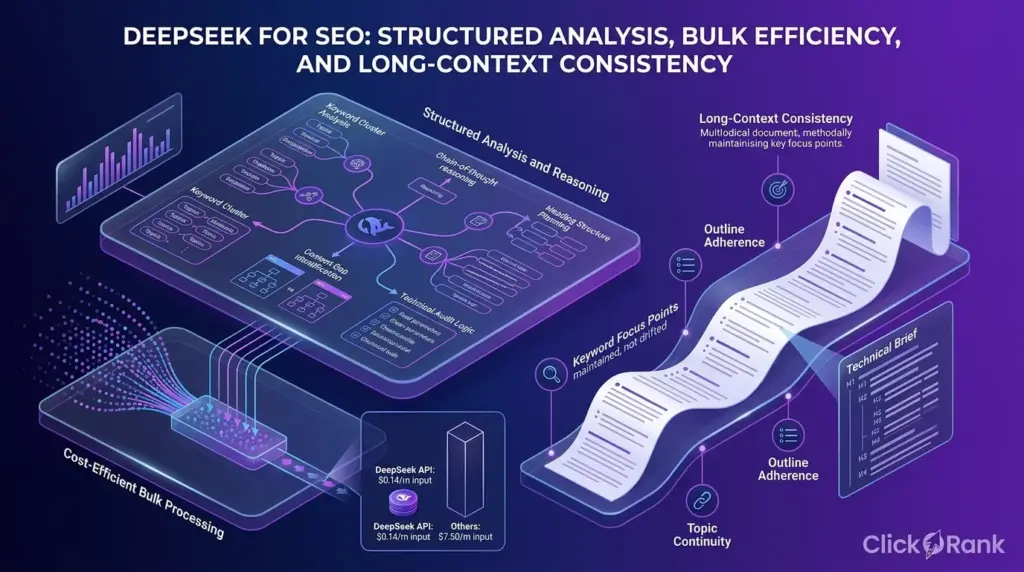
DeepSeek’s biggest genuine strength for SEO is its chain-of-thought reasoning. It thinks through problems visibly and systematically, which produces better output for tasks that require multi-step logical analysis.
For SEO, this means it performs well on keyword clustering, content gap analysis, heading structure planning, and technical audit logic. Tasks that are essentially structured problem-solving rather than creative output.
DeepSeek’s structured outline of a complex article walks through reasoning almost like thinking out loud. The structure is logical, similar to how a human would approach a technical topic, and it includes the key decision points behind each section.
Cost-Efficient Bulk Processing
DeepSeek charges about $0.14 per million input tokens and $2.19 per million output tokens, while ChatGPT’s o1 model runs around $7.50 per million input tokens. The result is significant cost savings, especially for high-volume tasks.
For SEO agencies processing large amounts of content at scale: bulk meta description generation, keyword clustering across thousands of terms, or technical documentation, DeepSeek’s API cost structure makes it an attractive option compared to ChatGPT at equivalent volume.
Long-Context Consistency
DeepSeek-V3.2’s Sparse Attention architecture handles long text more efficiently without losing track of keyword placement or drifting off-topic. You can load in a keyword list, competitor analysis, and a draft outline all at once, and the model keeps them in focus even through multiple paragraphs.
For SEO content work specifically, this means less drift mid-article on long-form pieces, which is a real problem with some other models.
Technical Outline Generation
DeepSeek is the choice for data-heavy structured writing and technical documentation in 2026. For technical briefs, structured content planning, and reasoning-heavy content prep, it produces clean, organized outputs.
Give DeepSeek a topic and ask for a detailed content outline. The structure it produces is logically sound and covers subtopics methodically. It is not the most creative outline you will see, but it is thorough.
Step-by-Step: How to Use DeepSeek for SEO
Step 1: Set Up Your Context
DeepSeek works best when you give it a detailed role and context upfront. Unlike Claude’s Projects feature, DeepSeek does not have persistent memory, so you need to reload your site context every session.
Start every conversation with:
You are a senior SEO strategist working on [site name].

Site niche: [your niche]
Target audience: [describe reader]
Content goals: [rank for informational keywords / generate leads /
build topical authority]

Rules for all content:
- Optimize for searcher intent, not keyword density
- Never use: delve, tapestry, pivotal, showcase, underscore
- Never open with: "In today's world" or "When it comes to"
- Write in plain, direct language

Confirm you understand before I give you the first task.
Step 2: Keyword Research and Clustering
DeepSeek handles keyword clustering better than most people expect. Its structured reasoning makes it good at grouping large keyword lists by intent and spotting overlap.
Keyword Clustering Prompt:
You are an SEO strategist.I will paste a raw keyword list for the niche: [niche]
TASK:
1. Group keywords into topical clusters
2. For each cluster:
- Suggest a pillar page title and primary keyword
- List 3 supporting post titles
- Label intent: informational / commercial / transactional
3. Flag any keywords that will cannibalize each other
4. Rank clusters by estimated difficulty
(low competition first)
EXISTING PAGES ON MY SITE: [list main URLs or write "none yet"]
KEYWORDS:
[paste your list]Long-Tail Keyword Generation Prompt:
Act as an SEO keyword researcher.

Generate 30 long-tail keyword variations for the seed term:
"[your keyword]"

For each keyword include:
- Search intent (informational / commercial / transactional)
- Whether it is likely low, medium, or high competition
- The type of content that would satisfy the intent
  (how-to guide / comparison / tool page / definition)

Group results by intent type. Output as a clean table.
Step 3: Content Outlines and Briefs
DeepSeek produces detailed, logically structured outlines. This is one of its stronger SEO use cases.
Content Brief Prompt:
Act as an SEO content strategist.
Create a detailed content brief for the following article.

PRIMARY KEYWORD: [keyword]
SECONDARY KEYWORDS: [list 3-5]
TARGET WORD COUNT: [X words]
AUDIENCE: [describe reader and their level of expertise]
SEARCH INTENT: [informational / commercial / transactional]

INCLUDE IN THE BRIEF:
- H1 title with keyword near the front
- Meta description under 155 characters with a hook
- 6-8 H2 sections with H3 subsections
- For each section: what to cover + key question it answers
- FAQ section with 5 People Also Ask-style questions
- Internal link opportunities (pages I already have)
- What to avoid: filler, vague claims, keyword stuffing

Do not write the article. Write the brief only.
Step 4: On-Page Optimization
Content Optimization Prompt:
Act as an on-page SEO editor.Review this article and identify specific improvements to
make it rank better for the target keyword.
DO NOT just add more keywords.
Focus on: structure, depth, missing subtopics,
and intent alignment.
For each issue you find:
- Name the problem
- Explain why it matters for rankings
- Give the specific fix in one sentence
TARGET KEYWORD: [keyword]
SEARCH INTENT: [type]
ARTICLE: [paste full text]
TOP COMPETITOR URLS: [paste 2-3]Meta Tag Generation Prompt:
Act as an SEO copywriter.

Write meta tags for these pages.
For each page deliver:
- 3 title tag options (under 60 characters, keyword near front)
- 2 meta description options (under 155 characters, soft CTA)

Rules:
- No clickbait
- Keyword in first 30 characters of title where possible
- Each option must use a different angle

PAGES:
1. URL: [url] | Topic: [topic] | Keyword: [keyword]
2. URL: [url] | Topic: [topic] | Keyword: [keyword]
3. URL: [url] | Topic: [topic] | Keyword: [keyword]

Output as a clean table.
Step 5: Technical SEO Assistance
Technical Audit Prioritization Prompt:
Act as a technical SEO specialist.I have identified these technical issues on my site.
Rank them by SEO impact from highest to lowest.
For each issue tell me:
1. The specific ranking impact if left unfixed
2. The fix in one sentence
3. Priority tier: fix this week / this month / later
ISSUES:
[paste your list from Screaming Frog or GSC]
SITE TYPE: [blog / ecommerce / SaaS / local business]Schema Markup Prompt:
Act as a technical SEO specialist.Generate valid JSON-LD schema markup for this page.
Requirements:
- Article schema with datePublished and dateModified
- FAQPage schema using the Q&A pairs below
- Organization schema for the site
- BreadcrumbList schema
Output only clean JSON-LD code blocks.
No explanation. No prefix text. Paste-ready only.
PAGE TOPIC: [topic]
SITE NAME: [name]
SITE URL: [URL]
AUTHOR NAME: [name]
AUTHOR URL: [URL]
FAQ PAIRS:
Q: [question 1]
A: [answer 1]
Q: [question 2]
A: [answer 2]Where DeepSeek Falls Short for SEO
Being direct here matters. DeepSeek has real limitations that affect its day-to-day usefulness for SEO practitioners.
Writing Quality Lags Behind ChatGPT and Claude
ChatGPT still leads creative writing in 2026. It handles storytelling, persuasion, tone control, and long-form cohesion more naturally. It also adapts better to voice rules and examples, which is critical for marketers and bloggers.
Most SEO teams will find ChatGPT more useful as a daily work platform because SEO work is broader than raw reasoning. It includes content planning, search intent analysis, page briefs, metadata ideas, content refreshes, internal linking logic, reporting, and collaboration across functions.
DeepSeek produces technically correct content. It often reads stiff. For SEO content that needs to hold a reader’s attention across 2,000 words, you will edit more after DeepSeek than after Claude or ChatGPT.
No Native Multimodal Capabilities
DeepSeek is still mainly text-first. Even in newer releases, it does not match ChatGPT’s native image and voice processing. You can build pipelines around DeepSeek to handle files, but that requires extra setup. For multimodal tasks, ChatGPT wins clearly.
For SEO workflows that involve image alt text optimization, screenshot analysis, or visual content, DeepSeek is not the right tool.
No Live Web Access in Standard Mode
DeepSeek’s standard models do not browse the web. For SEO tasks that require knowing what is currently ranking, what competitors just published, or what the current SERP looks like for your target keyword, you need to bring that data in yourself. This is the same limitation as Claude, but unlike Perplexity, DeepSeek has no native research mode.
The Privacy and Security Problem
This is the issue that cannot be glossed over.
DeepSeek stores all user data on servers located in the People’s Republic of China. Under Chinese intelligence laws, particularly the 2017 National Intelligence Law, organizations and individuals must “support, assist, and cooperate with national intelligence efforts.” This means Chinese authorities can legally compel DeepSeek to hand over user data upon request, with no requirement to notify affected users.
Cybersecurity firm Wiz reported that DeepSeek had accidentally left over one million lines of sensitive data exposed on the open internet, including digital software keys and chat logs from real users. The database had no authentication or access controls. Anyone who found it could read, modify, or download the contents.
DeepSeek has been banned from government devices by multiple federal agencies including the Pentagon and NASA, and has faced outright bans in Italy, Australia, Taiwan, and South Korea over data privacy concerns.
For individual users researching general SEO topics: the risk profile is lower. For agencies or enterprise teams: pasting client data, proprietary strategy, or any personally identifiable information into DeepSeek’s web interface is a decision that needs explicit consideration and ideally legal review.
The safer alternative for teams that want DeepSeek’s cost efficiency without the data concerns is running DeepSeek locally through its open-source weights. Running DeepSeek locally ensures full data privacy by eliminating reliance on external servers. It requires technical expertise and powerful hardware, but for organizations handling confidential data, it removes the jurisdictional risk entirely.
DeepSeek vs ChatGPT vs Claude for SEO: Which Wins Where
| Task | DeepSeek | ChatGPT | Claude |
|---|---|---|---|
| Long-form content writing | Weaker | Strong | Strongest |
| Structured outlines | Strong | Strong | Strong |
| Keyword clustering | Strong | Strong | Strongest |
| Meta tag generation | Good | Best for volume | Best for quality |
| Technical audit analysis | Good | Good | Strongest |
| Schema markup generation | Good | Good | Strong |
| Real-time SERP data | None | Limited | None |
| API cost | Cheapest | Most expensive | Mid-range |
| Data privacy for agencies | High risk | Low risk | Low risk |
| Writing quality | Below average | Good | Best |
DeepSeek is better for structured, data-heavy technical writing and documentation. ChatGPT is better for creative nuance and human-first content. For SEO specifically, the combination of both models gives you coverage across different task types that neither handles alone.
When to Use Each Tool
Use DeepSeek when: you are working with non-sensitive general content, building outlines for technical topics, clustering large keyword lists through the API at scale, or running a self-hosted instance where data privacy is controlled.
Use ChatGPT when: you need creative writing that adapts to brand voice, multimodal workflows, a mature integration ecosystem, or reliable output on mixed-format tasks.
Use Claude when: you are working with large documents, need the highest writing quality for long-form SEO content, or want complex multi-constraint prompts followed precisely across a 3,000-plus word article.
Use all three strategically: Many teams end up using both models instead of committing to one. In practice, DeepSeek handles the structured analytical layer while ChatGPT handles the creative and audience-facing output.
Doing This Manually at Scale? ClickRank Automates DeepSeek for SEO So Every Page Is Optimized Automatically.
Every workflow in this guide requires you to manually export data, paste it into DeepSeek, check the output, make edits, and implement the changes. For one page, that takes maybe 30 minutes. For 200 pages across a client’s site, it takes weeks.
ClickRank automates the data layer that makes all of this possible at scale. Instead of manually exporting your Search Console data and pasting it into prompts, ClickRank connects your live keyword rankings, competitor movements, and content performance directly to your optimization workflow.
It identifies which pages need attention right now. It surfaces the keyword opportunities worth acting on. It tracks whether optimizations are moving rankings after they go live. DeepSeek handles the execution. ClickRank handles the intelligence that tells you what to execute.
Teams that use ClickRank alongside AI tools like DeepSeek stop guessing at priorities and start working from a data-driven queue that updates automatically. The prompts above are powerful. The strategy behind them is what ClickRank provides.
Can DeepSeek replace ChatGPT for SEO work?
For specific tasks, yes. For keyword clustering, technical outlines, and schema generation, DeepSeek performs comparably. For creative writing, brand-aligned content, and any work involving multimodal inputs, ChatGPT is stronger. Most serious SEO teams will use both.
Is DeepSeek safe to use for SEO agency work?
Avoid DeepSeek if you handle any sensitive personal, financial, health, or professional information, work for a government agency or regulated industry, or need an AI tool for enterprise use. For agencies pasting client strategy, keyword data, or any identifiable client information, the data risk requires careful consideration.
How much cheaper is DeepSeek than ChatGPT for API use?
DeepSeek charges about $0.14 per million input tokens compared to ChatGPT o1's $7.50 per million. For high-volume API workflows, that is a significant cost difference that justifies building around DeepSeek for the right tasks.
Does DeepSeek have a free tier?
Yes. DeepSeek's consumer app is free for most users. Its API is roughly 96 percent cheaper than ChatGPT's equivalent models. The web interface and mobile app are available at no cost.
Can I use DeepSeek locally to avoid data privacy concerns?
Yes, and for enterprise teams this is the recommended approach. Running DeepSeek's open-source weights locally means data never leaves your infrastructure. It requires technical setup and GPU hardware, but removes the Chinese jurisdiction risk entirely.