Podcast SEO is the practice of making a show’s spoken words readable by search engines, because Google does not index raw audio but indexes written text like titles, descriptions, show notes, and full transcripts instead. Done well, it builds real podcast discoverability across Google, Apple Podcasts, Spotify, and YouTube, turning casual search traffic into steady, loyal new listeners and subscribers.
What Podcast SEO means
Podcast SEO means shaping a show’s text, metadata, and web pages so search engines can read and rank it. Audio alone gives Google nothing to scan.
The core mechanism behind podcast SEO is simple: Google does not index audio, it indexes text.
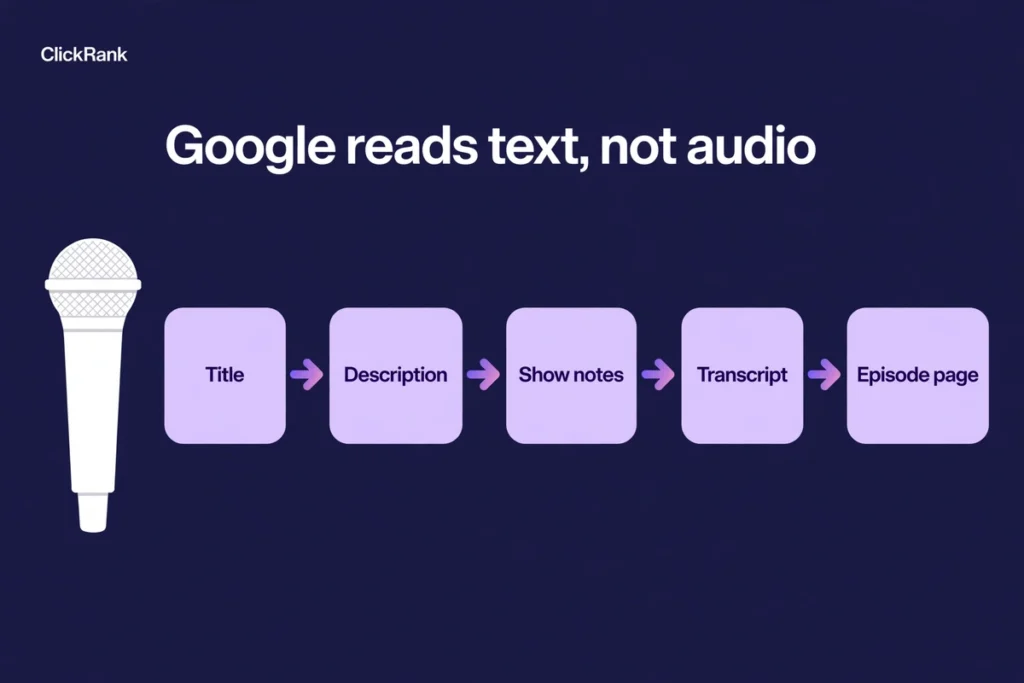
A podcast becomes findable the moment its words exist as text: the episode title, the description, the show notes, the transcript, and a dedicated episode page on a website. Without that text layer, even a well-made show stays invisible to search.
This is why podcast discoverability depends on what surrounds the audio file, not only on the audio itself. A show with strong episodes but thin written content rarely shows up in a Google search.
Learning how to rank a podcast starts with accepting that recording is half the job. Writing the record search engines can actually read is the other half, and it is the half most shows skip.
Why podcast SEO works
It works because people search by topic and intent, not by format. A listener types a question into Google; they do not type “podcast.”
That is how to rank a podcast in practice: answer the question the listener typed, in text the search engine can read.
Edison Research, in The Infinite Dial 2025 report, found that 55 percent of Americans age 12 and older had listened to or watched a podcast in the past month, around 158 million people. That is up from 48 percent in 2024.
That single year of growth means more shows competing for attention inside Apple Podcasts and Spotify. It also means more people typing podcast topics into Google, where text-based podcast SEO can still win visibility.
- 55 percent of Americans listened to or watched a podcast in the last month (about 158 million people), Edison Research, March 2025
- 40 percent listened in the last week (about 115 million)
- 73 percent have ever consumed a podcast (about 210 million)
- 51 percent have ever watched a podcast
A podcaster on r/podcasting, 16 episodes in over three to four months with about 1,000 downloads, said Google search was their top traffic source, ahead of any podcast directory. That single data point matches a wider pattern others on the same forum described.
Shows with clear episode pages, transcripts, and specific titles tend to get found through search long before they build a following inside any podcast app. That is the real case for Spotify SEO and Apple Podcasts SEO working alongside, not instead of, Google.
Podcast SEO by the numbers
The scale of podcasting now makes podcast SEO harder to skip. More shows exist, more platforms compete for attention, and the paths listeners use to find a show have shifted.
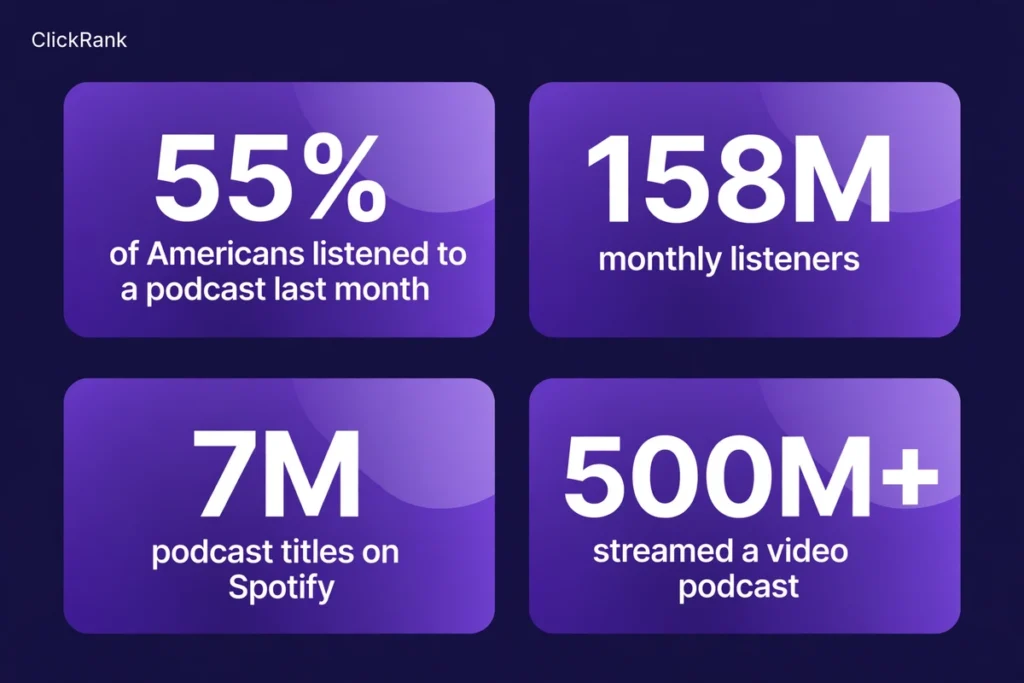
- 158 million Americans listened to or watched a podcast in the last month, Edison Research, The Infinite Dial 2025, March 2025 survey of 5,020 Americans age 12 and older
- Spotify’s podcast catalog passed 7 million titles by May 2026, according to Spotify’s Investor Day 2026 figures
- More than 500 million Spotify users had streamed a video podcast by May 2026
- Google shut down the separate Google Podcasts app worldwide on 24 June 2024, after stopping it in the US on 2 April 2024, folding podcasts into YouTube Music
- Google cited Edison data showing 23 percent of weekly US podcast listeners used YouTube, against only 4 percent for Google Podcasts, as part of its reason for the shutdown
Seven million titles on Spotify alone means a show without a distinct text footprint competes against an enormous, growing catalog. Discovery inside the app matters, but it cannot carry a show on its own.
The Google Podcasts shutdown also matters for anyone planning podcast SEO work. It confirms that YouTube, not a dedicated podcast search app, is now Google’s preferred home for audio and video shows, which raises the value of YouTube SEO for any podcaster who also publishes video episodes.
How to do podcast SEO, step by step
It is not one task. It is a short list of habits repeated every time a new episode goes out.
- Research one keyword per episode.
Pick a single search term the episode answers, not a vague topic.
A long-tail keyword, a specific phrase like “how to train a puppy not to bark”, usually fits one episode better than a broad term. Free tools work fine for this stage.
- Google Keyword Planner shows search volume ranges for a term
- Google Trends shows whether interest in a topic is rising or falling
- YouTube Suggest reveals what people type when searching for similar video content
- AnswerThePublic groups real questions people ask around a topic
Match one keyword to one episode. Trying to rank a single episode for five unrelated terms usually means it ranks for none of them.
- Write a real episode title.
Use the keyword near the start of the title, but keep it readable for a human first. “How to Train a Puppy Not to Bark” ranks better than “Episode 42.”
Do not start the title with the episode number. A listener searching for a topic will skip “Episode 42” and click the title that names the topic.
- Write a description that reads like a short blog post.
A one-line summary does not give Google enough text to match against a search. Several paragraphs, with the keyword used naturally, give both search engines and AI tools something to work with. - Publish a full transcript.
Transcripts turn forty minutes of audio into thousands of words of indexable text. Tools like Descript, Otter.ai, Castmagic, and Riverside can produce a usable transcript quickly, and a human should still proofread it. - Build a dedicated episode page.
Each episode needs its own canonical URL on a podcast website, separate from the general show page. This page should hold the title, description, transcript, and a player embed. - Add PodcastEpisode schema.
PodcastEpisode schema is a structured data type built for exactly this content. Marking up the episode title, description, duration, and publish date in schema helps search engines understand the page without guessing. - Keep RSS feed metadata clean.
Apple Podcasts, Spotify, and other directories pull show and episode details from the RSS feed. The feed handles syndication to every directory.
Inconsistent titles, missing categories, or broken artwork in the feed hurt ranking in every app that reads it.
- Link episode pages to each other.
Internal links between related episode pages help both listeners and search engines understand which episodes belong together. This also supports general SEO strategy across the whole site, not just the podcast section. - Earn backlinks, don’t force them.
A guest mentioning the episode on their own site, or a press mention, counts as a link worth earning. Demanding a backlink as a condition of a guest appearance tends to produce a low-quality, unnatural link and can strain the relationship.
A Reddit podcaster on r/podcasting, eight months into the show with 25 episodes in a niche topic and slow 5 to 10 percent growth, asked the community how other people found new shows.
The advice that came back was to say the keyword out loud in the episode, write descriptions like blog posts, publish transcripts, and keep the RSS feed clean. That is close to the exact list above.
How Apple Podcasts and Spotify rank shows
Google ranking and in-app ranking are two separate systems, and podcast SEO needs to work on both.
In practice, Apple Podcasts search rankings lean on the show title, episode titles, and the category assigned to the show. Apple Podcasts SEO means choosing a specific, accurate category rather than a broad one, since a narrow category means less competition for the top spots.
Pick the category that matches the show’s topic, not the biggest one. A show listed under a broad category competes with thousands of shows, while a narrow category puts it in front of listeners who already want that topic.
Ratings and reviews also appear to factor into Apple Podcasts SEO. A show with few or no reviews has less signal for Apple to rank on, regardless of audio quality.
Spotify works on a similar logic but weighs other signals too. Spotify SEO benefits from consistent publishing, since the algorithm appears to reward shows that release new episodes on a predictable schedule rather than in bursts.
- Follower counts and completion rates appear to factor into Spotify’s in-app search and recommendations
- Episode titles matter as much inside Spotify search as they do on Google
- Spotify’s catalog passed 7 million titles by May 2026, so a generic title competes against millions of others using similar words
Apple added a feature in 2024 that changes both the user experience and the SEO picture. On 5 March 2024, Apple introduced transcripts for Apple Podcasts in English, French, Spanish, and German, available on iOS 17.4 and iPadOS 17.4.
Apple described the feature this way: “Transcripts offer full-text display for each episode, making podcasts more accessible and immersive than ever before.”
Creators can supply their own transcript through RSS tags or Apple Podcasts Connect, rather than relying only on Apple’s automatic version.
Listeners can read the full episode text, search it for a word or phrase, and tap any line to jump the audio to that point. That makes a clean, creator-submitted transcript part of real Apple Podcasts SEO, not just an accessibility extra.
Podcast SEO for AI search
AI tools like ChatGPT and Perplexity, along with Google AI Overviews, now answer many questions that used to send a person straight to a search results page. Podcast SEO has to account for that shift.
These tools cannot listen to an episode. They read text, the same way Google’s classic search does, which means the same transcript and show notes written for Google also feed AI answers.
Clear, direct writing helps here more than clever writing. A show notes section that states a plain definition or answers a specific question in a few sentences is easier for an AI system to quote than a page full of vague teaser copy.
Conversational search rewards the same habit: a direct answer to a direct question.
This work is sometimes called GEO, generative engine optimization, and AEO, answer engine optimization. The signals are the same: clear text an engine can quote.
- Write one clear summary sentence near the top of each episode page
- Use question-and-answer formatting in show notes for topics the episode actually answers
- Keep transcripts complete and accurate, since a garbled transcript gives AI tools a garbled source to quote from
This overlaps closely with AI Citation SEO work done for blog content. The same principles used to track blog visibility apply to podcast pages too, covered in How to Measure AI Visibility.
A podcast that wants to show up in AI answers needs the exact same clear, well-structured text that it needs to rank in classic Google search.
Video episodes add another path. A podcast published as video on YouTube can benefit from video-first SEO practices, since YouTube’s own search and recommendation systems read captions and titles in a similar way to how Google reads web text.
Mistakes to avoid
Most podcast SEO failures come from skipping a step, not from doing something actively wrong.
- Publishing a one-line episode description instead of a full write-up
- Skipping transcripts entirely, which removes the largest block of indexable text a podcast can produce
- Using the same vague title format for every episode, like “Episode 54,” instead of a title that states the topic
- Letting RSS feed metadata go stale after a host or category change
- Treating the podcast page as a single static page instead of giving each episode its own canonical URL
- Ignoring Google Search Console data on the podcast website, which shows which episode pages already get impressions and clicks
- Demanding a backlink from every guest as a condition of appearing, which tends to produce forced, low-value links instead of links earned on merit
Measurement gets skipped often too. Google Search Console reports impressions and clicks per page, which shows whether an episode page is being seen in search results at all before worrying about its rank.
Checking branded search volume, meaning how often people search the show’s name directly, separates organic discovery from returning listeners who already know the show. Analytics platforms like Chartable and Podtrac can also break down downloads by source, showing whether a spike came from search, social, or a directory feature.
Check Search Console once a month. Open the performance report, filter by the episode pages, and note impressions, clicks and average position.
Spotify for Creators and Apple Podcasts Connect show plays, followers and completion inside each app, so check those numbers next to the Search Console numbers.
Backlinks still matter for a podcast website the same way they matter for any site. The mechanics are covered in general link building and off-page SEO work.
A guest appearance or a press mention that happens naturally, without a backlink demand attached, tends to hold up better over time. It also supports the show’s E-E-A-T signals as a trustworthy source in its topic.
Podcast SEO is not a trick or a shortcut. It is the plain work of giving every episode a written record that Google, Apple Podcasts, Spotify, and AI tools can actually read.
A transcript, a specific title, a real description, and a dedicated episode page cover most of what matters. The rest is consistency: publishing on a schedule, keeping the RSS feed accurate, and checking which episode pages already get found in search.
None of this replaces making a good show. It just gives a good show a text trail that search engines and AI tools can follow back to it.
Is podcast SEO even a thing?
Yes. Google does not index audio, so a show ranking depends on its text: titles, descriptions, show notes, and transcripts tied to a real episode page, exactly like any other web content gets ranked.
How long does podcast SEO take to work?
It depends on competition for the chosen keyword and how much text exists on the episode page, since new pages generally need time to get crawled, indexed, and evaluated before ranking improves. There is no fixed timeline that applies to every show or topic.
Does Google index audio?
No. Google indexes text, which is why the transcript, title, and description attached to an episode matter more for ranking than the audio file itself.
Do transcripts help podcast SEO?
Yes. A transcript turns a 40-minute episode into thousands of words of text that search engines and AI tools can actually read, search, and quote, which a short description alone cannot provide.
Can a podcast rank on Google?
Yes, through its episode page rather than the audio file directly. A page with a full transcript, a specific title, and show notes written like a blog post can rank the same way any article does.
Do I need a blog for podcast SEO?
Not a separate blog, but each episode needs its own page with real written content. A podcast website with one page per episode, built with titles, descriptions, and transcripts, serves the same function a blog post would.