In the subdomain vs subdirectory choice, a subdirectory is the usual pick when a section belongs with your main site and shares its setup. A subdomain fits a section that runs on its own platform or needs separate technical control, such as a store.
What is a subdomain?
A subdomain is a label placed before your root domain, such as blog.example.com. It works like a separate address that hangs off your main domain.
A subdomain needs its own DNS record. That is the main setup difference in the subdomain vs subdirectory decision.
Well-known sites use subdomains for specific jobs:
- Google uses support.google.com for its help content.
- HubSpot uses blog.hubspot.com for its blog.
- HubSpot uses shop.hubspot.com for its shop.
Semrush and HubSpot both publish explainers on this topic. Semrush covers the subdomain vs subdirectory question in detail.
Subdomain SEO starts with reading a URL correctly. The next two questions cover that.
Where is the subdomain in a URL?
The subdomain is the part before the root domain, separated from it by a dot. In blog.example.com, “blog” is the subdomain and example.com is the root domain.
You read it from right to left. The top-level domain comes last, then the root name, then anything added in front.
Can a URL have two subdomains?
Yes. A URL can stack subdomains, each separated by a dot, such as shop.uk.example.com.
Every added level is still a subdomain of example.com. Subdomain SEO questions apply to each level you add.
What is a subdirectory?
A subdirectory sits after the domain, as in example.com/blog. It is also called a subfolder, and it lives inside the main site’s own address.
A subdirectory needs no separate DNS record, hosting or SSL certificate. HubSpot’s explainer on the subdirectory vs subdomain setup compares the two options.
Here is the setup difference at a glance:
- Subdomain: blog.example.com, needs its own DNS record.
- Subdirectory: example.com/blog, needs no separate DNS record, hosting or SSL certificate.
The URL shape is the first thing to check when you compare a subdomain vs subdirectory for a new section.
Subdomain vs subdirectory at a glance
The table puts the main differences side by side. The Semrush guide, the HubSpot guide and the NiCE reference cover the same choice.
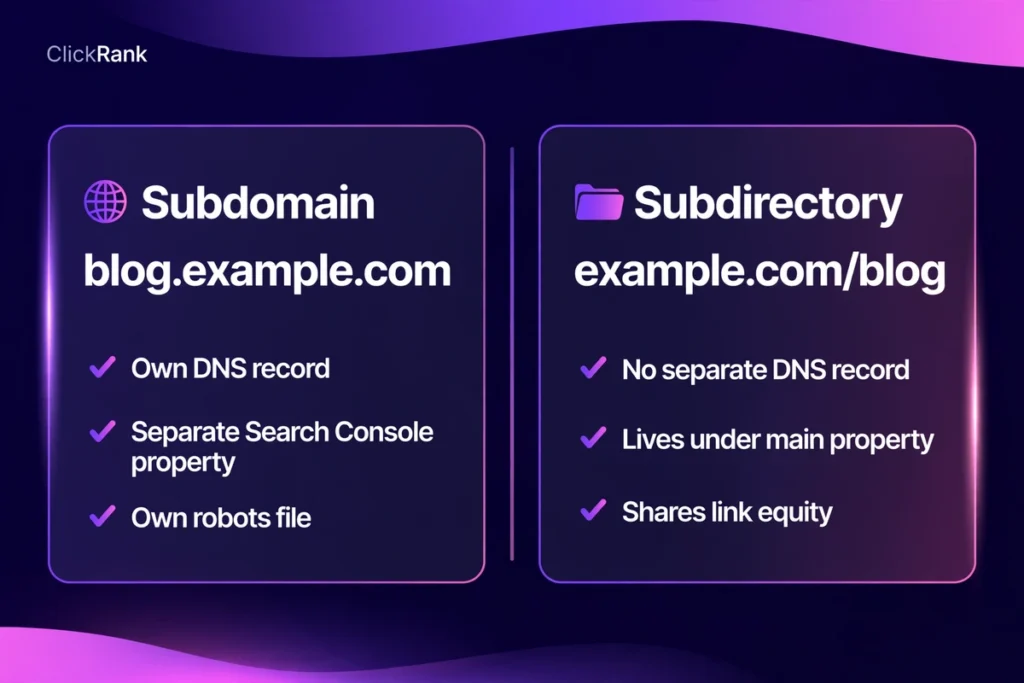
| Subdomain | Subdirectory | |
| What it is | A separate host name under your root domain | A folder path on the same host |
| Example URL | blog.example.com | example.com/blog |
| How Google sees it | Part of the site, but learned and crawled separately (John Mueller) | A path on the main site |
| Link equity | Not automatic; it moves through links | Higher chance of being treated as the same site (Patrick Stox) |
| Setup | Needs its own DNS record | No separate DNS record; reverse proxy only if hosted elsewhere |
| Best for | Separate products, apps or remotely hosted tools | Blogs, guides and content tied to the main site |
How does Google treat subdomains vs subdirectories?
Google says it has no preference. John Mueller of Google said that “Google Web Search is fine with using either subdomains or subdirectories” and that “it doesn’t make any difference from a ranking standpoint.”
Google’s crawling and indexing FAQ says the same: “From an indexing and ranking perspective, Google doesn’t have a preference.”
Matt Cutts, then head of webspam at Google, said in a 2012 video that the choice does not matter the way people think.
The subdomain vs subdirectory debate lives on because of crawling. Mueller said Google has to learn to crawl subdomains separately.
Are subdomains bad for SEO?
No. Google states no ranking preference, so a subdomain is not a penalty.
The cost is practical. A subdomain is learned and crawled on its own, so it needs its own internal links and its own attention.
Subdomain vs subdirectory SEO: where they actually differ
Subdirectory SEO and subdomain SEO follow the same ranking rules. The difference is how much work each setup asks of you in four areas:
- Link equity: Patrick Stox of Ahrefs says most SEOs prefer subdirectories because there is a higher chance Google treats them as the same site.
- Internal linking: Stox also says that if everything is internally linked well, there is no difference. Strong internal linking matters more on a subdomain, because it is the main bridge back to the root site.
- Crawl budget: In the subdomain vs subdirectory choice, a subdomain is crawled on its own terms, because Google learns it separately. A subdirectory shares the main site’s crawl budget.
- Google Search Console: Check the subdomain’s crawl and indexing reports separately instead of assuming they match the main site. A technical SEO audit of each host catches problems early.
Are subfolders always better than subdomains?
No. Google has no stated preference, and Patrick Stox of Ahrefs said this in an r/TechSEO thread in March 2023:
“Either will work. Whatever is easier for you to setup and maintain. Most SEOs prefer subdirectories because there’s a higher chance it will be treated as the same site, but if it’s all internally linked well… there won’t be a difference.”
Reddit users are less neutral. In the r/TechSEO thread “Are subfolders always better than subdomains?” (41 comments), one user called a subdomain “effectively a wholly separate website for SEO.” That is one person’s comment, not proof.
A subdirectory is usually simpler to set up, but there is one exception. Cloudflare’s 2019 blog explains that a CNAME record only works at domain level, not for a path like example.com/blog. To serve a remotely hosted blog under a subdirectory, you need a reverse proxy, such as an NGINX location block or Cloudflare Workers.
Do subdomains inherit backlink authority from the root domain?
Not automatically. One r/TechSEO commenter, Lxium, argued that authority only flows through links, not automatically via a subdirectory. The same logic applies to a subdomain, so link to it from the root site.
In a May 2025 r/SEO discussion, a user asked for data to argue against moving a section from a subdirectory to a subdomain and wanted to quantify link equity loss. One commenter wrote: “moving is almost always bad… you can recover, but if you don’t have to, why?”
That is a discussion, not proof. No public before/after migration study with traffic numbers was found.
If you do move a section, record positions before the switch with a rank tracker so you have your own numbers to compare.
When should you use a subdomain?
A subdomain fits parts of your site that work like separate properties. Search engines often treat them that way too, so the content stands apart from the main site’s ranking strength.
Common use cases:
- International sites: Wikipedia uses subdomains for languages, for example en.wikipedia.org.
- Testing and staging: a copy of the site at something like staging.example.com stays away from live pages.
- Distinct design and functionality: an app or customer portal can have its own look and its own code.
- Support: a help center often runs on a separate platform, so support.example.com is a natural home.
- Store: HubSpot runs its shop at shop.hubspot.com.
- Events: a short-lived event site can carry its own branding and then be retired.
In each case, the separation is the point.
When should you use a subdirectory?
A subdirectory is the better default when content belongs to the main site. Everything sits under one domain, such as example.com/blog/.
The usual reasons to pick it:
- Easy management: one site, one setup, one place to maintain.
- Consistent branding: visitors stay in the same look and feel.
- Blog as part of the main site: articles sit next to the pages they support.
Leigh McKenzie put the stakes plainly in a 2025 LinkedIn post:
“Subdomain vs Subdirectory isn’t just an SEO question: it’s a business strategy decision.”
Why might using a subdirectory in place of a subdomain be better?
McKenzie notes that subdirectories tend to rank faster because they inherit domain authority more directly. Subdomains can work too, but they often behave like separate sites.
You also run one site instead of two, which means less to set up and less to keep in sync. The Semrush guide walks through the same trade-offs.
Subdomain vs subdirectory for international SEO
Weglot (updated 20 Oct 2026) says hreflang tags are mandatory regardless of URL structure. Getting them right matters more than the folder or host you pick, and the hreflang and canonical setup steps cover the details.
Weglot’s guide for multilingual sites also lists setups to avoid:
- The same URL with cookie or JavaScript based language switching.
- ?lang=fr style URL parameters.
Google recommends separate URLs for each language.
A ccTLD (country-code top-level domain, such as example.fr or example.de) is a third option besides subdomains and subdirectories. It sends the strongest geo-targeting signal, but you run a separate domain for every country.
Nike uses subdirectories for regions, for example nike.com/au/. Wikipedia goes the other way with subdomains for languages. Both setups work for large sites.
Patrick Stox of Ahrefs gave a short answer in a Reddit r/TechSEO thread from March 2023 about going international:
“Either will work. Whatever is easier for you to setup and maintain.”
So the subdomain vs subfolder choice for languages comes down to what your team can run well. Once the structure is set, international SEO keyword research decides what goes on each version. If you serve specific cities rather than countries, local SEO is a separate job from picking a URL structure.
Subdomain vs subdirectory for a blog
Most sites are better off with the blog in a subdirectory, such as example.com/blog/. Posts and the links they earn build on the main domain, which fits McKenzie’s point about authority.
A subdomain still has a place. HubSpot runs its blog at blog.hubspot.com, so a subdomain for blog content can work for a large, established brand. In the subdomain vs subdirectory choice for a blog, the cost is that the blog may behave like a separate site.
When should you use a subdomain for a blog?
Choose a subdomain for blog content when it runs on a different platform, has its own team, or needs a design that differs from the main site. A separate technical setup is a good reason to keep it apart.
Accept that the blog may need to earn its own authority. If the blog exists mainly to support your product pages, a subdirectory is the simpler path.
How to move from a subdomain to a subdirectory
Moving blog.example.com to example.com/blog changes the URL of every page, so most of the work is mapping and redirecting. The subdomain vs subdirectory choice is easy to make early and costly to reverse later.
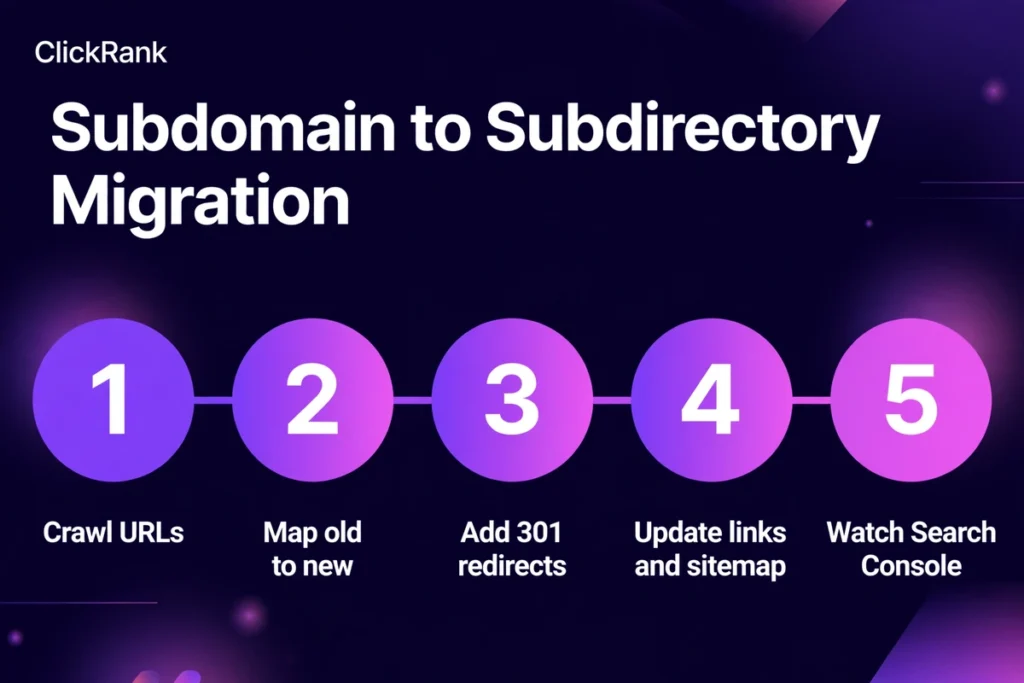
- Crawl the subdomain and list every URL you want to keep.
- Map each old URL to one new path.
- Build the pages under the new subdirectory. If the content stays on a separate platform, serve it through a reverse proxy.
- Add a 301 redirect from each old URL to its matching new URL.
- Update internal links, canonical tags and the sitemap to the new paths.
- Submit the new sitemap in the main Search Console property and keep the old subdomain property open to watch for errors.
Cloudflare’s 2019 blog says a remotely hosted blog needs a reverse proxy to appear under a subdirectory, for example an NGINX location block or Cloudflare Workers. The Cloudflare Workers guide covers the Workers option.
After launch, run log file analysis to confirm Googlebot is requesting the redirects and the new URLs. Recheck Core Web Vitals too, since a proxy adds a layer between the visitor and your content.
Is moving from a subdomain to a subdirectory risky?
Yes. Every URL change carries risk, and no public before/after migration study with traffic numbers was found. Any claim about guaranteed gains is unproven.
Reddit users describe the downside. In a Nov 2026 r/TechSEO thread with 41 comments, one user reported moving a news site from a subdomain to a subfolder through a reverse proxy. They said they lost Google News syndication and saw ranking and traffic volatility. That is one anecdote, not a case study.
A commenter in a May 2025 r/SEO discussion wrote: “moving is almost always bad… you can recover, but if you don’t have to, why?” It is an opinion from a forum, not proof.
How to move from a subdirectory to a subdomain
The mechanics run in reverse, and the same redirect discipline applies.
- Set up DNS and hosting for the new subdomain.
- Verify the subdomain as its own Search Console property, with its own sitemap and robots file.
- Copy the content and map each old path to its new subdomain URL.
- Add a 301 redirect from each old path to the matching subdomain URL.
- Update internal links and canonical tags, then submit the new sitemap.
- Keep the redirects live and watch both properties for crawl errors.
The main cost is reporting. The subdomain starts as a separate property, so you now check two sets of data instead of one.
The risk is the same as the other direction, and no public migration study with traffic numbers covers this move either. The Reddit caution about avoiding unnecessary moves applies both ways.
Tracking and analytics across subdomains and subdirectories
Measurement is where subdomain vs subdirectory setups differ most in daily work. Here is how each tool treats them:
- Search Console: each subdomain is usually a separate property with its own sitemap and robots file. A subdirectory lives under the main property.
- GA4: a subdirectory is tracked in the same property and session as the main site with no extra setup. A subdomain on the same tag is also tracked in one session, because GA4 sets its cookie on the root domain. Cross-domain configuration is only needed when the section lives on a different root domain.
- Sitemaps: a subdomain needs its own sitemap. A subdirectory can sit in the sitemap of the main site.
For subdomain vs subfolder reporting, the subfolder is the lower-maintenance option. A subdomain is not wrong, but it adds setup you have to keep checking.
Subdomain vs subdirectory and AI search
No competitor article covers AI crawlers, AI Overviews or GEO for this topic in any depth. Weglot has only one collapsed FAQ question asking whether multilingual SEO best practices also improve GEO.
That leaves little sourced evidence on whether subdomain vs subdirectory affects AI search, and this article will not invent any. What can be said comes from the setup facts above.
Each subdomain has its own robots file, so any rule for AI crawlers must be set on every host. A subdirectory sits under one robots file. To see whether a section gets cited in AI answers, follow the steps on how to measure AI visibility and track each host or path separately.
Subdomain vs subdirectory: which one should you pick?
Use this checklist to decide. It leans on setup and maintenance facts, not on claims of a ranking edge.
- Pick a subdirectory if the content supports the main site’s topic and you want one Search Console property.
- Pick a subdirectory if you want the section in the main GA4 property with no extra tracking setup.
- Pick a subdirectory if you can serve the content from the main host, or can run a reverse proxy for a remote platform.
- Pick a subdomain if the content is a separate product, platform or team with its own hosting.
- Pick a subdomain if you accept a separate property, sitemap and robots file for that section.
- Pick a subdomain if you would rather run it as its own site than blend it into the main one.
- Do not move a live section unless you have a clear reason and a full redirect map.
The subdomain vs subfolder decision is mostly about control and upkeep. For a broader comparison of the two setups, Semrush has a subdomain vs subdirectory guide.
The subdomain vs subdirectory question has a short answer: Google treats them the same. What separates them is management, not ranking.
Pick the setup your team can actually maintain. A subdirectory keeps link equity on one domain and lives inside one Search Console property, which makes day to day work lighter. A subdomain gives a section its own space, at the cost of a second property to watch.
Either way, in the subdomain vs subdirectory choice, the address you choose is a small part of the outcome. Clean structure, working links and content people want will matter more than where the blog sits.
What is an example of a subdomain?
Picture a company site at example.com that runs its blog on blog.example.com. Here blog is the subdomain, and it sits before the root domain. The same pattern covers shop.example.com or support.example.com.
Are subdomains bad for SEO?
No. Google has no stated preference in the subdomain vs subdirectory debate, so neither setup is penalized. John Mueller has said as much, and Google crawling and indexing FAQ makes the same point.
Can a URL have two subdomains?
Technically yes. A hostname can carry more than one label in front of the root domain, so something like news.blog.example.com resolves. Most sites never need that depth, and one subdomain is easier to keep track of.
When should you use a subdomain?
Choose one when a section needs to run on its own. Each subdomain is a separate Google Search Console property, which suits a team that handles its own hosting or wants its own reporting. If you would rather pool link equity and keep setup simple, take the subdirectory instead.
What is the difference between a subdomain and a subdirectory?
A subdomain sits before the root domain, as in blog.example.com. A subdirectory sits after the domain, as in example.com/blog. To a visitor the two look much alike, but they behave differently in Search Console and in how links flow.
Where is the subdomain in a URL?
It appears before the root domain, right after the protocol. In blog.example.com, the subdomain is blog and example.com is the root. Everything after the first slash is the path, not the subdomain.