You’re checking your rankings, but your traffic is dipping. Google is answering questions before users even click. This guide shows you how to adapt your strategy for AI engines so you don’t lose visibility.
What is AI SEO and Why Traditional SEO No Longer Works?
To understand AI SEO, you have to stop thinking of Google as a “Sorting Machine” and start seeing it as a “Reasoning Engine.”
Traditional SEO was built on predictability. We knew that if we mapped X keywords to Y backlinks, we would likely get Z ranking. But that linear model has collapsed. AI SEO is the strategic alignment of your digital footprint with how machine learning models like Google’s Gemini or OpenAI’s GPT interpret, synthesize, and recommend information.
The “Death” of the Keyword-First Model
Traditional SEO no longer works because search engines have moved beyond string matching (matching the exact words a user types) to semantic intent (understanding the “why” behind the search).
- The Zero-Click Reality: In traditional SEO, the goal was the click. Today, AI-generated overviews solve the user’s problem directly on the SERP. If your strategy is only “rank for a keyword,” you are fighting for a click that might no longer exist.
- The Context Gap: Traditional SEO relied on “gaming” signals like keyword density. AI SEO focuses on Information Gain. If your content doesn’t provide new, unique, or expert data that an AI hasn’t seen before, the AI has no reason to include you in its generated response.
From “Ranking” to “Reliability”
The reason the old playbook fails is that AI engines don’t just “rank” pages anymore; they evaluate them.
Traditional SEO was about being the loudest (most links, most pages). AI SEO is about being the most trusted. If your content is vague, lacks structured data, or doesn’t demonstrate E-E-A-T (Experience, Expertise, Authoritativeness, and Trustworthiness), an AI model will filter you out as “low-confidence” data. In short: Traditional SEO was built for bots; AI SEO is built for intelligence.
What does AI SEO actually mean in modern search?
AI SEO is the practice of optimizing content not just for a ranking algorithm, but for Large Language Models (LLMs) and Generative Search Engines (like Gemini, ChatGPT, and Perplexity).
In the modern context, it means ensuring your brand’s data is “digestible” enough for an AI to synthesize, credit, and recommend. It’s no longer about matching keywords; it’s about Entity Recognition and Contextual Authority. You aren’t just trying to be a result; you’re trying to be the answer.
How is AI SEO different from traditional SEO?
The shift is fundamental. Think of it as the difference between a library index (Traditional) and a personal research assistant (AI).
| Feature | Traditional SEO | AI SEO |
| Primary Goal | High rankings for specific keywords | Inclusion in AI-generated summaries |
| Content Focus | Keyword density & Backlink volume | Information density & Narrative authority |
| Success Metric | Click-Through Rate (CTR) | Brand Mentions & “Citation Share” |
| Technical Requirement | Sitemaps & Fast loading | Structured Data & API-friendly content |
Why ranking is no longer visibility in AI search?
In the past, being “Position 1” meant you captured ~30% of the traffic. Today, Search Generative Experiences (SGE) push organic results so far down the page that even the top result is “below the fold.”
Furthermore, if an AI answers the user’s query directly on the search page (Zero-click searches), the user never needs to visit your site. Visibility now means being the cited source within that AI answer, rather than just a link sitting underneath it.
How AI engines retrieve content instead of ranking pages?
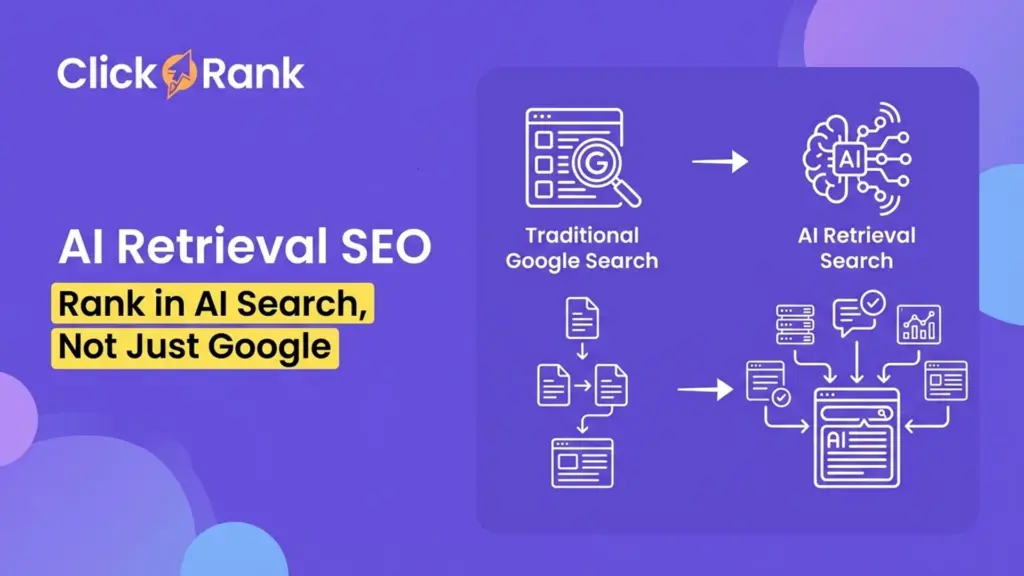
Traditional search engines used crawlers to index keywords. AI engines use Vector Search and Retrieval-Augmented Generation (RAG).
Instead of looking for the word “best running shoes,” the AI looks for “mathematical representations” (vectors) of your content’s meaning. It retrieves chunks of information from various sources and stitches them together. If your content is fluffy or lacks clear, factual “entities,” the AI cannot retrieve it effectively because it doesn’t “understand” the value you’re providing.
Why AI visibility is replacing SERP visibility?
We are entering the “Answer Engine” era. Users are moving away from scrolling through Search Engine Results Pages (SERPs) and toward conversational interfaces.
If a user asks, “What is the best CRM for a small floral business?” and the AI mentions three brands, those three brands have 100% of the AI Visibility. The 50 other brands on page 1 of Google have 0%. To survive, you must optimize for “Inference” ensuring that when an AI model is trained or retrieves data, your brand is the most logical conclusion for it to reach.
How AI Search Engines Work (Retrieval, Not Rankings)
AI search engines work by shifting from index-based ranking to retrieval-augmented generation (RAG). Instead of matching keywords to a static list of URLs, AI engines convert your content into “vectors” (mathematical representations of meaning). When a user asks a question, the AI retrieves specific clusters of information from across the web, synthesizes the most relevant facts, and generates a cohesive answer.
In this model, “ranking” is replaced by “Selection for Synthesis” meaning your visibility depends on how well the AI can extract and trust your data to build its final response.
What is AI retrieval-based search?
AI retrieval-based search, often powered by RAG (Retrieval-Augmented Generation), is a process where the search engine fetches specific snippets of information from across the web to build a custom answer in real-time.
Unlike traditional search, which points you to a URL and says “Go find the answer yourself,” retrieval search extracts the relevant facts first. It uses Vector Embeddings to understand the “mathematical meaning” of a query, allowing it to find relevant content even if the exact keywords aren’t present.
How do AI engines select sources for answers?
AI engines don’t just pick the site with the most backlinks; they pick the site with the highest Contextual Relevance and Information Density. The selection process generally follows three criteria:
- Factuality: Does this source provide concrete data points?
- Authority (E-E-A-T): Is the source a recognized entity in this specific niche?
- Synthesizability: Is the content written in a way that the AI can easily rephrase and combine with other sources?
What is AI content extraction?
Content extraction is the AI’s ability to “scrape” the core value from your page while ignoring the “fluff” (ads, navigation, and filler intro text).
Using Natural Language Processing (NLP), the AI identifies Entities (people, places, things) and Attributes (facts about those things). If your content is buried in long, winding sentences, the extraction “confidence” score drops, and the AI is less likely to use your data.
How does AI summarisation work?
Summarization is the “Generative” part of the process. Once the AI has retrieved several high-quality snippets, it uses an LLM to condense that information into a coherent response.
- Extractive Summarization: Picking the most important sentences directly from your site.
- Abstractive Summarization: Understanding the concepts and rewriting them in a new, shorter form. Your goal as a writer is to provide “Nuggets” clear, punchy sentences that are easy for an AI to lift and use as a summary.
What is AI citation logic?
Citation logic is the algorithm that determines which source gets the “Link Credit” in an AI answer. AI engines usually cite sources that:
- Directly support a claim: If the AI makes a factual statement, it links to the source that provided that specific fact.
- Provide “Deep-Dive” value: If the summary is a surface-level overview, the citation goes to the page that offers the most comprehensive secondary details.
- Structured Data: Pages using Schema.org markup often get priority because the AI can verify the source’s data structure with 100% certainty.
Why AI SEO Needs a System, Not Just Content
AI SEO requires a system because modern search engines process data at a volume and velocity that manual workflows cannot match. To win in AI search, you aren’t just publishing articles; you are managing a knowledge graph. A system ensures that your content is structured, updated, and interlinked automatically, making it “crawl-ready” for LLMs that demand high-density, high-accuracy data at scale. Without a system, your content remains “invisible” to the retrieval mechanisms that power AI answers.
Why manual AI SEO doesn’t scale?
Manual SEO is linear; AI search is exponential. If you have 500 pages, manually auditing them for “AI extraction readiness” or updating them to reflect real-time data takes weeks. By the time you finish, the AI models have already updated their training sets. Manual processes create information lag, which is the leading cause of losing AI visibility.
Why automation is required for AI SEO?
Automation is the “pipeline” that feeds the AI. It is required for:
- Real-time updates: Ensuring facts are current so AI engines don’t flag your content as “hallucination-prone.”
- Schema Injection: Automatically applying structured data so AI can “read” your tables and lists instantly.
- Internal Linking: Building the semantic relationships between topics that AI uses to determine your niche authority.
Why tools alone don’t solve AI visibility?
Buying a subscription to an AI writing tool is not a strategy. Tools provide outputs, but systems provide outcomes.
- Tools generate text.
- Systems ensure that text is mapped to a specific Entity, validated for accuracy, and distributed to the right technical “hooks” (like JSON-LD) that AI engines actually use for retrieval.
Why AI SEO needs infrastructure?
Infrastructure refers to the technical backbone of your site your CMS capabilities, API connections, and hosting speed. AI engines prefer “Headless” or highly structured data environments. If your infrastructure is messy (slow scripts, broken redirects, unorganized database), the AI’s extraction confidence drops. Good infrastructure ensures that your data is “clean” enough for an LLM to digest without errors.
Why AI SEO must be operational, not theoretical?
Theoretical SEO is “knowing” that AI matters; Operational SEO is having a SOP (Standard Operating Procedure) that executes on it daily. AI search changes weekly. An operational approach means you have a feedback loop:
- Monitor AI Citations.
- Analyze why a competitor was cited instead of you.
- Adjust the content structure immediately. If your SEO strategy is a PDF gathering dust, it isn’t operational and in the AI era, that means it’s obsolete.
ClickRank as the AI SEO Infrastructure Layer
What is ClickRank’s role in AI SEO?
ClickRank acts as an intelligent automation layer that bridges the gap between traditional websites and the requirements of AI-driven search. It functions as a data-driven infrastructure that directly optimizes on-page content to ensure it is easily discoverable and accurately interpreted by both traditional search engines and modern AI chatbots.
How ClickRank automates AI optimization
ClickRank uses a lightweight JavaScript snippet to implement real-time SEO fixes without requiring manual backend changes. Its AI analyzes your website’s existing performance data from Google Search Console to automatically rewrite meta titles, descriptions, and heading structures, ensuring your site remains perfectly optimized as search algorithms evolve.
How ClickRank structures AI-readable content
The platform automatically organizes your website’s hierarchy to be “AI-friendly” by:
- One-Click Schema Generation: Automatically injecting JSON-LD structured data so AI agents can understand the context of your products, articles, or FAQs.
- Smart Heading Alignment: Re-structuring H1-H3 tags to create a logical content hierarchy that AI crawlers can easily parse.
- Keyword Injection: Seamlessly adding missing high-intent keywords into your content to align with AI search queries.
How ClickRank builds AI trust signals
ClickRank strengthens the authority and credibility of your site key factors for AI recommendations:
- Vision AI Recognition: Analyzing images to generate highly relevant alt text, which improves accessibility and provides AI with more context for your visual assets.
- Internal Linking: Automatically suggesting and creating internal links to distribute link equity and prove the depth of your site’s topical authority.
- Technical Health: Instantly resolving duplicate tags and missing metadata that could otherwise signal low-quality content to AI models.

How ClickRank enables AI visibility at scale
ClickRank’s Bulk Optimization feature allows users to apply sophisticated, data-driven strategies (like “Trend Seeker” or “CTR Boost”) across thousands of pages simultaneously. By automating bulk optimizations and instantly deploying them via the cloud, it ensures your entire digital footprint is ready for AI overviews and conversational search results in minutes rather than months.
How ClickRank Validates AI Visibility (AI Model Index Checker)
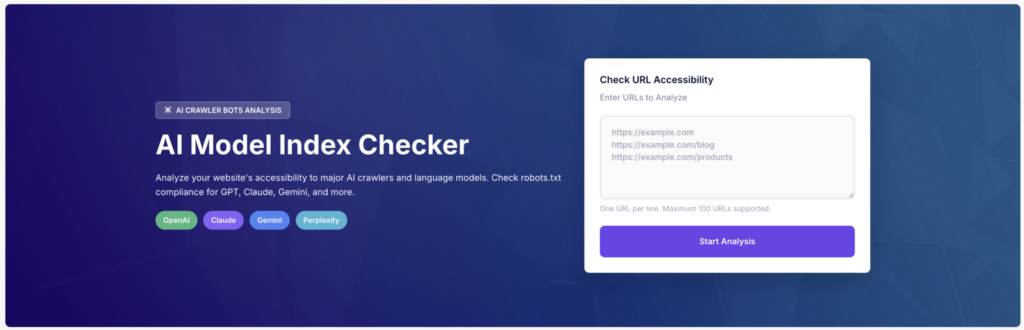
The AI Model Index Checker serves as the final audit in the system, ensuring that the optimizations made are actually being recognized by LLM crawlers.
- Crawler Accessibility: It specifically checks if bots like GPTBot, ClaudeBot, and PerplexityBot are being blocked by hidden robots.txt directives or “noindex” tags.
- Compatibility Testing: The tool runs compatibility tests from global data centers to see if your content “vectors” are reachable and digestible for different AI models.
- Index Signals: It provides a “Crawlability Score” that tells you exactly how high the confidence level is for an AI model to retrieve your data for a Search Generative Experience (SGE).
| Feature | AI Model Index Checker | AI Model Compatibility |
| Primary Function | Checks if AI bots (GPTBot, etc.) are physically allowed to crawl your site. | Analyzes if your content structure (Schema, Headings) is “readable” by LLMs. |
| Key Metric | Bot Accessibility Status. | AI Extraction Confidence Score. |
| Actionable Result | Fixes robots.txt or server-level blocks. | Suggests changes to JSON-LD or semantic density. |
Core Components of the ClickRank AI SEO System
How does ClickRank optimize AI-friendly metadata?
ClickRank automates the generation and optimization of meta titles, descriptions, and headers to improve search visibility and user engagement.
- Data-Driven Suggestions: The system connects directly with Google Search Console (GSC) to analyze real performance data and integrate high-impact keywords into metadata.
- CTR Enhancement: It generates catchy, SEO-friendly descriptions designed to increase click-through rates (CTR) by matching user intent.
- Real-Time Deployment: Optimizations are applied instantly via a lightweight JavaScript snippet, ensuring sites stay ahead of frequent algorithm shifts.
How does ClickRank automate schema for AI engines?
The platform manages complex structured data tasks to ensure AI systems like ChatGPT and Gemini can interpret web content effectively.
- JSON-LD Generation: ClickRank provides one-click schema generation, automatically creating and deploying JSON-LD structured data for products, organizations, and articles.
- AI Interpretation Layer: By labeling key details, schema acts as a “translation layer” that helps AI search engines understand the exact meaning and context of a page’s content.
- Rich Snippet Eligibility: Automated deployment qualifies pages for rich search results, which can improve visibility in both traditional and AI-powered search environments.
How does ClickRank structure internal linking for AI retrieval?
ClickRank uses AI to build a strategic internal linking structure that enhances site indexability and topical authority.
- Automated Suggestions: The system analyzes a website’s architecture to suggest and implement relevant internal links between related pages.
- Optimized Anchor Text: It automatically generates descriptive, keyword-rich anchor text for these links to reinforce relationships between different content nodes.
- Improved Retrieval: This connectivity helps AI crawlers and retrieval-augmented generation (RAG) models map the site’s “knowledge graph,” making content easier to find and cite.
How does ClickRank optimize content semantics?
Beyond keyword matching, ClickRank focuses on the underlying meaning and intent of content to align with semantic search models.
- Topic Clustering: The AI guides the creation of content clusters, connecting interconnected pages around broader topics rather than isolated keywords.
- NLP Alignment: It uses natural language processing (NLP) to ensure content matches the tone and preferences of users, improving relevance for conversational AI queries.
- Gap Analysis: The system identifies missing subtopics or related concepts that users might search for, helping to fill semantic gaps in the content.
How does ClickRank manage entity relationships?
ClickRank treats the website as a connected network of entities people, products, and concepts rather than just a collection of pages.
- Entity-First Strategy: The system focuses on clarifying the definitions and intents of content, reinforcing the site’s brand and authority within Google’s Knowledge Graph.
- Contextual Connectivity: It uses schema and internal links to explicitly express relationships between entities (e.g., “Product X” is “ownedBy” “Organization Y”).
- AI Trust Signals: By establishing these clear fact-based relationships, ClickRank builds the trust signals necessary for a brand to be cited as a primary source in AI Overviews and answer boxes.
AI SEO for Major AI Engines
How does ClickRank optimize for Google Gemini SEO?
ClickRank enhances visibility in Google Gemini by aligning your site with Google’s internal data ecosystem and E-E-A-T signals.
- Entity Structuring: The system uses semantic data modeling and advanced schema markup to align with Google’s AI training signals, improving context for Gemini’s summarization engine.
- GSC Integration: By connecting directly with Google Search Console, ClickRank integrates top-performing keywords that Gemini prioritizes when fetching real-time data.
- Topical Authority: It builds multi-layered internal linking structures to establish the domain depth that Gemini requires to trust a source for AI Overviews.
How does ClickRank optimize for ChatGPT Search?
ClickRank focuses on making your content “citation-ready” for OpenAI’s web crawlers and conversational search.
- Conversational Mapping: It creates FAQ-structured pages that match the natural language prompt patterns users employ in ChatGPT.
- Citation-Ready Content: The system optimizes for verifiable facts and outbound references, which ChatGPT prioritizes when demonstrating authority and trust.
- Metadata Recognition: ClickRank embeds specific structured metadata that is easily recognizable by ChatGPT’s browsing models.
How does ClickRank optimize for Perplexity SEO?
For Perplexity, which functions as an “answer engine,” ClickRank prioritizes high-quality citations and skimmable data.
- IQQI Methodology: It uses Implicit Question Query Identification to frame headings as questions, matching how Perplexity retrieves authoritative answers.
- Information Density: ClickRank streamlines content into high-density “answer-ready units” that Perplexity can easily parse and prioritize.
- Entity Enrichment: The platform embeds knowledge-graph entities (organizations and topics) to help Perplexity identify your brand as a primary source.
How does ClickRank optimize for Bing AI SEO?
ClickRank optimizes for Bing Copilot by leveraging GPT-4’s search-plus-conversation blend.
- Factual Consistency: It ensures that your brand’s core data is consistent across the web, which Bing’s generative answers rely on for footnotes and citations.
- Generative Answer Alignment: The system optimizes content to be summarized easily, increasing the probability of your site being used as a source in Copilot’s conversational replies.
How does ClickRank optimize for Claude AI SEO?
Optimization for Anthropic’s Claude model focuses on high-fidelity retrieval and AI visibility through the AEO + GEO framework.
- Model-Ready Architecture: ClickRank rebuilds content into semantic clusters that Claude can efficiently find and cite during complex reasoning tasks.
- Synthesis Optimization: It ensures content clarity and synthesizability, making it easier for Claude to summarize your data while maintaining brand accuracy.
How does ClickRank optimize for Meta AI SEO?
ClickRank helps brands rank and gain citations within Meta AI’s social and integrated search ecosystems.
- AEO + GEO Framework: It uses a specialized framework for Meta AI that focuses on Answer Engine Optimization and Generative Engine Optimization.
- Mobile-First Design: Since Meta AI users are primarily mobile, ClickRank ensures your technical optimization (such as speed under 1.2 seconds) meets AI crawler expectations.
How does ClickRank optimize for AI Overviews SEO?
ClickRank is specifically designed to target the “Zero-Click” nature of Google’s AI Overviews (formerly SGE).
- Bullet Point Optimization: The system automatically breaks down complex info into lists and bullet points, a format highly favored by AI Overviews for direct answers.
- Executive Summaries: It encourages and automates the addition of “Key Takeaways” sections to the top of pages, increasing the chance of being cited in the gist of a response.
- Vector Relevance: ClickRank ensures your content is “vector-relevant” by integrating keywords that align with the mathematical embeddings AI models use to match queries with sources.
AI SEO Data Layer & Intelligence
AI SEO intelligence is the process of providing structured, interconnected data that allows search engines to “reason” about your content. Instead of just looking at words on a page, AI search engines analyze four critical layers: Behavioral (how users interact), Semantic (what you mean), Entity (who/what you are), and Trust (why you matter). When these four layers are optimized, your content moves from being a simple webpage to becoming a “verified fact” in the AI’s Knowledge Graph.
How does AI SEO use behavioural data?
AI engines use behavioral data like dwell time, click-through patterns, and “natural language” queries to understand user satisfaction.
- The AI Logic: If users frequently “rage click” away from your site or immediately refine their search after visiting, the AI learns that your content didn’t satisfy the intent.
- Optimization: We focus on “Success Signals” structuring content so users find answers instantly, which tells the AI your page is a high-quality destination for that specific intent.
How does AI SEO use semantic data?
Semantic data is about meaning and context. AI uses Natural Language Processing (NLP) to look for “Topic Clusters” and “Power Phrases” that prove you understand the broader subject.
- The AI Logic: It doesn’t just look for the keyword “running shoes”; it looks for related semantic terms like pronation, midsole cushioning, and marathon durability.
- Optimization: By building deep semantic maps, you signal to the AI that your content is comprehensive and worthy of being summarized.
How does AI SEO use entity data?
Entities are the “Nouns” of the internet (People, Places, Brands, Concepts). AI search is Entity-First.
- The AI Logic: It tries to connect your brand to known entities in its database. If you mention “SEO” and “ClickRank” together consistently, the AI begins to recognize ClickRank as a primary entity in the SEO space.
- Optimization: We use SameAs schema and persistent naming conventions to ensure the AI “disambiguates” your brand from competitors and treats you as a distinct, authoritative entity.
How does AI SEO use trust data?
Trust data (often called E-E-A-T) is the verification layer. AI models are trained to avoid “hallucinations” by prioritizing high-confidence sources.
- The AI Logic: It checks for author credentials, publication dates, and citations from other high-trust entities (like government sites or major news outlets).
- Optimization: By hard-coding author bios and linking to verified external sources via structured data, you provide the “Proof” the AI needs to cite you safely.
How does ClickRank unify AI SEO data layers?
ClickRank acts as the Central Intelligence Hub for these layers. Instead of managing them separately, ClickRank unifies them by:
- Extracting Entities: Automatically identifying and tagging the entities in your content.
- Structuring Semantics: Reorganizing your H2s and H3s into a logical hierarchy that AI engines can “read” instantly.
- Injecting Trust: Automatically applying the latest Schema.org markups (Person, Organization, FAQ) to verify your data.
- Closing the Loop: Using behavioral signals from Search Console to automatically adjust your metadata, ensuring your “Intelligence Layer” stays ahead of the competition.
Future of Search = AI SEO
The future of search is Generative Engine Optimization (GEO). We have transitioned from a “Discovery” model where users browse a list of websites to a “Consultancy” model, where AI agents synthesize information and provide direct answers. In this new era, SEO success isn’t defined by your rank on a page, but by your eligibility to be cited by the AI. If an LLM doesn’t trust your data enough to use it in a summary, your website effectively ceases to exist for the modern searcher.
Why AI SEO will replace traditional SEO?
Traditional SEO was based on Keyword Matching and Backlink Volume. AI SEO replaces this with Intent Satisfaction and Information Gain.
- Synthesized Results: AI-generated overviews now appear in over 60% of searches. These overviews provide the answer immediately, making traditional “Position 1” organic links less relevant.
- Context over Keywords: AI understands the “why” behind a search. Traditional SEO tactics like keyword stuffing now act as a negative signal, marking content as “low-quality” or “bot-written.”
Why AI engines will dominate search?
AI engines (Gemini, ChatGPT, Perplexity) are dominating because they solve the “Information Overload” problem.
- Efficiency: Users prefer a single, accurate paragraph over clicking five different links to piece together an answer.
- Personalization: AI search adapts to a user’s specific context, history, and even sentiment something a static list of search results can never do.
- Agent-to-Agent Search: In 2026, a significant portion of search traffic is actually AI agents “searching” on behalf of humans to find products or book services.
Why businesses must adapt now?
The “First-Mover Advantage” in AI SEO is massive because AI models are iterative.
- Entrenchment: AI models tend to rely on a “Knowledge Core” of trusted sources. Once an AI identifies your brand as a reliable authority for a topic, it is much harder for competitors to dislodge you.
- Revenue Risk: With “Zero-Click” searches becoming the default, businesses that don’t adapt to being cited in AI summaries will see a total collapse in their top-of-funnel traffic.
Why ClickRank is built for AI search future?
ClickRank isn’t an “add-on” tool; it is a Future-Proofing Engine.
- Native RAG Compatibility: ClickRank structures your data specifically for Retrieval-Augmented Generation, making it easy for AI to “lift” your content into its answers.
- Entity Mapping: It automatically creates the digital connections (schema and metadata) that tell AI exactly who you are and why you are an expert.
- Autonomous Adaptation: As AI search algorithms change (which they now do daily), ClickRank’s infrastructure adjusts your site’s “Machine-Readable” layer in real-time.
Why AI SEO is not optional anymore?
In 2026, AI SEO is the difference between Growth and Obsolescence.
- The Numbers: Over 80% of enterprise SEO specialists have already moved their budget into AI-integrated strategies.
- Consumer Behavior: Users have lost patience with traditional search. If your brand isn’t part of the “Conversation” provided by an AI assistant, you are no longer in the consideration set.
- Trust as a Metric: AI search has turned “Trust” from a vague concept into a hard technical metric (E-E-A-T). If you aren’t optimizing for these trust signals, search engines will filter you out to protect their users from “hallucinations.”
Reaady to build AI visibility, not just rankings?
Rankings are vanity; visibility is sanity. In an era where AI-generated summaries take up the entire screen, being “Number 1” on a hidden list is useless. Are you ready to move your brand into the AI Overview, where your insights are synthesized and presented as the definitive answer? It’s time to stop chasing a position and start chasing a presence.
Ready to optimise for AI engines, not just Google?
The search landscape is no longer a monopoly. Your customers are asking Gemini, ChatGPT, and Perplexity for advice. Optimizing solely for the “old Google” means you are invisible to the millions of users moving toward conversational AI. Are you ready to optimize for the models that are actually making the decisions?
Ready to build AI trust, not just traffic?
Traffic without trust is a bounce; trust with AI is a citation. AI engines are programmed to be “risk-averse” they won’t recommend you if they can’t verify you. Are you ready to implement the deep-level E-E-A-T and Schema infrastructure that turns your website into a “High-Confidence” source that AI agents feel safe recommending?
Ready to automate AI SEO?
The speed of AI search is too fast for spreadsheets and manual updates. If you aren’t automating your data layers, you are falling behind every single hour. Are you ready to let intelligent systems handle the technical heavy lifting from entity tagging to real-time content refreshing so you can focus on high-level strategy?
Ready to scale AI visibility with ClickRank?
Growth in the AI era shouldn’t be a struggle; it should be a system. Whether you are managing 100 pages or 100,000, your visibility should be consistent and comprehensive. ClickRank provides the industrial-grade infrastructure required to ensure every piece of content you own is “AI-Ready” the moment it’s published.
Ready to build AI visibility, not just rankings?
Rankings are vanity; visibility is sanity. Stop chasing a position and start chasing a presence in the conversational interfaces where your customers are asking for advice.
Stop Guessing. Start Optimizing. Whether you are on WordPress, Shopify, Webflow, or Wix, you can deploy high-level AI SEO optimizations instantly via our lightweight JavaScript snippet.
Streamline your site audit with the Professional SEO Audit Tool and uncover your AI visibility gaps in minutes! Try Now!
How does ClickRank solve the Zero-Click search problem?
ClickRank shifts your strategy from ranking for clicks to becoming the citation. By optimizing content for Generative Engine Optimization (GEO), the platform ensures your expertise is synthesized by AI Overviews, placing your brand directly into the answer box where visibility is now concentrated.
Why is ClickRank’s AI Model Index Checker essential for visibility?
The AI Model Index Checker validates that your site is physically accessible to LLM crawlers like GPTBot and ClaudeBot. It identifies hidden server blocks or robots.txt directives that prevent these bots from retrieving and indexing your content for AI-generated answers and citations.
How does ClickRank’s Schema generation help AI engines?
ClickRank provides one-click JSON-LD Schema generation, creating a translation layer that helps engines like Gemini and ChatGPT interpret your data with 100% certainty. This structured data explicitly defines your brand as an Entity, significantly increasing the probability of being cited as a trusted source.
Can I use ClickRank alongside plugins like RankMath?
Yes, ClickRank is designed to work as an infrastructure layer that enhances, rather than replaces, your existing SEO plugins. While RankMath handles traditional on-page fields, ClickRank adds a dynamic AI optimization layer that directly implements metadata and semantic fixes via a lightweight JavaScript snippet.
How does ClickRank automate internal linking for AI SEO?
ClickRank uses AI to analyze your site’s hierarchy and automatically suggest strategic internal links. This builds a Topical Authority graph, making your content easier for Retrieval-Augmented Generation (RAG) models to lift and summarize during conversational search queries.
Is ClickRank compatible with non-WordPress platforms?
ClickRank is fully compatible with any CMS that allows JavaScript injection in the head section, including Shopify, Webflow, Wix, and custom-built sites. This allows you to deploy high-level AI SEO optimizations instantly without needing to modify your backend code or database