Digital PR for SEO is the practice of earning media coverage, backlinks and brand mentions by pitching journalists, publishers and newsletters a real story, not a sales pitch. It works because links, mentions and citations are signals that search engines and AI systems use to judge reputation, and done well it builds trust that outlasts any single Google ranking update.
What digital PR for SEO means
Digital PR for SEO starts with a definition, not a tactic list. Semrush describes digital PR as an activity that aims to build a brand’s visibility and reputation through gaining media coverage, high-quality backlinks and positive mentions across digital channels.
That definition matters because it separates digital PR from plain outreach.
Digital PR is story-first. You pitch an idea, a data point or an expert view that a journalist wants to publish for their own readers, not for your website.
Link building, by contrast, is page-first. You start with a page that needs links and look for places to put it.
Digital PR for SEO starts with a story and treats the link as one result among several, alongside brand mentions, referral traffic and reader trust.
Traditional PR lived in print, TV and radio. Digital PR lives where people read and search today: online publishers, email newsletters, podcasts, YouTube and social platforms, plus the search results those channels feed into.
Search Engine Land put it simply: digital PR is an optimized reputation. Google’s own Search Quality Rater Guidelines instruct human raters on how to judge a site’s and a content creator’s reputation, which is exactly what consistent press coverage builds over time.
That reputation signal connects directly to E-E-A-T, the quality concept Google’s raters use to judge experience, expertise, authority and trust. Coverage in outlets readers already trust is one of the clearest ways to show authority to both raters and algorithms.
Why digital PR works for SEO
Links still matter, but not the way many SEOs assume.
At Pub con in September 2023, Google’s Gary Illyes told attendees, as reported by Search Engine Land: “I think they [links] are important, but I think people overestimate the importance of links. I don’t agree it’s in the top three. It hasn’t been for some time.”
That is a shift from Google’s own history.
In 2016, Google’s Andrey Lipattsev named backlinks as one of the top three ranking factors.
Google’s documentation today still says PageRank “continues to be part of our core ranking systems,” so links have not disappeared, their relative weight has changed.
This is why digital PR for SEO works better than pure link building in a mature market. A single placement in a trusted outlet can produce a link, a brand mention, referral clicks and a lasting reputation signal, all from one piece of coverage.
A digital PR strategy built around real stories also tends to earn links that are harder to replicate.
Competitors can copy a blog post. They cannot copy a quote a journalist already published under your name.
Off-page SEO has always included more than links: mentions, citations, reviews and reputation all count. Digital PR is the main engine for building most of those signals at once.
Digital PR for SEO by the numbers
The scale of the link problem explains why digital PR for SEO gets so much attention from SEO teams. Ahrefs’ study of about 14 billion pages, 2023 research with the page updated 12 August 2026, found that 96.55 percent of all pages get zero traffic from Google.
The same study looked specifically at pages with no backlinks at all:
- About 20 million pages have zero referring domains.
- Only 2,997 of those pages get more than 1,000 search visits a month.
- That is roughly 1 in every 6,671 pages with no backlinks.
Those numbers are not a reason to give up on content without links. They are a reason to treat link acquisition as a core part of the plan rather than an afterthought.
Ahrefs also ran its own campaign and published the results as a case study. The company built a statistics page, then ran outreach to pitch it as a resource:
- 515 outreach emails sent, 473 delivered.
- 36 backlinks earned from 32 separate websites.
- Conversion rate of 5.71 percent, reply rate of 17.55 percent.
- Nine of the 32 linking sites had a Domain Rating of 70 or higher.
- The page went on to rank number 1 for the term “SEO stats.”
Ahrefs noted in the stats page case study that it sent no follow-up emails, and estimated that follow-ups could have pushed the conversion rate toward 11 percent. That single detail says a lot about how much headroom typical digital PR link building campaigns leave on the table.
What digital PR for SEO is not
Digital PR for SEO is not a rebrand of cold email outreach. Sending the same templated pitch to five hundred bloggers asking for a link back is link building, and it is usually the weak kind: low reply rates, low relevance and links that rarely come from outlets anyone recognizes.
It is also not guest posting under a different name.
Guest posts are written by you and placed on someone else’s site.
Digital PR for SEO works the other way: the journalist or publisher writes the piece, decides the angle and chooses whether to include you at all.
Digital PR for SEO is not a one-off project either. A single successful pitch can produce a spike in traffic and links, but a real digital PR program runs as an ongoing practice, feeding new data, new angles and new expert commentary to the same reporters over months.
It is not a replacement for on-page SEO or technical SEO. Coverage and links help a site rank, but only if the site itself is structured and written well enough to convert that authority into rankings and clicks.
Finally, it is not something that can be faked with AI-generated “studies” or invented statistics. Journalists check sources, and once an outlet publishes a correction, it damages the exact reputation that digital PR exists to build.
Five tactics that earn coverage
Not every digital PR tactic works the same way or for the same type of brand. Here are five digital PR examples that consistently produce coverage, links or both.
- Original data and surveys. Publish a statistic nobody else has, built from your own data or a small original survey. Journalists need numbers to support stories, and a citable number is the easiest thing to pitch.
- Data journalism and stats pages. Build a resource page around a topic your audience searches for, the same approach Ahrefs used in its stats page case study, where original research became the hook for outreach.
- Expert commentary and reactive PR. Offer a fast, usable quote when a relevant news story breaks. This is the core of digital PR link building through journalist request platforms, covered in the next two sections.
- Newsjacking with a real angle. Attach your brand’s expertise to a trending story quickly, but only when there is a genuine, defensible connection, not a forced one.
- Founder or expert visibility. Place a founder or in-house expert on podcasts, in newsletters or as a guest on YouTube channels your audience already watches, building both mentions and a recognizable voice in the space.
Good digital PR examples share one trait: the story would be interesting to the publication’s own readers even if your brand were removed from it entirely.
How to run your first campaign, step by step
A first digital PR for SEO campaign does not need a large team or budget. It needs a clear story and a disciplined process.
Step 1: Pick one data point or angle.
Choose a single finding, trend or expert opinion that a journalist could use in one sentence. Trying to pitch five ideas at once usually means none of them land.
Step 2: Build the asset.
Turn that angle into something citable: a short data page, a survey result or a tight written statement. Keep it simple enough that a reporter can quote it without rewriting it.
Step 3: Build a short, targeted list.
Find journalists and publications that already cover your topic. A list of twenty relevant contacts usually beats a list of five hundred unrelated ones.
Step 4: Pitch with the story first.
Lead with what is newsworthy, not with your brand name. Keep the pitch short enough to read in under a minute.
Step 5: Monitor journalist request platforms daily.
Reactive opportunities move fast. Checking requests once a week will miss most of them.
Step 6: Answer requests the way journalists want them answered.
Lead with the answer in the first sentence. Keep the response to two to four sentences.
Write it in first person, as the actual quote, not as a description of what you could say if asked.
Step 7: Follow up once.
Ahrefs’ own case study found no follow-up emails were sent and estimated that follow-ups could have lifted the conversion rate from 5.71 percent toward roughly 11 percent, which suggests one polite follow-up is worth the time.
Step 8: Track what each pitch produces.
Record which pitches led to coverage, which outlet published, and whether the link, if any, was followed.
Journalist request platforms after HARO
Help a Reporter Out, known as HARO, was founded in 2008 by Peter Shankman and became one of the most used sources of journalist requests for over a decade. Cision acquired HARO in 2010.
The platform went through several changes in quick succession.
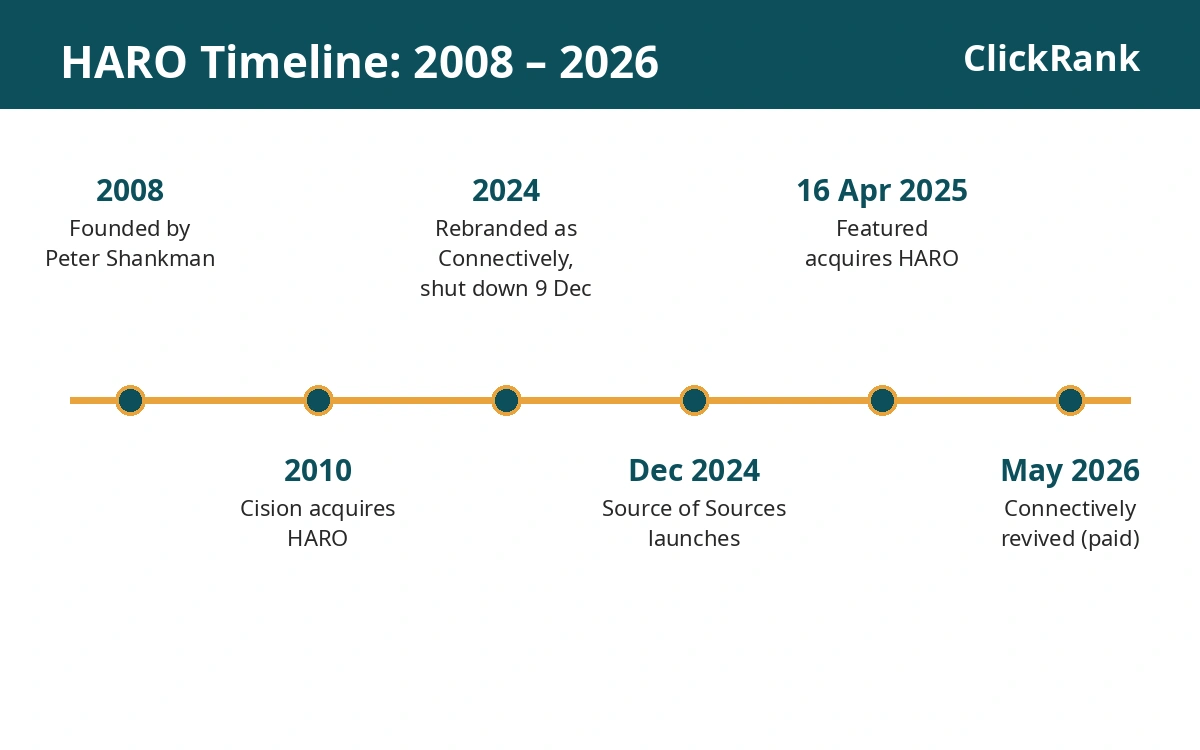
In early 2024, Cision rebranded HARO as Connectively.
On 9 December 2024, Cision permanently discontinued Connectively, HARO included, ending the service entirely.
Shankman did not let the format disappear.
In December 2024 he launched Source of Sources, a free email digest built in the original HARO style.
Then, on 16 April 2025, Featured.com announced it had acquired HARO from Cision, and the first relaunched free email went out on 22 April 2025, in three weekday editions.
In May 2026, Featured revived the Connectively name again, this time as a separate paid platform.
The result is a split field of digital PR tools rather than one dominant tool. Current digital PR tools for finding journalist requests include:
- Qwoted: free Basic plan allows 2 pitches a month with a 2-hour delay on new requests; the Pro plan costs $149 a month for 35 pitches with no delay.
- Connectively: free plan allows 3 answers a month; paid plans start at $19 a month.
- HARO: now a free email digest again, run under Featured.
- Source of Sources: free, run by Peter Shankman.
- X and LinkedIn: reporters post requests directly, often tagged with hashtags such as #journorequest.
BuzzStream analyzed requests across these platforms from May to June 2025 and found real differences in quality.
On Qwoted, 70.3 percent of requests came from outlets rated Domain Rating 70 or higher.
On Source of Sources, 36.26 percent of requests offered a followed link, the highest share among the platforms studied.
That data suggests a practical split: use Qwoted when the goal is coverage from large, high-authority outlets, and use Source of Sources when the goal is a followed link.
How digital PR helps AI visibility
Digital PR for SEO is not only about search rankings anymore. AI answer engines like Google’s AI Overviews, AI Mode and ChatGPT decide which brands to name, and the signals that predict that decision are different from classic ranking factors.
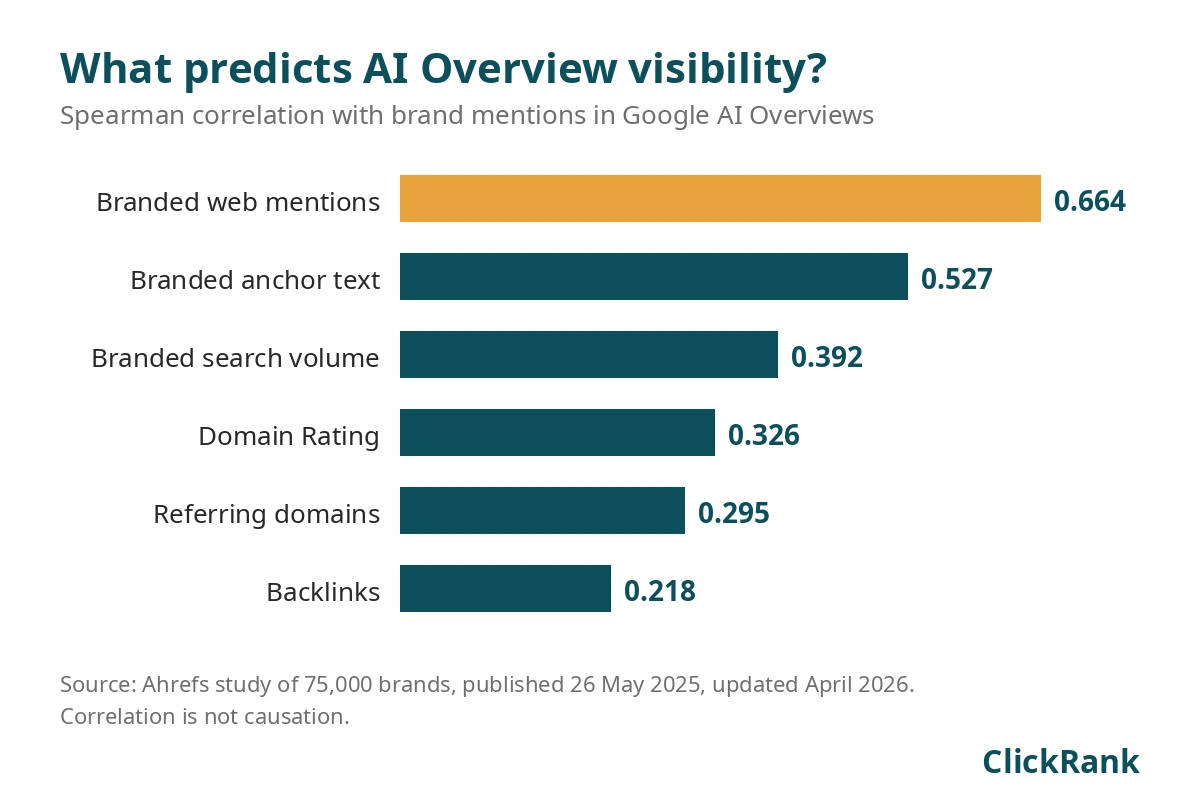
Ahrefs studied 75,000 brands, published 26 May 2025 and updated April 2026, measuring the Spearman correlation between several signals and how often a brand gets named in Google AI Overviews:
- Branded web mentions: 0.664
- Branded anchor text: 0.527
- Branded search volume: 0.392
- Domain Rating: 0.326
- Referring domains: 0.295
- Number of backlinks: 0.218
Branded mentions tracked AI Overview visibility about three times more strongly than raw backlink count, according to Ahrefs’ 75,000-brand study. Ahrefs was clear that correlation is not causation, so this is a pattern worth watching, not proof that mentions cause visibility.
A December 2025 follow-up on the same 75,000 brands extended the comparison to other AI systems. Branded web mentions correlated at 0.656 for ChatGPT and 0.709 for AI Mode, while backlinks correlated at only 0.191 for ChatGPT and 0.244 for AI Mode.
This is where digital PR for SEO earns a second job.
Every mention it generates, whether linked or not, adds to the branded mention signal that AI systems appear to weigh more heavily than backlinks alone.
For a deeper look at how these citation patterns work, see AI Citation SEO.
Unlinked mentions in articles, roundups and newsletters used to be treated as a consolation prize by SEOs chasing links. Under this data, they look more like a separate asset worth tracking on their own.
How to measure digital PR for SEO
Measuring digital PR for SEO means tracking more than rankings, because a single placement can move several metrics at different speeds. The core metrics to track are:
- New referring domains gained after each campaign.
- New backlinks, both followed and unfollowed.
- Brand mentions, linked and unlinked.
- Branded search volume, since coverage often drives people to search your brand name directly.
- Referral traffic from the publications that covered you.
- Ranking movement on the pages your digital PR strategy supports.
Judge a campaign over a quarter or longer, not over a few days, and compare the results against similar pages that got no new links or coverage in the same period. That comparison is the only way to separate the effect of the campaign from normal search volatility.
Google Search Console remains the main free tool for the search side of this, showing clicks and impressions by page and query.
Its Generative AI performance report adds AI impressions, but only impressions: no clicks, no queries and no split between AI Overviews and AI Mode, which limits how precisely you can attribute AI visibility to a specific campaign.
For a closer look at filling that gap, How to Measure AI Visibility covers the options in more depth.
Some of this shows up in day-to-day tracking. In the week of 18 to 24 October 2026, ClickRank’s own numbers looked like this:
- AI Mode citations: 1,025+ pages.
- AI Overview citations: 785+ pages.
- Clicks: flat at 2,730.
That gap between rising citation counts and flat clicks is exactly why citation tracking and click tracking need to sit side by side, not be treated as the same signal.
A page can be cited constantly by AI systems while its click count stays still, which says more about how AI answers satisfy the reader directly than about anything wrong with the page.
ClickRank applies the same logic to its own data assets. On 2 November 2026, the site refreshed its LLM leaderboard page with November 2026 figures, the same idea behind Ahrefs’ stats page: fresh numbers that other sites and writers can cite, refreshed often enough to stay worth linking to.
Mistakes to avoid
Several mistakes show up repeatedly in digital PR campaigns that underperform.
- Pitching the brand instead of the story. Journalists want a story their readers care about, not a description of your product.
- Ignoring reactive opportunities. Platforms like Qwoted and Source of Sources move fast; checking them once a week means missing most live requests.
- Writing pitches as summaries instead of quotes. A response that describes what you could say is weaker than a response written as the actual first-person quote a journalist can paste directly into a story.
- Treating every link as equal. Nine of the 32 links in Ahrefs’ stats page case study came from sites with a Domain Rating of 70 or higher, and those links carry more weight than dozens of low-authority ones.
- Skipping the follow-up. Ahrefs estimated that follow-up emails could have lifted its conversion rate from 5.71 percent toward roughly 11 percent, nearly doubling results from the same list.
- Measuring too soon. Judging a campaign after a week or two misses the slower effects on branded search volume and AI mentions, which build up over a quarter or longer.
- Ignoring unlinked mentions. Branded web mentions correlated with AI Overview visibility at 0.664, far ahead of backlink count at 0.218, so a mention without a link is not a wasted placement.
Digital PR for SEO works because it produces more than one signal from a single placement: a link, a mention, referral traffic and a small, lasting gain in reputation. The data backs that up, from Gary Illyes’ comments on overestimating links to Ahrefs’ finding that branded mentions track AI visibility more closely than backlinks.
None of this replaces solid SEO strategy or good content marketing.
It sits alongside them, feeding both the links search engines count and the mentions AI systems are starting to weigh more heavily.
Teams that also build a presence through channels like Reddit SEO are already working with the same mention-based logic that digital PR for SEO depends on.
Is digital PR the same as link building?
No. Link building starts with a page that needs links and looks for placements. Digital PR for SEO starts with a story and earns links, along with mentions and referral traffic, as one result of coverage.
Do I still need backlinks if AI mentions matter more?
Backlinks still matter for classic search rankings and for Google core ranking systems, which still include PageRank. But Ahrefs 75,000-brand study found branded mentions correlate more strongly with AI visibility than backlinks do, so both are worth pursuing together.
How long does a digital PR campaign take to show results?
Measurement should run over a quarter or longer, comparing against pages with no new links or coverage in the same period. Early metrics like referral traffic can appear fast, while ranking and branded search volume changes take longer.
What replaced HARO?
HARO was discontinued by Cision on 9 December 2024 after being rebranded as Connectively. Featured.com acquired the HARO name on 16 April 2025 and relaunched it as a free email digest on 22 April 2025, while Peter Shankman Source of Sources and the paid Connectively platform now operate separately.