Instagram SEO means optimizing your profile, captions, hashtags, alt text and Reels so Instagram search and Explore can find your content, and so Google can index your public posts. It mixes keyword research with clear writing and steady posting. Done well, it raises profile visits, saves, shares, follows and website clicks from people who were searching for what you offer.
What is Instagram SEO?
Instagram SEO is the set of choices you make so Instagram’s own search system, the Explore page and now outside search engines can match your content to what people type. It covers your name field, bio, captions, hashtags, alt text and Reels.
The goal is simple. You want the right words in the right fields so Instagram shows your account to people who are already looking for it, instead of relying only on paid reach.
Picking the right Instagram SEO keywords matters because Instagram reads text in your profile and posts the same way a search engine reads a webpage. Toptal’s Instagram SEO guide frames this as matching content to search intent: informational, navigational and transactional.
An informational searcher wants to learn something, like “how to make cold brew.” A navigational searcher is looking for a specific account or brand.
A transactional searcher wants to buy or book, like “vegan bakery near me.” Your captions and bio should answer one of these clearly, not try to cover all three at once.
How Instagram search works
Instagram search blends a few signals. HubSpot’s Instagram SEO techniques describe it as a match between the words someone types and the words in your profile, captions and alt text, combined with relevance signals, popularity signals, engagement velocity, follower count and share rate.
In practice, that means:
- Text match: does your username, name, bio or caption contain the search term
- Popularity: how many likes, comments, saves and shares a post gets relative to its reach
- Engagement speed: how fast people interact after you post
- Relationship: whether the searcher already follows you or follows similar accounts
Results can surface in several places: Instagram search itself, the Explore page, the Reels tab, and Suggested feeds. Each surface weighs these signals a little differently, which is why a post can perform well in Explore but barely appear in search results, or the other way around.
There is also a newer layer. Reddit’s r/InstagramMarketing discussed in June 2026 how Instagram’s recommendation system increasingly relies on Meta AI rather than the classic search bar.
One widely discussed post claimed the search bar had effectively been replaced for many users. That claim has not been confirmed by Meta.
But it points to a real shift: Instagram is reading meaning, not just matching keywords, through natural language processing. This is the semantic search layer that Toptal’s guide also describes, where the platform tries to understand what a caption is about, not only which words appear in it.
Instagram SEO on Google: why your posts now show in search
This is the part that changed the conversation around Instagram SEO the most. Google and Bing can now index public content from professional Instagram accounts, which means a well-written caption can appear in a general web search, not only inside the app.
An Adobe Express survey of 1,000 business owners and marketers, published October 28, 2025, found that 53% already knew Instagram content could appear in Google search results. The same survey found 30% had already changed how they post because of it, and another 26% planned to.
The same research found that 62% of respondents expect social SEO to grow in importance for brand discovery over the next one to two years. And 23% said SEO-optimized Instagram posts consistently outperform paid ads or other SEO content, with another 51% saying it happens sometimes.
On LinkedIn, Sixmar Diaz described the shift directly: Instagram has started allowing Google and Bing to show public posts from professional accounts in search, which widens the audience for a single well-optimized caption beyond Instagram’s own users. VeraContent put it more bluntly: “Instagram is now an SEO tool. This is huge.”
This is the main reason Instagram SEO now overlaps with normal web SEO work. A caption that ranks on Google for a branded or topical query is doing double duty, inside the app and outside it.
How to do keyword research for Instagram
Keyword research for Instagram starts the same way it does for a blog post, but the tools are different.
- Type your topic into Instagram’s own search bar and read the autocomplete suggestions, which reflect what real users search
- Check the Explore page after searching a term to see what kind of content Instagram already rewards for it
- Use Hashtagify or RiteTag to find hashtag volume and related terms
- Use Google Keyword Planner or Semrush to check if the same term has search volume outside Instagram, which tells you if it is worth using in a caption that might get indexed
- Use Keysearch, recommended by consultant Brittany Herzberg in an April 26, 2026 post, for comparing keyword difficulty before committing to a profile name change
Once you have a list, split your Instagram SEO keywords into a primary keyword, the single term that describes your account or post best, and a handful of secondary keywords that describe related topics.
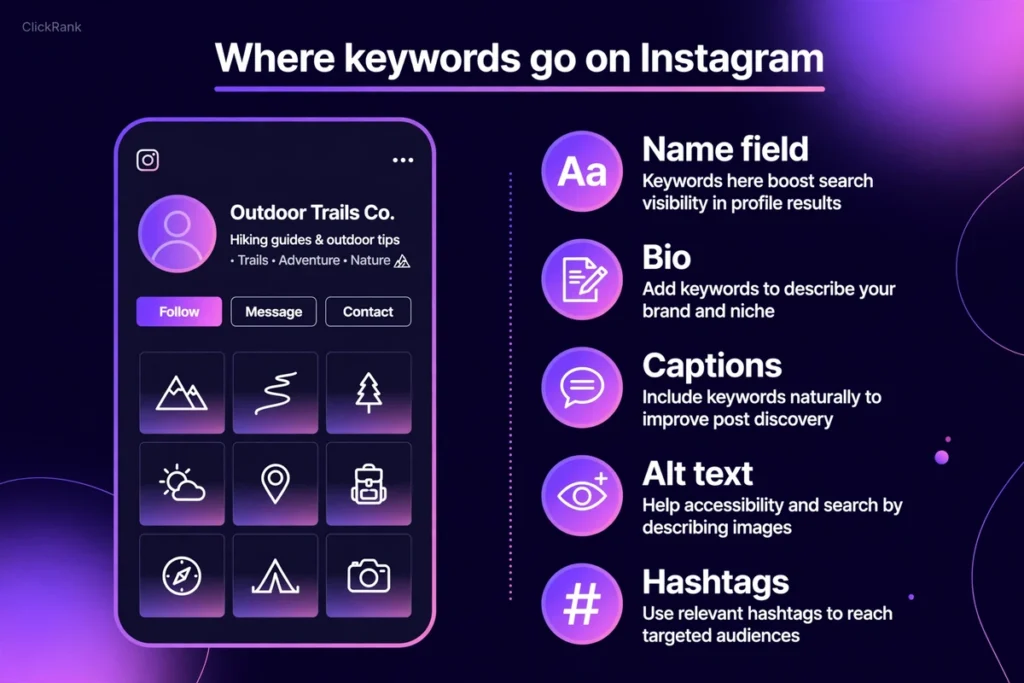
Put the primary keyword in your name field and first caption line. Spread the secondary keywords across your bio, captions and alt text over time, rather than stuffing them all into one post.
How to optimize your Instagram profile
Your profile is the part Instagram SEO work touches first, because it is permanent and applies to every post you publish.
- Keep your account public and set it to Business or Creator, which unlocks category labels and analytics
- Put your primary keyword in the name field, not just the username, since the name field carries more weight in search
- Use category labels that match what you actually do
- Write a bio under 150 characters that states who you help and how
- Pin your best-performing or most keyword-relevant posts to the top of your grid
- Use a UTM-tagged bio link so you can see in your website analytics how much traffic came from Instagram specifically
Brittany Herzberg’s April 26, 2026 case study shows this in action. A coaching client named Kayla changed her name field to “Kayla | Embodied Nutrition, Fitness, & Identity Coaching,” putting her service keywords directly where Instagram search reads them first.
The structure is a repeatable template for any profile: who you help, how you help them, why you, then the keywords.
How to write captions that rank
Captions carry more weight for Instagram SEO than most accounts realize, partly because Instagram’s semantic search reads the whole caption, and partly because Google only sees the text, not the image.
The first 125 characters matter most, since that is what shows before “more” truncates the rest and what a search snippet is most likely to quote. Vera Content’s LinkedIn post put it plainly: treat the first line of a caption like a headline, not an afterthought.
Write that first line the way you would write a search result: state the topic and the primary keyword early, in plain language a person would actually type. After that, write naturally.
A June 23, 2026 Reddit thread in r/InstagramMarketing argued that caption SEO is now more important than hashtags, because Instagram’s AI reads the full caption for meaning rather than scanning for keyword matches alone. The thread’s advice, writing the first line like a search result and staying topically consistent across posts, lines up with how HubSpot describes Instagram’s relevance signals.
The same thread cites a figure that 41% of Gen Z use social platforms as their primary search engine. That number comes from the thread itself, not from a published study, so read it as a sign of where attention is moving.
Consistency compounds. Posting around a small set of content pillars, three or four core topics you return to, helps Instagram associate your account with those topics over time, which strengthens how often you show up for related Instagram SEO keywords.
Instagram hashtags: are they dying?
The honest answer is that hashtags matter less than they did, but they are not dead.
Multiple commenters on the June 2026 Reddit thread said they had dropped hashtags entirely with no drop in reach, and several noted Instagram has started limiting usable hashtags in some tests, similar to TikTok’s five-tag limit. That tracks with where the platform’s semantic search is heading: meaning matters more than tags.
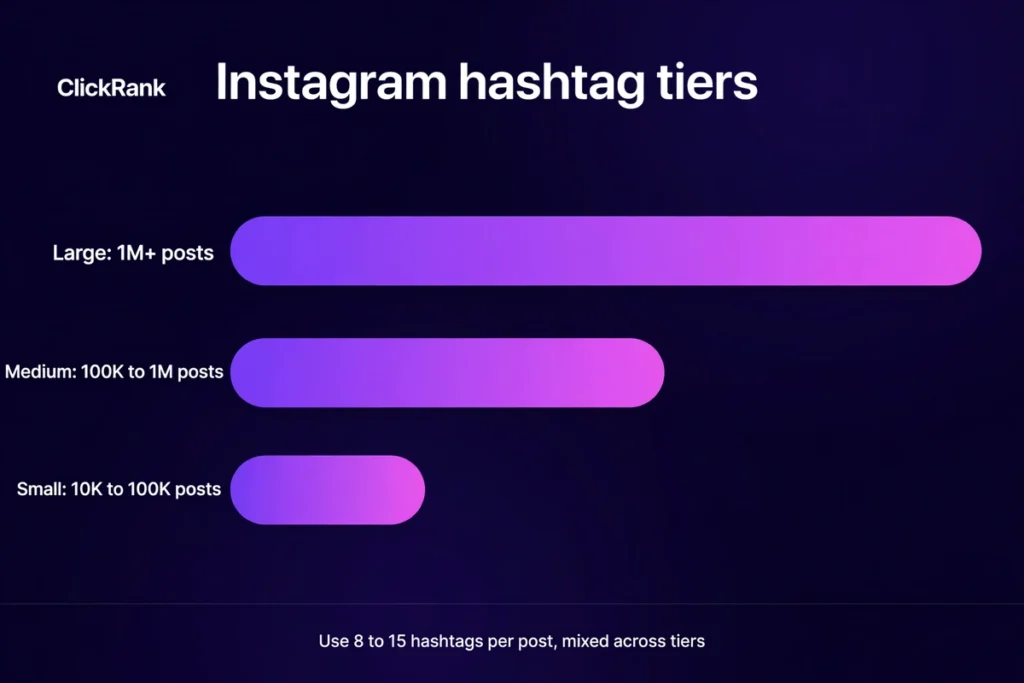
Even so, Toptal’s guide still recommends 8 to 15 hashtags per post, mixed across three tiers:
- Small hashtags, roughly 10,000 to 100,000 posts, for niche reach
- Medium hashtags, roughly 100,000 to 1 million posts, for steady discovery
- Large hashtags, over 1 million posts, for broad visibility, used sparingly since competition is highest here
A practical approach is to use Instagram hashtags as a support layer, not the main strategy. Pick a few niche and local tags that match your actual audience, skip the generic ones everyone uses, and put your real keyword effort into the caption and alt text instead.
Hootsuite’s research, cited widely in the industry, found that SEO-optimized posts, meaning posts with deliberate keyword and hashtag choices, achieved 30% greater reach and twice as many likes compared to posts without that optimization. That suggests Instagram hashtags still contribute even as their share of the work shrinks.
Instagram Reels SEO
Reels get their own search behavior, and Instagram Reels SEO now includes the audio track, not only the caption.
Instagram can transcribe spoken audio automatically and read on-screen text through image recognition, which means the words you say and the words you type on screen both count as searchable content. That is a meaningful shift from static posts, where only the caption and alt text are readable.
Practical steps for Instagram Reels SEO:
- Say your primary keyword or topic out loud in the first three seconds, since retention in that window strongly affects whether Instagram keeps showing the Reel
- Add on-screen text that repeats the keyword, since Instagram’s image recognition can read it even if viewers watch on mute
- Turn on auto-captions for accessibility and as a second text signal for search
- Watch Sends per Reach and Views in the Professional Dashboard, since Reels that get shared directly to friends tend to get pushed further by the algorithm
Toptal’s guide notes that results from consistent Reels and caption optimization typically start showing in 3 to 4 weeks, with full momentum building over 2 to 3 months. That timeline matters for setting expectations with a client or a team, since Instagram SEO is not an overnight channel.
Instagram alt text: the small step most people skip
Alt text is the field most accounts leave blank, and it is one of the easiest wins in Instagram SEO.
Instagram generates alt text automatically from image recognition, but that auto-generated text is generic, for example “photo may contain one person, outdoor.” Writing your own custom Instagram alt text replaces that with a real description, and it is one of the few places where Instagram allows a second shot at keyword placement outside the caption.
To add it, open Advanced settings when creating a post, then Accessibility, then write your own description. Keep it under 125 characters and describe what is actually in the image, including your primary keyword if it fits naturally.
Do this for every post, not just a few, since the gap between accounts that use Instagram alt text and accounts that ignore it compounds over time.
Instagram SEO for local businesses
Local businesses get an extra lever that national or online-only accounts do not: location tags.
Tagging the specific neighborhood or city on every post, not just a broad “United States” tag, helps Instagram match your content to nearby searches. Combine that with a city or neighborhood name in your bio and in a few posts each month, and pair broad category hashtags with local ones, like a city name plus your service.
This overlaps with local SEO work on Google Business Profile and your website. The same keyword list you build for Instagram, your service plus your location, should match the terms you target on your website, so Google sees the same signals across both.
How to measure Instagram SEO results
Instagram SEO is only worth doing if you can see the result, and Instagram’s built-in analytics, found in the Professional Dashboard, gives most of what you need.
Track these over rolling 14, 30, 60 and 90-day windows, since Instagram only retains some analytics data for 90 days:
- Profile visits, which show whether people are clicking through after finding you
- Explore and hashtag impressions, which show discovery beyond your followers
- Sends per Reach and Views for Reels specifically
- Saves and shares, which Instagram weighs heavily as a sign of real value
- Follower growth broken down by source
- Website clicks from your bio link
Third-party tools like Hootsuite and Sprout Social add trend charts and competitor comparisons on top of Instagram’s own analytics, which helps when 90 days of native history is not enough.
The HubSpot 2026 State of Marketing Report found that 41% of marketers are already exploring SEO updates specifically because of how search behavior is changing, which is a sign this measurement work is becoming standard practice, not optional.
For anyone running Instagram alongside a website, it is worth checking your website analytics for Instagram-sourced referral traffic and Google Search Console for branded search growth, since a caption that ranks well on Google can quietly lift both.
What to avoid: black-hat tactics and banned hashtags
Some tactics that used to work on Instagram now carry real risk, including a shadowban that quietly limits your reach without telling you.
Avoid:
- Reposting stolen content without credit or permission
- Using bots to like, comment or follow on your behalf
- Keyword stuffing, cramming unrelated terms into a caption or bio just to match more searches
- Fast or mass following, following large numbers of accounts quickly to trigger follow-backs
- Buying followers, which drags down your engagement rate and signals low quality to Instagram’s ranking systems
Banned hashtags are another trap. Instagram periodically blocks hashtags that get flooded with spam or policy-violating content.
HubSpot’s techniques guide points to #costumes as an example, a tag that gets flagged during Halloween seasons when its post volume spikes with low-quality content, triggering a “Recent posts are currently hidden” message.
Before adding any hashtag to your list, search it first and check whether that warning appears. If it does, drop the tag rather than risk your post being filtered along with it.
Can AI search tools like ChatGPT find your Instagram profile?
AI search is becoming part of Instagram SEO whether or not an account has planned for it. Tools like ChatGPT, Claude and Perplexity pull from public web content when answering questions, and an indexed Instagram post is part of that pool once Google or Bing has crawled it.
Brittany Herzberg’s April 26, 2026 post argues that a clear, repeated message across your profile name, bio and captions matters now for AI search the same way it matters for Google, because AI tools tend to surface the same consistent phrasing an account uses everywhere rather than piecing together inconsistent branding.
This connects directly to the broader question of how to measure AI visibility for a brand, since Instagram is now one more surface where AI citations can originate.
A caption that would make a good quoted answer, a direct statement of what you offer and who it is for, stated plainly and repeated with the same wording across your bio and pinned posts, is more likely to get pulled into an AI-generated answer than a vague or purely visual caption.
The same logic applies across other platforms that AI tools and search engines both crawl. The same keyword and profile discipline used for Instagram SEO carries over to Pinterest SEO, Reddit SEO, Quora SEO and YouTube SEO, since each of these platforms now has public content that search engines and AI tools can read and quote.
Instagram SEO is no longer a side activity for an app that lives inside its own walls. Once Google and Bing started indexing public professional accounts, every keyword choice in a bio or caption started doing work in two places at once.
The mechanics are not complicated: a clear name field, a keyword-aware bio, captions written like real answers, a handful of well-chosen hashtags, custom alt text, and Reels that say the keyword out loud in the first few seconds.
What has changed is how far that small list of tasks now reaches: well past the follower count and into Google results and AI-generated answers.
Toptal guide estimates early signs within 3 to 4 weeks of consistent keyword and caption work, with fuller momentum building over 2 to 3 months. Results depend on posting consistency and how competitive your niche keywords already are.
Reddit discussions from June 2026 argue hashtags matter less than captions now, since Instagram semantic search reads the whole caption for meaning. Hootsuite research still links deliberate hashtag and keyword use to 30% greater reach and twice as many likes, so a smaller, more targeted set of 8 to 15 tags remains worth using.
Start with Instagram own autocomplete suggestions and the Explore page, then check volume with Hashtagify, RiteTag or Semrush. Compare the same terms in Google Keyword Planner to see if they have search demand outside the app too.
Yes. Google and Bing now index public content from professional Instagram accounts, and the Adobe Express survey from October 28, 2025 found 53% of marketers already knew this was happening, with 30% changing how they post because of it.
There is no single best tool, since different tasks need different ones: Hashtagify and RiteTag for hashtag research, Semrush or Google Keyword Planner for keyword volume, Keysearch for comparing keyword difficulty, and Iconosquare or Hootsuite for tracking performance over time.
It can, if your profile is public, professional and already indexed by Google or Bing, since that is where AI tools like ChatGPT, Claude and Perplexity pull public content from. Keeping consistent wording in your bio, name field and pinned captions makes that content more likely to get quoted accurately. How long does Instagram SEO take to work?
Are hashtags still important for Instagram SEO?
How do I do keyword research for Instagram?
Does Instagram SEO help on Google?
What is the best Instagram SEO tool?
Can ChatGPT or AI search find my Instagram profile?