Semrush vs Ahrefs comes down to scope and price. Semrush is a broader marketing suite with daily rank tracking, PPC tools and a stronger AI visibility toolkit. Ahrefs has a deeper live backlink index and cleaner multi-domain handling. Choose Semrush for an all-in-one budget, Ahrefs for dedicated link building and agency portfolios. Check total cost, since add-ons change the price.
What is Semrush?
Semrush started as a keyword research tool and grew into what it now calls an all-in-one marketing suite. It covers SEO, PPC, content marketing tools, social media and competitor analysis under one login.
In April 2026, Adobe completed its acquisition of Semrush for about $1.9 billion, paying $12.00 per share. Semrush now operates as an Adobe company, a detail both the Ahrefs comparison page and the Semrush site footer confirm.
The core modules are Keyword Magic Tool, Keyword Strategy Builder, Keyword Gap, Site Audit, Position Tracking, Backlink Analytics, Organic Research, Traffic Analytics and the Advertising Toolkit for PPC Keyword Tool work. Semrush also ships an AI Visibility Toolkit built on its AI Search Database.
Any Semrush vs Ahrefs comparison has to start here, because Semrush’s pitch is breadth. One subscription replaces several point tools, which matters once you start counting seats and add-ons later in this piece.
What is Ahrefs?
Ahrefs built its name on Site Explorer and its backlink database, and that reputation still drives most Semrush vs Ahrefs searches today. The product line now includes Keywords Explorer, Content Explorer, Site Audit, Rank Tracker, Link Intersect and Backlink Gap.
Ahrefs tracks Domain Rating (DR) and URL Rating (UR) as its authority metrics, parallel to Semrush’s Authority Score. Both are proprietary and not interchangeable across tools.
AhrefsBot is the most active SEO crawler and the 10th most active crawler overall on Cloudflare Radar, according to data as of July 2026 cited on the Ahrefs comparison page and corroborated by the Semrush blog. That crawl volume is part of how Ahrefs keeps its backlink database current.
Ahrefs has also added Brand Radar for AI brand-mention tracking and a credit-based crawl system for Site Audit. There is no free trial, a point that comes up often in Semrush vs Ahrefs pricing discussions.
Semrush vs Ahrefs at a glance
Before the pricing and feature breakdowns, here is how the two tools stack up on paper as of November 27, 2026.
| Factor | Semrush | Ahrefs |
| Entry price | $139.95/month (SEO plan) | $29/month (Starter) |
| Free trial | 7 days on SEO, Starter, Pro+ | None |
| Backlink claim | 43 trillion links (live + dead) | 35 trillion live backlinks |
| Keyword database | 29.2 billion keywords | 28.7 billion keywords |
| Rank tracking | Daily, included | Weekly default, daily costs extra |
| Site audit checks | 140+ checks | 170+ parameters, credit-based |
| AI visibility tool | AI Visibility Toolkit | Brand Radar AI |
| G2 rating (Nov 2025) | 4.5/5, 8.6/10 | 4.5/5, 8.3/10 |
The table shows parity on ratings but a real split on structure. Semrush bundles more into lower tiers, while Ahrefs charges less to start and more to scale.
Semrush vs Ahrefs pricing: what does each plan cost in 2026?
Semrush pricing changed in a 2026 restructure that replaced the old Pro, Guru and Business plans. Anyone still citing those old plan names is working from outdated information.
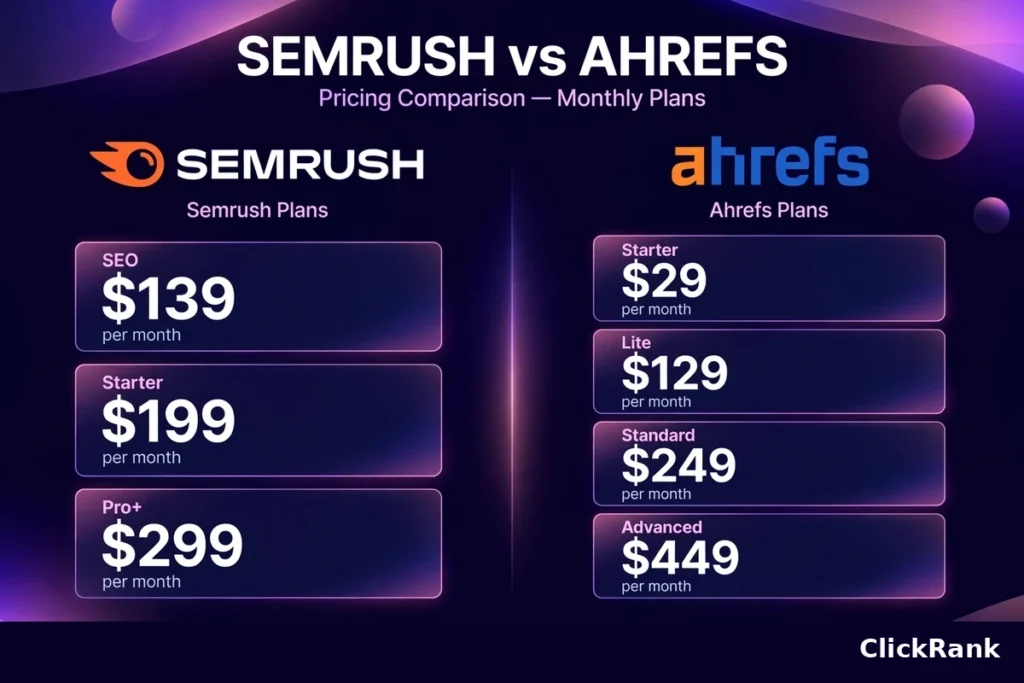
Current Semrush pricing, checked November 27, 2026, runs SEO at $139.95 per month, Starter at $199, Pro+ at $299, and Advanced at a custom quote. Annual billing saves up to 17 percent, and a free plan exists at $0.
Add-ons stack on top: extra users from $45 per month, Lead Generation at $90, Base Report at $10 and Pro Report at $20.
Starter also caps you at 5 websites, a limit flagged repeatedly in a Reddit thread in r/DigitalMarketing from April 14, 2026.
Ahrefs pricing, also checked November 27, 2026, starts at Starter for $29 per month, then Lite at $129, Standard at $249, Advanced at $449, and Enterprise at a custom price. Ahrefs states plainly on its pricing page that it never runs discounts, though annual billing still saves up to 17 percent.
Ahrefs add-ons include Brand Radar AI from $199 per month, Content Kit from $99, and Report Builder at $99 for 50 reports. Stack Brand Radar onto Lite and the Semrush blog, posted November 10, 2026, calculated the total at $328 per month, against $199 for Semrush Starter with comparable AI visibility features built in.
That single comparison is the clearest Semrush vs Ahrefs pricing argument either vendor has made this year. Ahrefs looks cheaper at the entry tier, but the gap narrows or reverses once you add the features teams actually ask for.
For a Semrush vs Ahrefs for beginners budget, the honest picture is this: Ahrefs Starter at $29 is the cheapest way into either tool, but it is a stripped-down plan with limited row counts. Semrush pricing starts higher: the $139.95 SEO plan is a bigger first step but comes with a trial period to test it risk-free.
Semrush vs Ahrefs keyword research: which database is better?
Keyword research is where most Semrush vs Ahrefs for beginners comparisons start, because it is the most visible use case for either tool. Semrush reports 29.2 billion keywords across 142 databases, with 4 billion of those in its US database, per the Semrush blog post from November 10, 2026.
Ahrefs reports 28.7 billion keywords in Keywords Explorer, with 2.3 billion in its US database, covering 217 countries according to figures compiled by SE Ranking using November 2025 data. The two totals sit close enough that database size alone should not decide this.
Semrush’s Keyword Magic Tool groups results by intent and topic, and its Personal Keyword Difficulty score adjusts difficulty based on your own site’s current ranking profile. Ahrefs’ Keyword Difficulty score instead estimates how many backlinks you would need to rank, a different lens on the same question.
Both tools support search intent tagging and Topical Authority style grouping, just under different names. Semrush calls its grouping feature Keyword Strategy Builder; Ahrefs leans on Content Explorer to surface topic clusters from ranking pages rather than from the keyword list itself.
Smaller teams doing keyword research at scale tend to notice the UI difference more than the row-count difference. Semrush’s interface groups more automatically, while Ahrefs expects you to build your own clusters from exported data.
If your keyword research also needs rank-tracked follow-through, pairing either database with a rank tracker that fits your reporting cadence matters more than which vendor’s raw keyword count is 2 percent bigger.
Semrush vs Ahrefs backlink analysis: whose index is really bigger?
Backlink analysis is the single most contested category in any Semrush vs Ahrefs discussion, and the published numbers do not agree. Semrush claims 43 trillion links, 390 million referring domains, and 10 billion URLs crawled daily, per its own blog dated November 10, 2026.
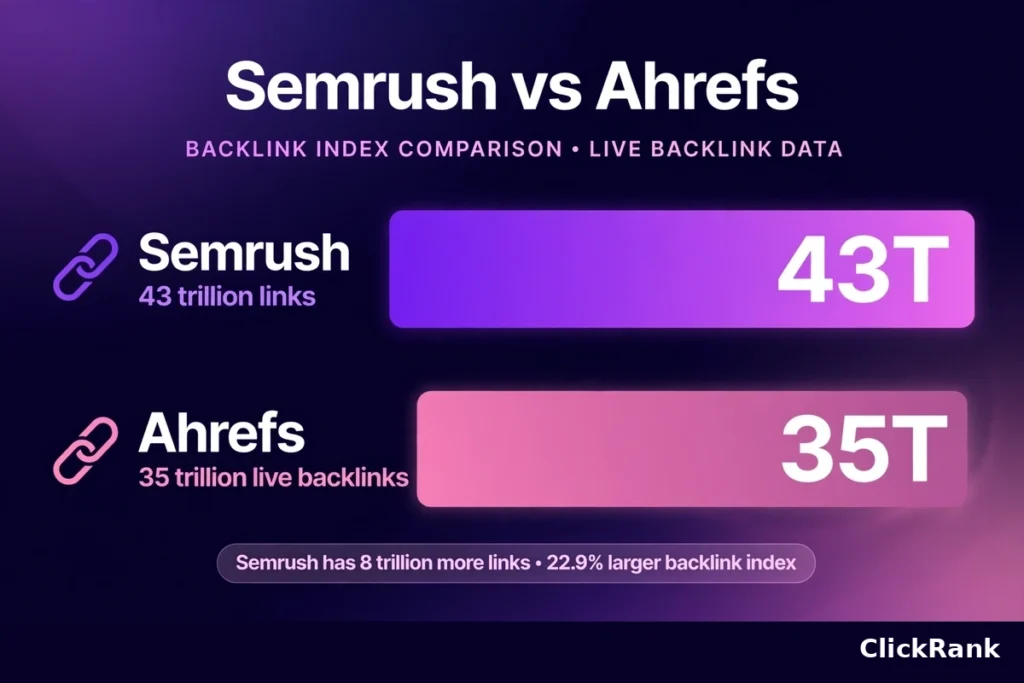
Ahrefs claims 35 trillion live backlinks on its comparison page, and Backlinko, in an article updated November 3, 2026, independently cites 35 trillion external backlinks from 213.3 million domains for Ahrefs. Those two Ahrefs figures roughly agree with each other.
The reason Semrush’s number looks bigger is not that its database is bigger in any simple sense. Semrush counts live and dead links together in its 43 trillion figure, while Ahrefs counts only live backlinks in its 35 trillion claim, so the raw totals are not directly comparable.
Worth noting here: Backlinko is owned by Semrush, and that ownership is disclosed only at the foot of its comparison page, after the article’s verdict has already been stated. Its “Semrush wins overall” conclusion should be read with that in mind.
For practical backlink analysis work, Ahrefs’ Site Explorer, Link Intersect and Backlink Gap tools remain the category reference point for most link builders. Semrush’s Backlink Analytics covers the same core job, toxic link flags, referring domain trends, anchor text distribution, but with a smaller independent reputation in that specific niche.
If your team runs backlink analysis as a standalone service line rather than a side task inside broader SEO work, that reputation gap shows up in client expectations more than in the actual data returned. Either tool’s export will overlap heavily with the other’s on any real domain you check.
Semrush vs Ahrefs rank tracking: daily or weekly?
Rank tracking cadence is a practical difference that rarely gets attention in Semrush vs Ahrefs roundups, but it affects day-to-day work directly. Semrush’s Position Tracking updates daily by default on every paid plan.
Ahrefs’ Rank Tracker defaults to weekly tracking, and daily tracking is an add-on that costs an extra $20 to $200 per month per project, according to figures compiled by SE Ranking from November 2025 pricing. That range depends on how many keywords and how many projects you are tracking daily.
For a single-site team checking rankings occasionally, weekly tracking is fine and the savings matter. For an agency managing client reports week over week, or a team tracking volatile SERPs after an algorithm update, the daily gap between the two tools becomes a real cost difference, not just a feature checkbox.
Anyone evaluating either platform primarily for tracking should read a dedicated rank tracker comparison before committing to a tier, since tracking frequency needs vary more by use case than by budget.
Site audit: which tool finds more problems?
Technical SEO audits are a core feature on both platforms, and the raw check counts favor Ahrefs on paper. Semrush’s Site Audit runs 140+ checks, while Ahrefs’ Site Audit covers 170+ parameters, per SE Ranking’s November 2025 comparison.
Ahrefs gates its audit by a credit system rather than a flat site limit: Lite gets 100,000 crawl credits per month, Standard gets 500,000, and Advanced gets 1,500,000. Larger sites burn through credits faster, so the effective audit capacity scales with your plan tier in a way that is easy to underestimate when budgeting.
Semrush’s Site Audit instead limits by page count per project, a simpler model to plan around but one that can feel restrictive on very large sites without upgrading. Neither model is objectively better; they just fail differently when you hit the ceiling.
For teams running technical SEO audits across many subdomains or a large e-commerce catalog, check your actual page count against both the credit system and the page-limit system before picking a plan, because the sticker price on either tool assumes a site size that may not match yours.
Content tools: which helps you write better pages?
Content marketing tools are a secondary battleground in Semrush vs Ahrefs comparisons, but they shape day-to-day writing workflows for content teams. Semrush offers SEO Content Template, SEO Writing Assistant and Topic Research, aimed at scoring drafts against top-ranking competitors before publishing.
Ahrefs leans on Content Explorer for research, surfacing which published pages already rank and get traffic for a topic, rather than scoring your draft directly. Neither tool does more than assist; both expect a human writer to do the actual composing.
SEO Writing Assistant checks readability, tone and keyword usage inline as you write, which fits teams that want real-time feedback. Content Explorer instead feeds the research stage, showing content gaps and competitor angles before a single word gets written.
Teams running a high content-volume workflow, publishing weekly or more, tend to lean on Semrush’s inline scoring to keep drafts consistent across multiple writers. Teams doing fewer, deeper pieces get more value from Content Explorer’s competitive research angle, since the bottleneck there is ideas, not formatting consistency.
AI visibility and AEO: which tool tracks AI search better?
AI visibility has become the live question in most 2026 Semrush vs Ahrefs discussions, more than classic rank tracking. Semrush’s AI Visibility Toolkit draws on its AI Search Database, which the Semrush blog reports at 317 million prompts total, 130.7 million in the US database, and 70.5 million tracked specifically on ChatGPT, as of November 10, 2026.
Ahrefs claims 592 million plus monthly AI prompts on its comparison page. These two prompt counts are vendor-defined and are not directly comparable, since each company tracks and categorizes prompts differently, so neither number should be read as proof that one database is objectively bigger.
Both platforms track visibility across ChatGPT, Gemini, Perplexity, Claude and Microsoft Copilot, alongside Google’s AI Overviews.
Drew Garrett, Senior Account Strategist for content and SEO at Directive, flagged a reporting quirk worth knowing about: Ahrefs counts an AI Overview citation as position #1, a measurement choice that can inflate apparent AI visibility wins if you are not reading the methodology carefully.
On native AI agents, Semrush ships Copilot for free, while Ahrefs offers Letaido at $99 per month plus a free Agent B tool. Both vendors also expose Model Context Protocol (MCP) servers, letting external AI systems query their data programmatically rather than through the dashboard UI.
A Reddit thread in r/DigitalMarketing from April 14, 2026, asked directly which tool to use for SEO plus AEO without overpaying.
The top answers split: Ahrefs for its stronger backlink database and Brand Radar, Semrush as the broader command center with a stronger AI Visibility Toolkit for AEO specifically, and one dissenting reply arguing neither tool gives a clear AEO picture on its own and a dedicated AEO tool should be layered in alongside whichever one you pick.
Garrett summed up the bigger point in his November 2026 piece: “The tool is the data source; your judgment is the moat.” That framing matters more than the prompt-count race, since raw AI visibility data is only useful once it is applied.
For teams measuring brand presence across AI answers specifically, a dedicated guide on how to measure AI visibility and an LLM leaderboard comparing models side by side cover ground that neither vendor’s own comparison page addresses fairly.
PPC, local SEO and reporting: where Semrush pulls ahead
Outside core SEO, Semrush’s Advertising Toolkit and PPC Keyword Tool give it a real edge for teams running paid search alongside organic work. Ahrefs has no comparable PPC module, so Semrush vs Ahrefs stops being close once paid search enters the budget.
Local SEO is a similar story. Semrush includes local listing management and local rank tracking features that Ahrefs does not offer natively, which matters for agencies serving multi-location clients. A closer look at local SEO tooling requirements is worth doing before assuming either platform covers that need out of the box.
White-label reporting exists on both platforms, but Semrush’s broader module set means one branded report can cover SEO, PPC and content in a single export. Ahrefs reporting stays tighter to SEO and backlink data, which some agencies prefer for clarity even if it means exporting from elsewhere for paid media numbers.
Ahrefs includes API and MCP access on every paid plan, while Semrush gates API access to its Advanced plan. Ahrefs publishes its history window per plan: 6 months on Lite, 2 years on Standard and 5 years on Advanced. Semrush lists historical SEO data on Pro+ and above, so check the plan page for the tier you are buying.
Which tool should you pick?
For Semrush vs Ahrefs for beginners, Semrush’s free plan and 7-day trial on SEO, Starter and Pro+ give a lower-risk entry point. Ahrefs offers no free trial at all, so beginners testing the waters without a card on file will find Semrush friendlier.
Small teams on a tight monthly budget often start with Ahrefs Starter at $29, then outgrow it quickly once row limits hit. Semrush’s SEO plan at $139.95 costs more up front but avoids that early ceiling for a solo operator or two-person team.
Link builders and anyone running backlink analysis as a primary service tend to prefer Ahrefs, given its independent reputation and AhrefsBot’s crawl footprint on Cloudflare Radar. That reputation, built over more than a decade, still carries weight with clients even where the raw data overlaps with Semrush’s output.
Agencies managing many client domains should weigh the Reddit thread’s practical point directly: Semrush Starter caps at 5 websites, while Ahrefs handles multi-domain portfolios more cleanly at comparable tiers. That single limit can decide the Semrush vs Ahrefs question for a 10-client agency faster than any feature comparison.
Enterprise buyers on either platform land on a custom quote. Semrush’s Advanced plan and Ahrefs’ Enterprise plan are both custom-priced with no public figure, so budgeting at that tier means going through sales directly rather than relying on a published rate card.
For teams specifically comparing cheaper alternatives before committing to either flagship tool, a look at Ahrefs vs KWFinder covers a lighter-weight option worth knowing exists.
The Semrush vs Ahrefs decision rarely comes down to one tool being objectively stronger across every category. It comes down to which gaps you can live with: Ahrefs’ lack of PPC and local SEO, or Semrush’s smaller independent reputation in pure backlink analysis.
Run the total cost math for your actual plan tier and add-ons before deciding, since list prices rarely match what either vendor bills once seats and extras stack up. Adobe’s ownership of Semrush and the 2026 pricing restructure already changed the math once this year; expect more changes before either platform’s next pricing cycle.
Is Semrush better than Ahrefs?
Neither tool is categorically better; they are built around different strengths. Semrush wins on breadth, PPC, local SEO and AI visibility tooling, while Ahrefs wins on backlink reputation and multi-domain handling, so the better fit depends on your specific job.
Which is cheaper, Semrush or Ahrefs?
Ahrefs is cheaper at entry, starting at $29 per month against Semrush $139.95 SEO plan. Once you add comparable AI visibility features, the Semrush blog November 2026 math shows Semrush Starter at $199 undercutting Ahrefs Lite plus Brand Radar at $328, so total cost depends heavily on which add-ons you actually need.
Which is better for backlinks?
Ahrefs holds the stronger independent reputation for backlink analysis, built on AhrefsBot crawl volume and over a decade of Site Explorer development. Semrush claimed index is larger in raw terms, but that figure counts dead links alongside live ones, so it is not a clean apples-to-apples comparison.
Which is better for beginners?
For Semrush vs Ahrefs for beginners specifically, Semrush free plan and 7-day trial make it easier to test before paying. Ahrefs offers no trial, so a beginner has to commit to a paid plan from day one to see the interface firsthand.
Can I use both Semrush and Ahrefs?
Yes, and some agencies do exactly that, running Ahrefs for backlink analysis and link prospecting while using Semrush for PPC, local SEO and reporting. The combined cost is significant, so this setup usually only makes sense once a team revenue justifies two full subscriptions.
Is Semrush or Ahrefs better for AI visibility?
Semrush AI Visibility Toolkit and AI Search Database lean more directly into AEO tracking as a built-in feature set. Ahrefs Brand Radar covers similar ground through brand-mention tracking, but one Reddit thread from April 2026 argued neither tool alone gives a clear AEO picture without a dedicated layer on top.