In 2026, the mandate for Chief Marketing Officers has shifted fundamentally from “growing traffic” to “proving revenue.” With the maturation of Generative Engine Optimization (GEO) and AI-driven search, the traditional funnel has collapsed. Users no longer just click; they converse with AI models that synthesize answers from authoritative sources. In this environment, content ROI cannot be measured solely by sessions or bounce rates. It must be measured by Brand Citations, Information Gain, and attributed revenue.
For the modern CMO, SEO is no longer a siloed technical discipline but a core business asset. The challenge lies in connecting the dots between a technical optimization, like fixing schema markup using ClickRank. and the bottom-line growth reported to the board. This guide outlines the strategic framework for measuring, optimizing, and reporting on content ROI in the AI-first era, moving beyond vanity metrics to actionable business intelligence that secures budget and drives growth. This is a part of our comprehensive guide on Scaling Content Production.
The Importance of Measuring Content ROI for CMOs
Measuring content ROI is the definitive litmus test for marketing efficiency in 2026. As organic search evolves into a “Zero-Click” ecosystem dominated by AI answers, CMOs must quantify the financial impact of their brand’s visibility. It is no longer sufficient to report on rankings; leaders must demonstrate how specific content assets reduce Customer Acquisition Costs (CAC) and accelerate pipeline velocity to justify continued investment.
The stakes have never been higher. In an era of automated content production, the market is flooded with low-quality noise. Measuring ROI allows CMOs to distinguish their high-performing “Power Pages” from digital clutter. By establishing a direct line between content consumption and revenue generation, marketing leaders can protect their budgets from CFO scrutiny. This shift requires a cultural change within the marketing department, moving away from “publishing volume” as a KPI to “revenue contribution” as the primary metric of success. It transforms the content team from a cost center into a measurable revenue engine.
Why is measuring content ROI critical for CMOs in 2026?
Measuring content ROI is critical because boardrooms now demand “Proof of Capital.” In 2026, marketing is viewed as an investment portfolio, not a cost center. CMOs must demonstrate that every dollar spent on content production yields a measurable return in customer acquisition, retention, or brand equity, specifically within the new AI-driven search ecosystems where visibility equates to market share.
Without clear ROI attribution, SEO budgets are the first to be cut during efficiency drives. In the age of AI, where content production costs have plummeted, the differentiator is no longer volume but performance. CMOs who can isolate the revenue contribution of specific Topic Clusters, showing, for instance, that “Enterprise Security Guides” drive 40% of high-value MQLs, gain the leverage to secure larger budgets. Conversely, failing to measure ROI leaves the marketing department vulnerable to being replaced by automated, generic content generation that damages brand prestige.
How does content ROI impact overall marketing strategy and budget allocation?
Content ROI data acts as the compass for resource allocation. It shifts budget from “guessing” to “doubling down.” If data reveals that bottom-of-funnel comparison pages have a 5x higher ROI than broad top-of-funnel blogs, the strategy pivots immediately to dominate transactional intent. This agility is essential for maintaining competitive advantage in fast-moving industries where customer preferences shift rapidly.
In 2026, smart allocation also involves investing in “Content Infrastructure.” Instead of just paying for writers, high-ROI strategies allocate funds to tools like ClickRank that automate the technical maintenance of these assets. By understanding which content types (e.g., interactive tools, whitepapers, video summaries) drive the highest lifetime value (LTV), CMOs can stop funding underperforming formats and funnel resources into “Evergreen Revenue Engines”, content assets that compound in value over time without requiring constant manual promotion.
What challenges do CMOs face in tracking content performance across channels?
The primary challenge is the “Dark Funnel” and fragmented user journeys. Users might discover a brand via an AI chatbot answer (zero-click), research on social media, and convert via a direct visit weeks later. Traditional cookie-based tracking fails to capture these non-linear paths, leading to under-attribution of organic content’s true value and a skewed view of marketing effectiveness.
Data silos further exacerbate this issue. SEO data often lives in Google Search Console, CRM data in Salesforce, and engagement data in GA4. Stitching these distinct datasets together to form a coherent narrative is difficult without unified dashboards. Additionally, privacy regulations and the deprecation of third-party cookies mean CMOs are often flying blind regarding cross-device behavior. Overcoming this requires advanced attribution modeling that can infer impact from “Brand Mentions” and “Search Share of Voice” rather than relying exclusively on direct-click attribution models.
Beyond Clicks: Why “Brand Mentions” in AI Search are the New Currency
In the Generative AI era, a “Brand Mention” or citation in an AI answer (like ChatGPT or Google’s Gemini) is as valuable as a traditional click. These citations position the brand as the trusted authority. Measuring the frequency and sentiment of these mentions is now a critical KPI, as they directly influence the “Consideration” phase of the buyer journey even without a direct website visit.
Traditional SEO focused on the “10 blue links.” AI SEO focuses on being the “Source of Truth” that the AI summarizes. If your brand is cited as the expert source for “Cloud Migration” in a Gemini answer, you gain immense credibility. CMOs must now track “Citation Velocity”, how often their proprietary data and insights are being referenced by Large Language Models. This shift requires a content strategy focused on high-quality, original research and unique data, exactly the type of content ClickRank helps identify and optimize for, rather than generic, repurposed blog posts.
How AI and Automation Are Changing ROI Measurement
AI and automation have revolutionized ROI measurement by moving it from retrospective spreadsheets to real-time predictive intelligence. In 2026, AI tools will act as the connective tissue between disparate data points, allowing CMOs to visualize the entire customer journey with unprecedented clarity. Automation removes the human error inherent in manual reporting, ensuring that decisions are based on the “Single Source of Truth.”
This technological shift allows for “granular attribution” at scale. Instead of vaguely knowing that “blogging works,” AI can pinpoint the exact paragraph in a specific article that correlates with a spike in demos booked. By automating the collection and synthesis of data from Search Console, CRMs, and ad platforms, tools like ClickRank free up the marketing team to focus on strategy rather than data entry. It democratizes access to sophisticated analytics, allowing even lean teams to operate with the financial discipline of a Fortune 500 enterprise.
How can AI improve the accuracy of content ROI measurement?
AI improves accuracy by synthesizing vast datasets to identify patterns invisible to human analysts. It can correlate subtle on-page changes (like semantic density improvements) with revenue spikes, filtering out seasonality and external noise. This allows for “True Lift” measurement, isolating the specific impact of SEO efforts from broader market trends.
Furthermore, AI-driven attribution models move beyond simplistic “Last Click” attribution. They use machine learning to assign fractional credit to every touchpoint in the customer journey. For example, AI can determine that a blog post read three months ago was the “Assisting Interaction” that eventually led to a closed deal today. This granular visibility helps CMOs prove the long-tail value of educational content that often gets ignored in traditional monthly reporting cycles, preventing the accidental deprecation of high-value top-of-funnel assets.
Which AI tools help track conversions and revenue attribution from content?
Tools like ClickRank.ai lead the market by integrating directly with Google Search Console and analytics platforms to bridge the gap between rankings and revenue. Unlike legacy tools that estimate traffic, these modern platforms use real performance data to attribute specific keyword clusters to conversion goals, providing a clear line of sight from SERP to Sale.
While general analytics tools like GA4 provide the raw data, specialized AI SEO platforms layer on the context. They can identify which specific sections of a page are driving engagement and correlate high-performing semantic entities with conversion rates. This allows marketing teams to see not just which pages are making money, but why; is it the comparison table? The FAQ section? This level of insight allows for surgical optimization of underperforming assets using Click SEO Fixes to boost overall portfolio ROI.
How does predictive analytics forecast content performance using ClickRank?
Predictive analytics in ClickRank uses historical performance data and live SERP volatility to forecast future traffic and revenue potential. By analyzing the trajectory of current rankings and competitor movements, it assigns a “Rankability Score” and projected ROI to potential Content Gaps before they are written, minimizing risk.
This capability transforms content planning from reactive to proactive. Instead of publishing and hoping for the best, CMOs can view a “Revenue Forecast” for their editorial calendar. If ClickRank predicts that optimizing existing product pages will yield a $50k revenue lift next quarter compared to $10k from new blog posts, the de cision becomes mathematical. This de-risks SEO investment by prioritizing initiatives with the highest probability of financial return, ensuring that resource allocation is always aligned with the highest yield opportunities.
How does automation simplify reporting for enterprise marketing teams?
Automation eliminates the manual drudgery of data collection, allowing teams to focus on analysis and strategy. Automated reporting tools pull data from GSC, GA4, and CRM systems into unified, real-time dashboards that update instantly. This ensures that the CMO always has the latest numbers for executive meetings without waiting for end-of-month spreadsheets or manual consolidation.
Beyond saving time, automation ensures consistency. Manual reports are prone to human error and cherry-picked metrics to make performance look better. Automated systems apply the same rigorous attribution logic to every campaign, providing a standardized “Single Source of Truth.” For enterprise teams managing thousands of URLs across multiple regions, this standardization is the only way to accurately benchmark performance, identify regional outliers, and scale successful strategies across the global organization.
How can automated dashboards save time for CMOs?
Automated dashboards provide “At-a-Glance” intelligence, visualizing complex data sets into clear trend lines for Lead Velocity, CAC, and Content LTV. This allows CMOs to diagnose health instantly, spotting a dip in organic conversion rates or a spike in brand search volume, and pivot strategy in real-time rather than retrospectively.
In 2026, the speed of decision-making determines market leadership. An automated dashboard acts as a “Mission Control” center. Instead of asking analysts to run queries, the CMO can see live data on how a recent Google Core Update is impacting revenue. This immediacy allows for rapid tactical adjustments, like deploying ClickRank to fix technical errors on a landing page, before they impact the monthly sales targets. It shifts the role of the CMO from “Reporter of History” to “Architect of the Future.”
Which metrics are most critical for executive decision-making in 2026?
Executives care about financial outcomes, not ranking positions or traffic volume. The most critical metrics are Customer Acquisition Cost (CAC) via organic search, Customer Lifetime Value (CLV) of organic cohorts, and Marketing Originated Revenue. These metrics speak the language of the CFO, proving that SEO is a profitable growth lever.
Ranking #1 for a vanity keyword means nothing if it doesn’t drive revenue. Executive dashboards must strip away the noise and focus on efficiency metrics. “Organic CAC” is particularly vital; in an era where paid media costs are skyrocketing, proving that SEO delivers customers at a 50% lower cost than paid search makes the CMO a hero. Linking “Organic Traffic” to “Closed Won Revenue” is the ultimate validation of the marketing strategy, moving SEO from a “nice to have” to a “critical business function.”
Key Metrics for Measuring Content ROI in 2026
To effectively manage content ROI, CMOs must monitor a specific set of KPIs that bridge the gap between SEO performance and financial results. In 2026, this means moving beyond “sessions” to track engagement quality, conversion assistance, and long-term customer value. These metrics provide a holistic view of how content contributes to the business at every stage of the funnel.
A robust measurement framework distinguishes between “Volume Metrics” (traffic) and “Value Metrics” (revenue). While traffic is necessary, it is the quality of that traffic, measured by engagement and conversion, that drives ROI. By tracking metrics like “Assisted Conversions” and “Retention Impact,” CMOs can defend budget allocations for top-of-funnel educational content that plays a crucial, albeit indirect, role in closing deals. This nuanced approach ensures that the entire content ecosystem is valued correctly.
Which KPIs should CMOs track to measure SEO and content performance?
CMOs must track a blend of leading and lagging indicators to get a full picture. Leading indicators include Share of Voice (SoV) in AI answers and Keyword Velocity (how fast new content indexes). Lagging indicators include Organic Revenue, Assisted Conversions, and Content Efficiency Ratio (Revenue generated per dollar spent on production).
This balanced scorecard prevents short-termism. Tracking only revenue (lagging) might hide a decline in top-of-funnel visibility that will hurt sales in six months. Conversely, tracking only traffic (leading) might hide poor lead quality. By monitoring the entire funnel, from AI visibility to closed-won deals, CMOs ensure sustainable growth. Special attention should be paid to “Engagement Rate” on key pages, as 2026 algorithms heavily penalize content that users bounce from quickly, utilizing tools like ClickRank to monitor and improve these User Signals.
How can metrics like engagement, organic traffic, and conversions reflect ROI?
Organic traffic reflects brand reach, while engagement metrics (Dwell Time, Scroll Depth) reflect brand resonance. High engagement signals that the content is solving the user’s problem, which correlates strongly with trust and future purchase intent. Conversions are the ultimate validation that this trust has been monetized.
However, in 2026, “traffic” is a nuanced metric. A drop in traffic but a rise in conversions often indicates successful optimization for high-intent queries (quality over quantity). CMOs should look for “Efficient Growth”, where traffic quality improves faster than volume. If a page gets 1,000 fewer visits but generates 10 more demos because ClickRank optimized it for transactional Search Intent, that is a positive ROI outcome despite the traffic dip.
How can assisted conversions provide a complete picture of content value?
Assisted conversions measure the influence of content that appears early in the buyer journey but doesn’t get the final click credit. For complex B2B sales cycles, a blog post read three months ago might be the “First Touch” that educated the buyer. Ignoring this undervalues the top of the funnel and can lead to cutting the very content that feeds the pipeline.
Without tracking assisted conversions, CMOs risk turning off the “faucet” of new leads. Attribution models often default to “Last Click,” giving all credit to the “Book a Demo” page. However, the user wouldn’t have booked that demo if they hadn’t read the “Industry Trends Report” three weeks prior. Assisted conversion metrics assign a dollar value to that report, proving that educational content is a revenue driver, not just a brand-building exercise. This insight is critical for defending the content marketing budget.
How do retention and lifetime value (LTV) metrics relate to content ROI?
Content ROI extends post-purchase. “Help Center” content and “Advanced Use Case” guides drive retention by helping customers get value from the product, measuring the LTV of customers who engage with support content versus those who don’t often reveals that well-informed users churn less, adding significant revenue value to “non-sales” SEO assets.
Customer retention is the new growth. In SaaS and subscription models, reducing churn by 5% can increase profitability by 25%. SEO plays a huge role here by making support documentation discoverable. If a user can Google their problem and find your solution immediately, they stay happy. If they can’t, they get frustrated and churn. Assigning a portion of “Retained Revenue” to the SEO budget reflects the reality that content is a customer success tool, not just an acquisition tool.
How can multi-touch attribution models help measure content impact?
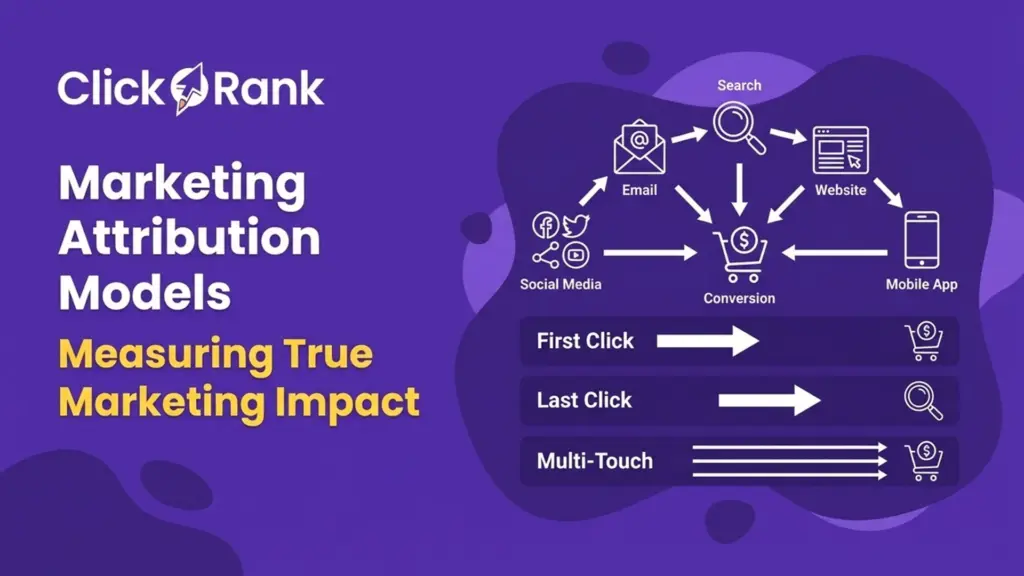
Multi-touch attribution (MTA) assigns value to every interaction: First Touch, Lead Creation, Opportunity Creation, and Closed Won. By using W-shaped or U-shaped models, CMOs can see that while “Pricing” pages close deals, “Industry Guides” open them. This holistic view prevents the “Last Click Bias” that often starves brand-building content of necessary budget.
Implementing MTA requires advanced analytics, often integrating data from ClickRank with CRM systems. It reveals the “Hidden Funnel.” For example, it might show that 60% of closed deals interacted with a specific whitepaper during the negotiation phase. This insight elevates that whitepaper from a “marketing asset” to a “sales enabler,” justifying further investment in similar deep-dive content. It allows the CMO to orchestrate a content strategy that supports sales at every critical juncture.
Linking SEO Performance to Business Outcomes
The ultimate goal of SEO for CMOs is to create a seamless link between organic search activity and the company’s financial statements. This requires breaking down the walls between marketing data and sales data. By integrating SEO platforms with CRMs, CMOs can trace the journey of a dollar from the initial Google search to the signed contract.
This connection transforms SEO from an abstract concept into a tangible business driver. It allows for “Revenue Engineering,” where the marketing team can predict how much revenue a specific keyword ranking improvement will yield. This level of precision is required to secure buy-in from the CEO and CFO, moving the conversation from “marketing spend” to “revenue investment.” It legitimizes the SEO function within the C-Suite.
How can CMOs connect content performance to revenue growth?
Connection requires integration. CMOs must integrate their SEO platforms (like ClickRank) with their CRM (Salesforce/HubSpot). This allows them to tag closed deals with the “Entry Point URL,” proving definitively that a $100k contract originated from a specific organic search query or landing page.
This “Closed-Loop Analytics” is the holy grail of ROI. It moves the conversation from “We rank #1 for X” to “The page for X generated $2M in pipeline.” It also allows for reverse-engineering. By analyzing the content consumption path of the highest-value customers, marketing teams can identify the “Money Pages” that drive whales versus minnows, allowing them to focus optimization efforts where the financial impact is highest.
How does AI help in attributing leads and conversions to specific content pieces?
AI algorithms pattern-match successful conversion paths across millions of data points. They can identify that users who read “Article A” are 3x more likely to convert than those who read “Article B,” even if the conversion happens weeks later. This probabilistic attribution helps quantify the “Influence Value” of content that doesn’t generate immediate form fills.
AI attribution goes beyond simple rules. It accounts for time decay, device switching, and multiple sessions. It might reveal that a specific “How-to” guide is the single biggest predictor of future conversion, even if no one converts on that page. Armed with this knowledge, a CMO can prioritize promoting that guide via paid channels or featured spots on the homepage, leveraging organic insights to drive broader marketing efficiency.
How can AI track performance across campaigns, channels, and regions?
AI tools normalize data from disparate sources, allowing for apples-to-apples comparison. They can track how a global SEO campaign is performing in APAC versus EMEA instantly, adjusting for local search nuances and currency differences. This global view is essential for multinational brands to allocate regional budgets effectively.
Global SEO is complex because search behavior varies by culture. AI helps decode these variances. It might show that in Germany, technical spec sheets drive conversions, while in the US, video testimonials work better. AI tracking highlights these regional preferences in real-time, allowing the CMO to tailor the content strategy for each market. This ensures that global campaigns are locally relevant, maximizing ROI across diverse geographies.
How can insights from ClickRank.ai reports inform future content investment?
ClickRank.ai reports identify “Content Gaps” where competitors are winning revenue, not just traffic. By highlighting high-value topics that the brand lacks, it provides a roadmap for high-ROI production. Additionally, its “Decay Detection” alerts CMOs to protect existing revenue streams by refreshing aging content before it loses rankings due to Content Decay.
Investing in content is like stock picking; you want to buy winners. ClickRank acts as the market analyst. It tells you which topics are “Bullish” (rising demand, low competition) and which are “Bearish” (saturated, declining interest). By following these data-driven recommendations, CMOs can avoid wasting budget on low-yield topics and focus entirely on building assets that will appreciate. It brings financial discipline to the creative process of content marketing.
Best Practices for Measuring Content ROI Effectively
Effective ROI measurement is not a one-time project; it is an ongoing operational discipline. It requires setting clear goals, establishing a regular cadence of audits, and maintaining a diversified content portfolio. CMOs must instill a culture of data-driven accountability where every content creator understands the business impact of their work.
These best practices ensure that the measurement framework evolves with the market. As AI search changes user behavior, the metrics and targets must adapt. By adhering to a rigorous measurement process, CMOs can ensure that their SEO strategy remains resilient, profitable, and aligned with the company’s broader strategic vision in 2026.
How should CMOs set measurable objectives for SEO and content teams?
Objectives should be tiered: “Output Goals” (Publish 10 optimized pages), “Outcome Goals” (Increase organic MQLs by 20%), and “Impact Goals” (Generate $500k in pipeline). This ensures teams are accountable for activity, performance, and business results simultaneously, creating a clear chain of accountability from the writer to the executive.
Goals must also be aligned with the “Maturity Curve” of the website. A new site should focus on leading indicators like “Impressions” and “Keyword Growth.” A mature site should focus on “Conversion Rate Optimization” and “Revenue Preservation.” Setting the right goal for the right stage prevents demotivation and ensures that the team is focused on the lever that drives the most value at that specific moment. ClickRank helps define these benchmarks based on competitor performance.
How can regular audits and reporting improve ROI over time?
Regular audits identify “Zombie Pages“, content that gets no traffic and dilutes domain authority. Pruning or merging these pages improves the overall health of the site, often leading to a lift in rankings for the remaining high-value pages. Reporting creates a feedback loop, ensuring that lessons learned from Q1 inform the strategy for Q2.
SEO is not a “set it and forget it” channel. The SERP changes daily. Regular audits using automated tools ensure that the site remains technically sound and semantically relevant. Reporting should focus on “Insights,” not just data. A good report says, “We lost traffic because a competitor updated their guide; here is our plan to fix it.” This proactive approach keeps the strategy agile and ensures that ROI continues to improve rather than stagnate over time.
How can CMOs balance short-term KPIs with long-term content value?
Balance is achieved by the “70/20/10 Rule.” 70% of resources go to proven, high-intent keywords (Short Term). 20% go to strategic thought leadership (Long Term Brand Building). 10% go to experimental formats (AI Optimization tests). This portfolio approach ensures immediate cash flow while building the brand equity needed for future dominance.
Short-term KPIs satisfy the sales team; long-term value satisfies the brand vision. If you only chase short-term keywords, you become a commodity. If you only write thought leadership, you starve for leads. The CMO’s job is to manage this tension. By allocating a specific budget to “Brand Defense” (long-term) and “Lead Gen” (short-term), and measuring them against different KPIs, you ensure the organization remains healthy and growing on both fronts.
Challenges and Pitfalls in Content ROI Measurement
Measuring ROI is fraught with complexity. Data silos, inconsistent definitions, and human bias can all distort the truth. CMOs must be vigilant against these pitfalls to ensure that their decisions are based on accurate reality. Recognizing the limitations of attribution models and the potential for “Vanity Metrics” to mislead is the first step toward true data maturity.
The landscape of 2026 adds new challenges, specifically the opacity of AI search traffic. As more users get answers without clicking, measuring “influence” becomes harder but more important. CMOs who can navigate these challenges, leveraging AI tools to illuminate the dark funnel, will have a significant competitive advantage over those who rely on outdated measurement paradigms.
What are the common mistakes CMOs make when tracking content ROI?
The most common mistake is obsessing over “Vanity Metrics” like raw pageviews without context. A million views from irrelevant users cost money in server fees but generate zero revenue. Another mistake is “Premature Evaluation”, cutting funding for SEO because it didn’t generate ROI in month one, ignoring the compounding nature of organic search investments.
CMOs also frequently fail to account for “Content Maintenance Costs.” They calculate ROI based only on creation cost, ignoring the ongoing cost of updating and re-optimizing assets. ClickRank solves this by automating maintenance with its Click SEO Fixes, significantly lowering the long-term cost basis and improving the true ROI calculation. Finally, ignoring the “assisted” value of content leads to a strategy that is too bottom-heavy, drying up the future pipeline.
How can data silos and inconsistent metrics distort ROI insights?
When Sales uses “Leads” and Marketing uses “MQLs” with different definitions, ROI calculation breaks down. Inconsistent tagging (UTM parameters) across channels makes attribution impossible. Unified governance and automated tagging tools are essential to ensure that data entering the system is clean and comparable across all departments.
Data silos create “Version Control” issues for truth. If Finance says marketing generated $1M and Marketing says $2M, credibility is lost. The solution is a unified data warehouse where all systems feed into a single dashboard. This requires close collaboration between the CMO and the CIO/CTO. By establishing a “Data Dictionary” that defines exactly what a conversion is, the organization can move past arguing about numbers and start arguing about strategy.
How can AI help mitigate human errors and reporting biases?
AI removes the “Human Bias” to cherry-pick positive data. It reports the cold, hard truth of performance, highlighting underperforming areas that humans might hide. Automated data collection also eliminates spreadsheet errors, ensuring that the numbers presented to the board are mathematically accurate and audit-proof.
Humans are emotional; data is not. Marketing managers often hide bad news hoping to fix it next month. AI reporting exposes these issues immediately, like a drop in Click-Through Rate (CTR) on a key landing page, allowing for instant intervention. This radical transparency might be uncomfortable, but it is the only way to build a high-performance culture. It ensures that decisions are made based on reality, not optimism.
Try the one-click optimizer today and see how fast your content can actually work for you. Try Now!
How can CMOs prove the value of content to the board?
CMOs prove value by translating SEO metrics into financial outcomes. Instead of reporting traffic growth, they tie organic performance to reduced CAC, pipeline contribution, and revenue influenced. For example, framing results as 'organic content lowered CAC by 15% and generated $1.2M in pipeline' makes the impact clear to financial stakeholders. Attribution dashboards make this connection indisputable.
Which AI tools are most effective for measuring content ROI?
ClickRank.ai is highly effective for SEO-specific ROI because it connects content performance directly to revenue opportunities using Google Search Console data. For full-funnel and enterprise-level attribution, tools integrated with Salesforce or HubSpot are used to measure multi-touch revenue impact across the buyer journey.
How often should content ROI be measured and reported?
Content ROI should be tracked at multiple levels. Operational teams should review performance weekly to optimize quickly. Executives should receive monthly reports focused on trends and targets, with a quarterly deep-dive to reallocate budgets based on LTV, retention, and growth efficiency.
How do you account for long-term ROI from evergreen content?
Long-term ROI is measured by calculating cumulative revenue over a 12–24 month period and comparing it to the one-time production cost. Evergreen content typically follows a J-curve, where profitability accelerates over time as the page maintains rankings with minimal ongoing investment, effectively turning into compounding revenue.
How can ClickRank improve future content investment decisions?
ClickRank uses predictive modeling to surface low-competition, high-value topics before they are saturated. By forecasting traffic and revenue potential for unwritten content, it helps teams invest in 'blue ocean' opportunities where faster rankings and higher ROI are achievable.